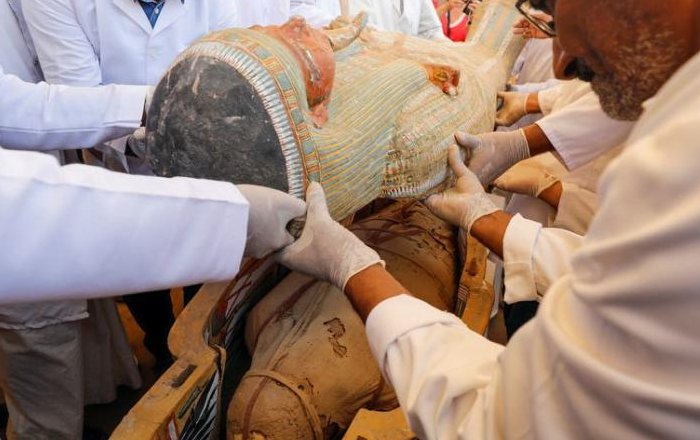
AncientPages.com - The coastal town of Exmouth in Western Australia is due to experience one of the most spectacular astronomical phenomena on April 20 2023—a total solar eclipse.
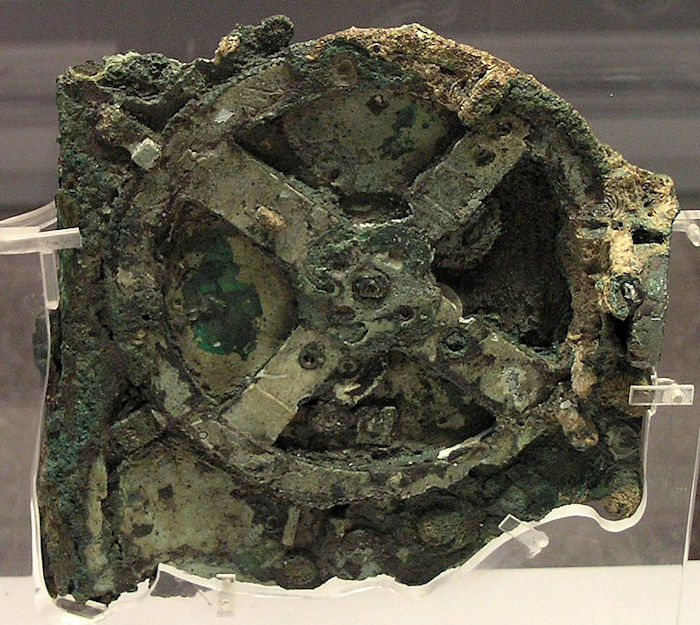
Antikythera mechanism fragment. Credit: Wikipedia - CC BY 2.5
Eclipses have entranced us for millennia. But it turns out calculating exactly when and where we can watch an eclipse in its full glory can be surprisingly hard.
Watching the sun and the moon
Being so dominant in the sky, the sun and the moon were the most captivating celestial bodies for ancient cultures to observe. Naturally, they also tried to anticipate and predict their motions.
While the sun's movement is quite simple, the moon moves across the sky with much more complexity. For one thing, it has phases; it also grows and shrinks in apparent size as it travels on an elliptical orbit around Earth.
On top of this, the moon appears to rock and wobble quite haphazardly on its journey across the sky, making it extremely challenging to accurately describe its orbit. In fact, explaining the moon's motion was the only problem that made Isaac Newton's head hurt.
Since eclipses are so startling to witness, many ancient peoples both noted their occurrence in writing and art, and discovered the repeating characteristics of such events.
During a lunar eclipse, where Earth blocks sunlight that would otherwise illuminate a full moon, the dimmed moon takes on a bloody hue. Many cultures attached foreboding to such events (like the partial lunar eclipse seen during the Fall of Constantinople in 1453) and quite reasonably wondered when the next such event might occur.
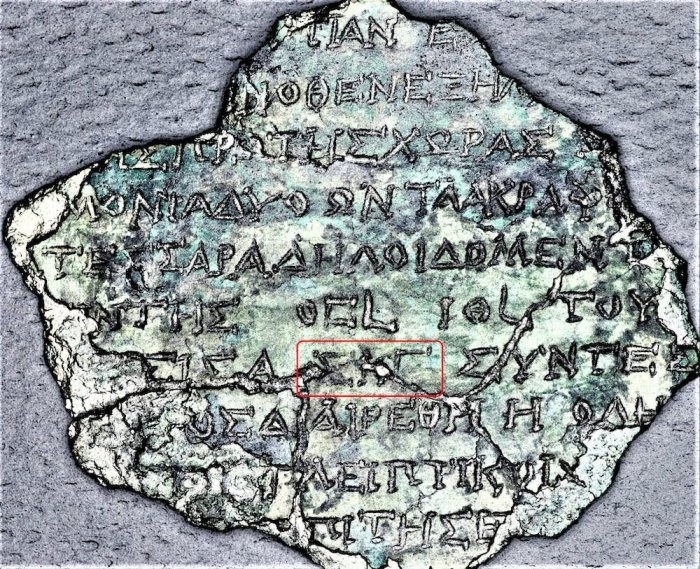
The Saros period (marked with a red rectangle) is visible on a fragment of the ‘user manual’ of the Antikythera mechanism. Credit: Xmoussas/Wikimedia Commons, CC BY-SA
The not-so-mythical Saros cycle
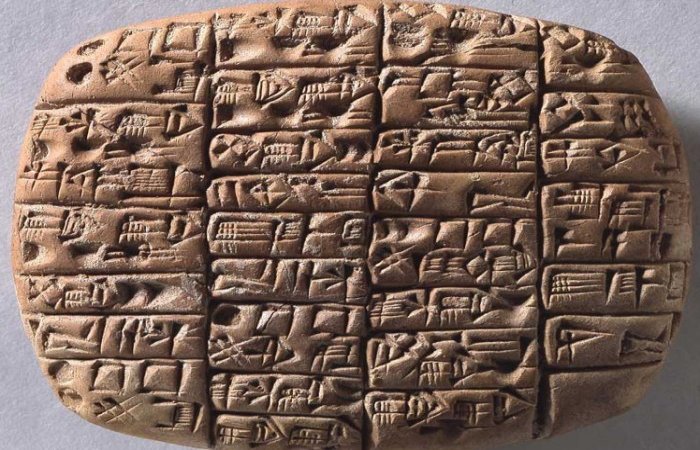
Various cultures around the world have independently discovered eclipses seem to occur on an 18-year cycle. It was mentioned in written records by the Babylonians and Assyrians (of ancient Mesopotamia and modern Iraq), and oral tradition suggests the cycle was used for ceremonial purposes by Torres Strait Islanders in what is now Australia.
This 18-year cycle, which can persist as a sequence for over a thousand years, is now known as a Saros cycle. The word "Saros" was referenced in the 10th-century Byzantine Suda encyclopedia, and possibly has a Greek origin ("saro" meaning "sweep", perhaps relating to how eclipses sweep across the sky).
The Saros cycle represents how long it takes for the sun-Earth-moon system to return to almost exactly the same triangular configuration. So, if you see a lunar eclipse, you can expect another one 18 years later, visible from most places on Earth.
If you were an ancient culture that happened to observe a total solar eclipse, you would have been very lucky indeed (they occur roughly every 375 years at a given region on Earth). But would you have seen a similar event 18 years later? Alas, no. While there probably was another total solar eclipse 18 years later, it would have been over a completely different part of the planet.
After 54 years—three Saros cycles—the eclipse region should have returned to roughly the same position on Earth. But only very roughly, as it could be thousands of kilometers away from the previous observation spot.
Worldwide, there is a total solar eclipse visible somewhere roughly every 18 months during one of two possible "eclipse seasons" per year. This is much more frequent than an 18-year Saros cycle, and is possible because multiple repeating Saros sequences overlap at once (roughly a dozen), each offset by at least six months. For example, the 2028 total solar eclipse that will be visible in Sydney is part of an entirely different Saros sequence than this year's eclipse.
After about a thousand years, when one long-term Saros sequence ends, another will begin with slightly different timing.
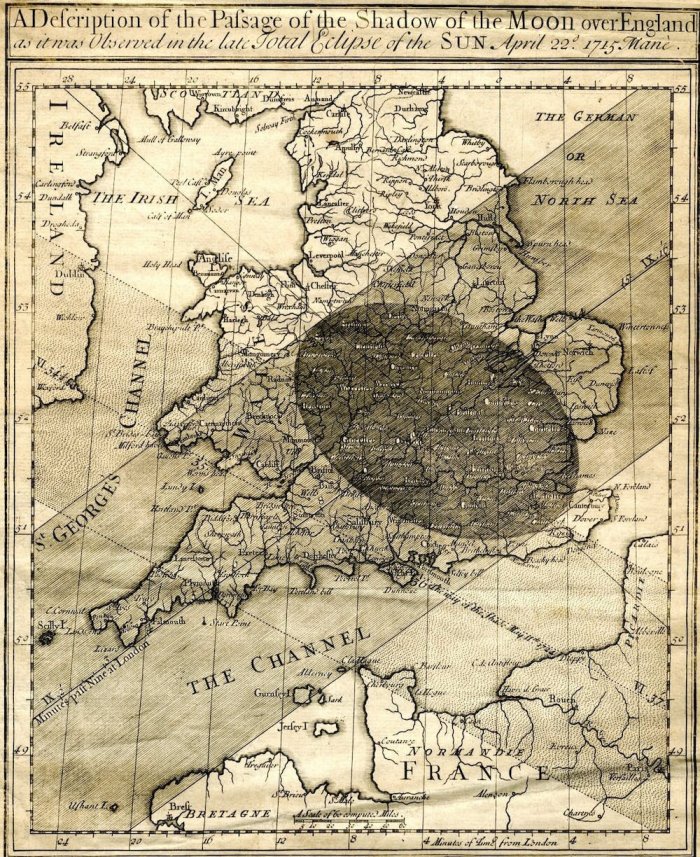
The path of the eclipse as described by Halley in 1715. Credit: University of Cambridge, Institute of Astronomy Library
From antiquity to modern day
So could our ancient ancestors actually predict eclipses? Yes, if we are talking about lunar eclipses, and perhaps even partial solar eclipses.
A famous predictive example is the Eclipse of Thales in 585 BCE, although the fact that a total solar eclipse happened over Greece was almost certainly more luck than science. That is, they wouldn't have predicted that 18 years later (567 BCE) a total solar eclipse was visible in what is now the United States.
It is likely the famed Greek Antikythera Mechanism, an astoundingly complicated 2,000-year-old mechanical device that was used to predict the night sky, could calculate the 18-year Saros accurately. But significantly, it could not predict total solar eclipses at a precise place on Earth—just their timing.
In summary, it is clear ancient people could predict timings for lunar eclipses and partial solar eclipses, but there is no convincing evidence of people predicting the times and locations of total solar eclipses.
Entering the modern era of science, the first true prediction of a total solar eclipse (both in time and location) occurred in 1715. Edmond Halley (of comet fame) correctly predicted, to within four minutes and 20 miles, a total solar eclipse that rather conveniently passed over his own house in London. He did this by making full use of Isaac Newton's new theories of gravity and orbital mechanics: the Principia.
Today, we don't rely on calculating the orbits of the whole solar system to predict eclipses. For example, NASA uses a highly advanced form of an ancient technique—pattern recognition. Using some 38,000 repeating mathematical terms, NASA can predict both solar and lunar eclipses for 1,000 years into the future. Beyond that, the moon's wobble and Earth's changing rotation make eclipse prediction less accurate.
So for those of you lucky enough to witness a total solar eclipse this month, take a moment to think about what this shared experience has meant to humans around the world for thousands of years.
Trying to predict and explain this phenomenon has directly driven advancements in mathematics and orbital mechanics, and with its beauty we have been forced to embrace the limits of our scientific knowledge.
Written by Research Associate Professor & UWA Research Fellow, The University of Western Australia; Research Fellow in Astronomy, The University of Western Australia
Provided by The Conversation
This article is republished from The Conversation under a Creative Commons license. Read the original article.