AncientPages.com - Imagine that you have an unhealthy interest in your neighbors' lives. Unable to ask them directly, you rifle through their rubbish bins. You find the bones of cooked chickens and try and work out what else they eat.
This is a bit like how archaeologists study the diets of extinct humans such as the Neanderthals and early homo sapiens. This is about more than satisfying curiosity. Understanding our ancestors' diets may reveal critical clues about their evolutionary success or failure.
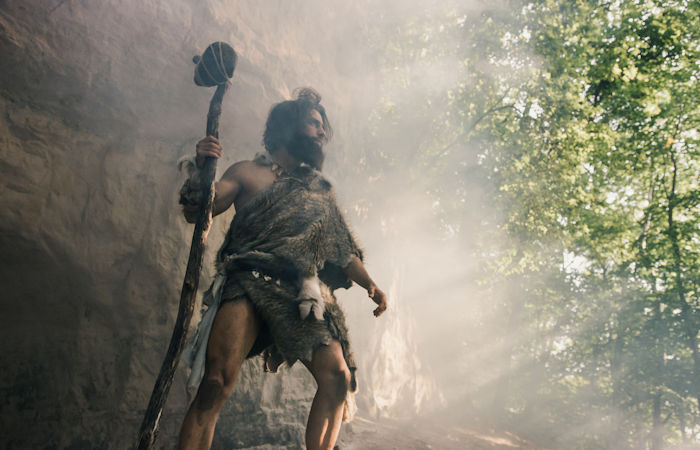
Credit: Adobe Stock - Gorodenkoff
A recent study which analyzed zinc from the tooth of a Neanderthal from Spain reveals they were mainly carnivores, wherever they lived. This discovery helps explain why they became extinct.
Neanderthals dominated Europe and western Asia during the last 200,000 years of the Ice Age, while homo sapiens were developing in Africa. Their remains and characteristic stone tools are abundant across Europe and the near East, and in smaller numbers as far east as Tadjikistan (which shares a border with China).
The Neanderthals lived in the heartlands of the Eurasian steppes (the largest grassland in the world, extending from Hungary to China), an area not rich in nutritional vegetables. But surveys of their campsites have revealed they ate nuts, fruits, mushrooms, shellfish and other food that can be easily gathered.
Neanderthals were a species constantly on the move who needed a high calorie diet. The butchered remains of horse, reindeer, bison and mammoths that Neanderthals left on their campsites reveal they hunted the most dangerous animals in their world. But that doesn't tell us whether their diets varied from group to group across their massive range.
Low carb diet
For the last two decades, advances in molecular biology have deepened archaeologists' understanding of early human diets. The cool conditions in northern Europe, such as France and Germany, help preserve collagen in fossil bone. With a technique called stable isotope analysis we can recover minute amounts of carbon and nitrogen from the collagen in early human bones, and find out where the protein they ate came from.
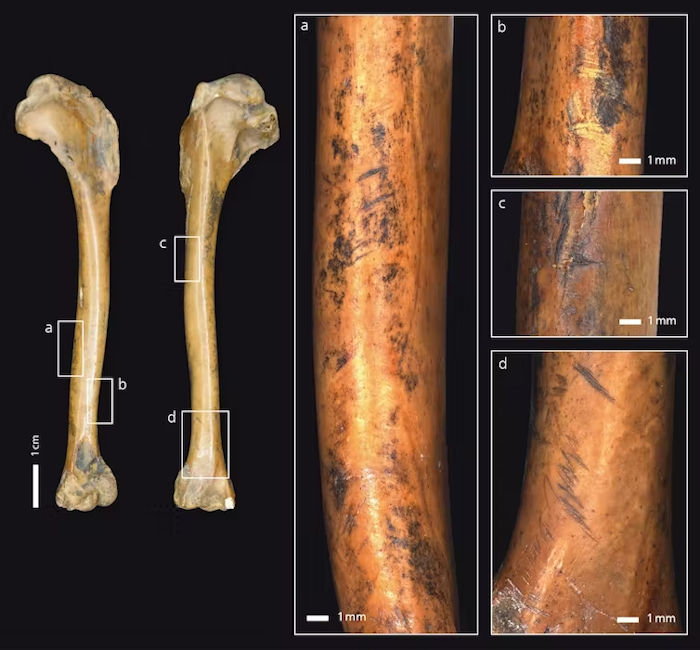
Cutmarks left by stone tools on this wing bone of a velvet scoter (sea duck), show that. smaller animals were part of Neanderthals’ diet. Sabine Gaudzinski-Windheuser, Author provided
Isotopes are groups of atoms belonging to the same element but have different mass. Studies of these bones' isotopes have shown Neanderthals in northern Europe got 80–90% of their protein from animals. That's up there with the wolves and hyenas. In the arid southern parts of Europe we're not so lucky. Collagen in fossil bone easily disintegrates in warmer climates, taking with it the clues to southern Neanderthals' diets.
But over the last year archaeologists have found that traces of zinc in Neanderthal bones also preserve information about the diet of the ancient person who they belong to.
Studies over the last few years of zinc isotopes show they have huge potential for unlocking clues about the evolution of life such as the rise of eukaryotes, a group of organism which humans belong to, and the complexity of marine food webs.
Expert hunters
The zinc level in carnivores' bones is lower than those of their prey. The difference is not affected by age, sex or decay over time. Zinc ratios can be measured from samples as small as 1mg of bone. Even these tiny amounts allow an accurate assessment of an animal's place in the food chain when they were alive.
The recent study's analysis of zinc from the tooth enamel of a Neanderthal, who lived and died around 150,000 years ago in the Spanish Pyrenees, gives new insights into the diet of ancient humans. Zinc isotopes were analyzed from 43 teeth of 12 animal species living in a grassland around the Los Moros I cave in Catalonia, Spain. These included carnivores such as wolf, hyena and dhole (also known as mountain wolf), omnivorous cave bears, and herbivores including ibex, red deer, horse and rabbit. The results brought to life a food web of the Pleistocene steppe, a system of interlocking food chains from plants up to the top carnivores. The zinc in the Neanderthal's tooth had by far the lowest zinc value in the food web, revealing they were a top level carnivore.
The bone heaps on Neanderthal campsites show they hunted big animals in large numbers. These heaps appear even in areas of the landscape where humans would be at a disadvantage, such as at the edge of water courses. Imagine trying to bayonet an adult bison or horse. Both weigh almost a ton. The new isotope study reveals Neanderthals' main survival strategy was to hunt whatever animals could be found wherever they were in the world. Small animals and vegetables probably amounted to little more than side dishes. Their game plan was to shoot first, and answer questions later.
Broader diets made us more resilient
Isotopes taken from sites across Europe from remains of the Homo sapiens groups who inherited Pleistocene Eurasia from the Neanderthals reveal they had broader dietary range. Plants, birds and fish were main courses for these early humans. The Pleistocene was a the grassland-steppe ecosystem that dominated Siberia during the Pleistocene and disappeared 10,000 years ago. It had a remarkably unstable climate and changed from dry grasslands and wet tundras to coniferous woodlands, constantly shaking up the variety and number of large herbivores grazing there.
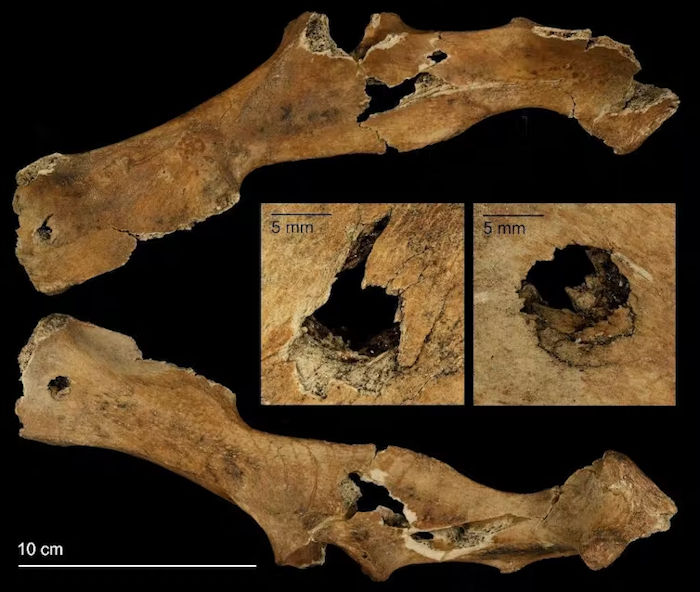
The impact from a spear on this pelvic bone of an adult fallow deer shows Neanderthals were hunting with bayonet-style spears around 120,000 years ago. Sabine Gaudzinski-Windheuser., Author provided
So an omnivorous diet would have made these people far more resilient than those who relied on big game hunting. We don't know much about what happened to Neanderthals when big game populations collapsed. If reindeer failed to show, what could they do? But with rapid progress in biomolecular science, I doubt we will have to wait long to find out.
Written by Paul Pettitt, Professor in the Department of Archaeology, Durham University
Provided by The Conversation
This article is republished from The Conversation under a Creative Commons license. Read the original article.