
Kanishka Casket – Beautiful Ancient Buddhist Treasure In Gilded Copper
A. Sutherland - AncientPages.com - The Kanishka Casket (known as the Kanishka reliquary) is a beautiful Buddhist treasure of gilded copper. The relic dates back to the first year of the reign of the Kushan emperor Kanishka, in 127 AD.
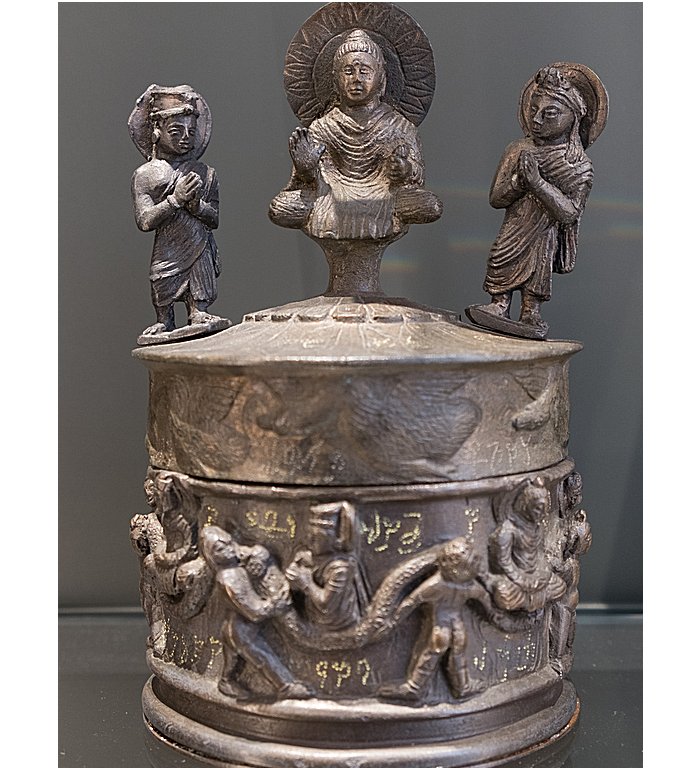
Kanishka casket, Asia, G33 South Asia British Museum, England. Image credit:
It was discovered in a deposit chamber under the massive Kanishka stupa during British archaeological excavations in 1908 - 1909 in Shah-ji-Dheri on the peripheries of Peshawar, Pakistan. Chinese Buddhist pilgrims described this gigantic structure in the 7th century as the tallest stupa in India. It was indeed an enormous structure.
The stupa is believed to have influenced later constructions of stupas throughout ancient Turkistan. These wooden towers, topped with metal chatras (chhatra (meaning "umbrella"), made such buildings act as lightning rods.
It was probably considered dangerous, so this structure gradually disappeared.
Undoubtedly, the Kanishka stupa is a valuable historical and cultural landmark, but so is the Kanishka Casket, which was unearthed with three small bone fragments of Buddha. The bones were transported to Burma by the British following the excavation, where they are still stored.
In Peshawar, Pakistan, the Kanishka stupa has been described as one of the tallest in the world and has been visited by early Chinese Buddhist pilgrims. One of them was Faxian (337 AD – c. 422 AD), a Chinese Buddhist monk and translator who traveled by foot from China to India, visiting sacred Buddhist sites.
The Kanishka Casket, is the precious the artifact (just over 19 cm in height, with a diameter of 10 cm or more) is now in the Peshawar Museum, and the British Museum has its copy.
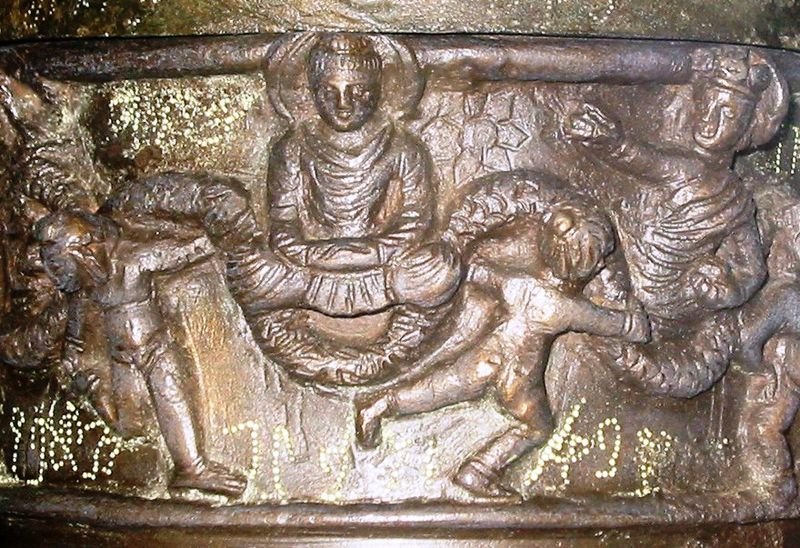
Detail of the Buddha, surrounded by cherubs, with devotee or bodhisattva. Image source
The casket is dedicated to the Kharoshthi script, an ancient Indian script used in Gandhara (now Pakistan and north-eastern Afghanistan) to write Gandhari Prakrit and Sanskrit. The script was also used in Central Asia.
The inscription reads:
"In Kanishkapura city, this incense box is the great king Kanishka's monastery's superintendents of construction of the fire hall, Mahasena's and Samgharakshita's, donation.
May it be for the benefit and pleasure of all living beings. In possession of the Sarvastivadin teachers."
Originally it was long believed that the text is signed by a Greek artist named Agesilas, who oversaw work at Kanishka's stupas ('caitya'), confirming the direct involvement of Greeks with Buddhist realizations at such a late date:
"The servant (dasa) Agisalaos, the superintendent of works at the vihara of Kanishka in the monastery of Mahasena" ("dasa agisala nava-karmi ana*kaniskasa vihara mahasenasa sangharame").
However, recent cleaning of the Kanishka Casket revealed that the inscription's old reading was inaccurate. Instead, the name is to be read 'agnisala' (instead of 'Agisalaos') and refers to the monastery, not a person.
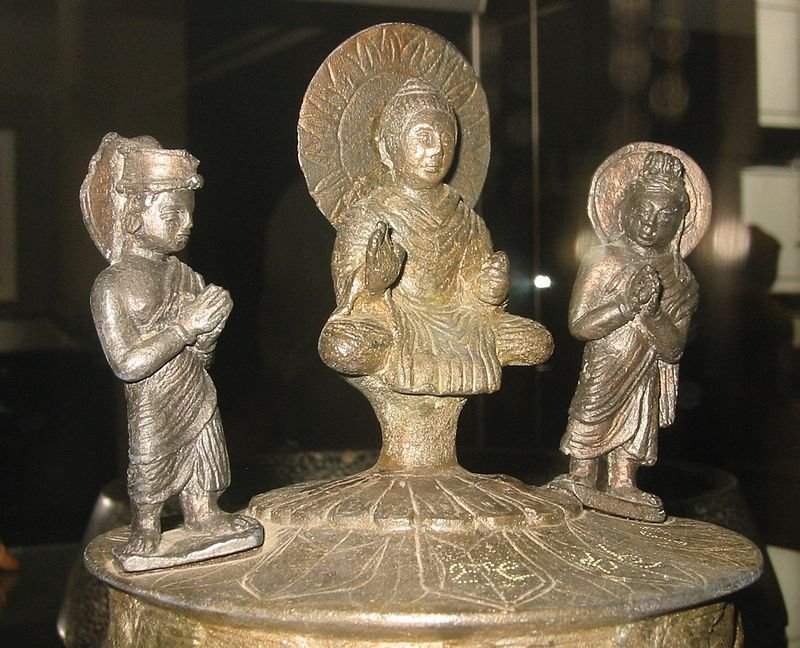 Kanishka Casket - Detail of the Indra, Buddha, Brahman trilogy. Image source
The casket's lid depicts the Buddha on a lotus pedestal and worshipped by Brahma and Indra.
"On the body of the casket, there is a standing figure of a man in Kushana costume and a row of small, active naked figures carrying a garland. In its swags appear other figures, either half-length or composed in the attitude of meditation". 1
The edge of the lid is decorated by a frieze of flying geese, or hamsa, used in Hinduism and Buddhism, as a symbol of protection against the evil eye and the symbol representing the interplay of the body's body chakras, the concept found in the early traditions of Hinduism. The 'hamsa' also means the travel of departing souls and the removal from samsara (the idea of rebirth and "life, matter, existence," all moving in cycles), a fundamental belief of most Indian religions.
The body of the casket represents a Kushan monarch, probably Kanishka in person, with the Iranian Sun god and Moon god at his side. On the sides are two images of a seated Buddha, worshiped by a royal figure, possibly a bodhisattva (one who can reach nirvana but delays doing so through compassion for suffering beings.)
Kanishka (or Kanishka the Great) was an emperor of the Kushan dynasty in the second century (c. 127–150 CE). He is famous and remembered for his military, political, and spiritual achievements. His native language is unknown.
Written by – A. Sutherland - AncientPages.com Senior Staff Writer
Updated on April 11, 2023
Copyright © AncientPages.com All rights reserved. This material may not be published, broadcast, rewritten or redistributed in whole or part without the express written permission of AncientPages.com
Expand for references- Myer, Prudence R. "Again the Kanishka Casket." The Art Bulletin48, no. 3/4 (1966): 396-403
Loeschner Hans, “The Stūpa of the Kushan Emperor Kanishka the Great”
More From Ancient Pages
-
 3D Scans Used To Study Mysterious Roman Burial Practice
-
 Surprising Evidence Of 12,000-Year-Old Unknown Advanced Secret Knowledge Held By Elite Individuals – The Article – Part 1
-
 DNA From 35,000-Year-Old Romanian Skull Reveals Flaws In The Theory Of Evolution
-
 Ancient Mystery Of Giant Mounds Of Jerusalem Built For Unknown Reasons – Archaeologists Are Still Baffled
-
 Who Was The The Mysterious Lady Of Bietikow And What Had She In Common With Ötzi Iceman?
-
 Beautiful Legend Of The Christmas Rose – A Symbol Of Love And Hope
-
 Herne The Hunter – The Horned God And Lord Of The Forest In British Mythology
-
 Fragarach: Supernatural Sword That Controlled Winds, Cut Through Wood, Metal And Bricks In Irish Myths And Legends
-
 Attila The Hun: The Destroyer Of Rome Among Most Fearsome Enemies The Empire Ever Faced
-
 Were Other Humans The First Victims Of The Sixth Mass Extinction?
-
 How Great Emperor Ashoka Realized And Showed All Living Beings Matter
-
 Early Humans In The Hula Valley Invested In Systematic Procurement Of Raw Materials Hundreds Of Thousands Of Years Ago
-
 Controversial 5,500-Year-Old Sumerian Star Map Of Ancient Nineveh Reveals Observation Of Köfels’ Impact Event
-
 Coral Castle Is Among Most Fascinating And Mysterious Buildings In Florida
-
 Magnificent Etruscan Underground Burial With Beautiful Artifacts Discovered In Aleria-Lamajone, France
-
 Fossil Teeth Reveal: Humans Were Present In Asia ‘20,000 Years Earlier’ Than Previously Thought
-
 What Can Ancient Toilets Teach Us About Maya Life And Tamales?
-
 Ephemeral Evidence Of Mediterranean Mobility – Boats, Migration, And The Central Mediterranean Passage In Focus
-
 Prehistoric House Of The Dead Discovered In Wiltshire – Is This The Burial Place Of Ancestors Of Stonehenge Builders?
-
 On This Day In History: Moscow Armistice Signed Between Finland And Soviet Union – On Sep 19, 1944

