
Khepri – Egyptian Progenitor God, Spirit Of Life, Resurrection And The Rising Sun
A. Sutherland - AncientPages.com - Khepri is one of the most important deities of Egyptian mythology. Khepri was the god of creation, the movement of the sun, life, and resurrection.
His name, Khepri, is also spelled as Khepera, Khepra, Kheper, and Chepri, which literally means "He Who is Coming into Being." The root word of 'Khepri' also means "to create" or "to transform," and it also refers to the "scarab beetle."
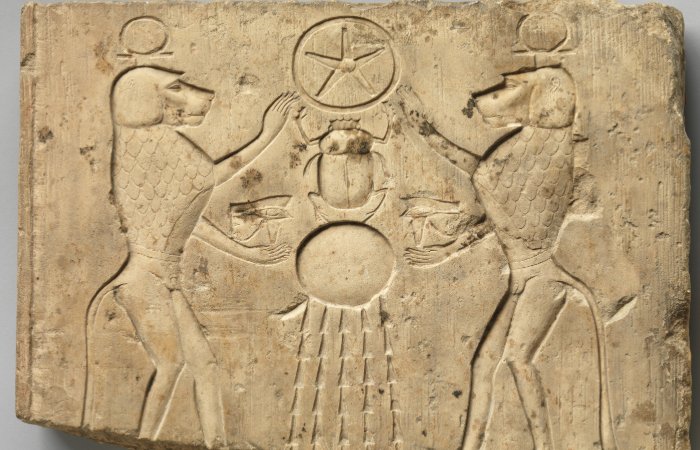
Relief, Khepri, baboons. Relief panel depicting two baboons offering the wedjat eye to the sun god Khepri, who holds the sign of the Underworld. On this relief panel, Khepri is depicted solely as a scarab beetle. Above his head, the sun god holds the Duat, a symbol for the afterlife. The scarab stands on a sun disk with sun rays extending downwards. 400–200 BC. Period: Late Period–Ptolemaic Period. Metropolitan Museum of Art - CC0 1.0
Symbolism Of God Khepri
Khepri - the self-existent creator god - was associated with the scarab or dung beetle due to the scarab’s habit of rolling a ball of mud or dung along the ground.
Observing the insect’s behavior, the Egyptians interpreted it as analogous to the ball moving across the sky each day. Khepri was the god of the first sunrise at the dawn of creation, and sometimes he also symbolized the sun in general, which means he was linked to the solar god Ra. However, his main mythological role was that of the rising sun.

This is a preview of our premium article available only to members of Ancient Pages.
Become a member to read more - Click here
If you are already a member and have logged in to your account, you can access the article here

See also:
Secrets Of The Scarab – Ancient Sacred Symbol In Human History
Wadjet – Egyptian Goddess Protected Pharaohs And Was Depicted As A Cobra-Uraeus
More From Ancient Pages
-
 Old Book Mysteriously Controlling The Minds Of Thousands Was Banned – But What Or Who Caused This Chilling Phenomenon?
-
 The Rise And Fall Of The Sasanian Empire
-
 Seven Times People Discovered The Americas And How They Got There
-
 Curious Story How Sæmundur The Wise Tricked The Devil Three Times
-
 Glorious And Scary Orava Castle – Realms Of Nosferatu And A Historical Landmark Of Slovakia
-
 Stonehenge May Have Aligned With The Moon As Well As The Sun
-
 Mysterious Advanced Underground Civilization And A Secret Society – Dangerous Knowledge And Verdict – Part 3
-
 Centeotl: Lord Of Maize Who Was Revered Before The Olmecs By All Mesoamerica’s Inhabitants
-
 Shango: Powerful Thunder God And Symbol Of Kingship Among Yoruba People Of West Africa
-
 When And Why Was Yakuza, The Japanese Mafia Founded?
-
 Edzna: Ancient Maya City With Sophisticated Underground System Of Canals To Control Unpredictable Floods
-
 Knowledge Of Secret Ancient Underground Civilization Revealed By Maya Priests
-
 What Happened To The Pythagorean Brotherhood?
-
 Anne Neville – The Dramatical Story Of The White Queen
-
 Mysterious Ancient Rulers With Elongated Skulls – Who Were They Really?
-
 The Helgö Treasure: Bronze Buddha Statue, Coptic Scoop And A Crozier Depicting Biblical Tale Of Jonah
-
 St. Elmo’s Fire – Ancient Plasma Phenomenon That Frightened Sailors
-
 Ancient Flying Canoes And Magic In The Pacific – Arrival Of Strange People – Part 1
-
 Bizarre Story Of Scottish Penkaet Castle
-
 Unexplained Ancient Case Of Missing Time And Mysterious Disappearance Into An Underground World

