
Why Was Alexander A Great Military Genius?
AncientPages.com - Alexander the Great (Alexander III of Macedon), was a military genius who changed the nature of the ancient world and he did it in little more than a decade.
Alexander was born in Pella, the ancient capital of Macedonia in July 356 BC. His parents were Philip II of Macedon and his wife Olympias.

After his father's death Alexander inherited a powerful yet very unstable kingdom but he quickly harnessed the Macedonian forces that his father’s reforms had made into the premier military power in the region. In 334 B.C., he led a grand army across the Hellespont in Asia.
With some 43,000 infantry and 5,500 cavalry, it was the most formidable military expedition ever to leave Greece.
He then led his powerful army to victories across the Persian territories of Asia Minor, Syria and Egypt and during this time, he suffered not a single defeat.
In his book "History's Greatest Military Commanders", Barry Linton writes:
"Alexander of Macedon conquered and expanded an Empire extending from Greece to faraway Indian Asia in a life cut short at the age of only 32..."
"In the key battle of Chaeronea – a decisive encounter in Phillip's campaign to defeat the Greeks and add their lands to the Macedonian Empire – the 18-year-old Alexander was given the responsibility of commanding the left wing in the line of battle. Even at this age, his military genius shone through and he was the first to break through the enemy's lines. He fought bravely and was seen as a great credit to his father.."

Aristotle Tutoring Alexander, by Jean Leon Gerome Ferris. Image via wikipedia
Alexander the Great was a leader with inspirations for his people.
"Roman historian Plutarch describes an event during the forced desert march where some of his soldiers brought Alexander their meager water supply in an upturned helmet. Alexander without hesitation refused to drink, boldly declaring that he would suffer thirst alongside his men. The surrounding soldiers were moved and responded that they would “follow such a King anywhere...”
See also:
How Did Alexander The Great Die?
Gordian Knot And How Alexander The Great Managed To Outmaneuver The Problem
His greatest victory was at the Battle of Gaugamela, in what is now northern Iraq, in 331 BC. The young king of Macedonia, leader of the Greeks, overlord of Asia Minor and pharaoh of Egypt became 'great king' of Persia at the age of 25.
Over the next eight years, in his capacity as king, commander, politician, scholar and explorer, Alexander led his army a further 11,000 miles, founding over 70 cities and creating an empire that stretched across three continents and covered around two million square miles.
The entire area from Greece in the west, north to the Danube, south into Egypt and as far to the east as the Indian Punjab, was linked together in a vast international network of trade and commerce.
This was united by a common Greek language and culture.
The fact that his army only refused to follow him once in 13 years of a reign during which there was constant fighting, indicates the loyalty he inspired.
Copyright © AncientPages.com All rights reserved. This material may not be published, broadcast, rewritten or redistributed in whole or part without the express written permission of AncientPages.com
Expand for referencesReferences:
Freeman Ph. Alexander the Great
Thomas R. Martin, Christopher W. Blackwell, Alexander the Great: The Story of an Ancient Life
More From Ancient Pages
-
 Vercingetorix – Visionary Nobleman And Mighty Warrior Who Led Army Of Gallic People Against The Roman Empire
-
 42,000-Year-Old Shell Jewelry Workshop Unearthed At The Paleolithic Site In France
-
 Hundreds Of Burials Discovered In Northern Lazio, The Home Of The Etruscan Civilization – Digitized
-
 New Macedonian-Era Tomb With Four Chambers Was Discovered In Pella
-
 Ancient Chaco Canyon Was Much More Than A Ceremonial Site New Study Reveals
-
 Climate, Conflict, Collapse: How Drought Destabilized The Last Major Precolonial Mayan City
-
 Researchers Use 21st Century Methods To Record 2,000 Years Of Ancient Graffiti In Egypt
-
 Remarkable Early Medieval ‘Govan Warrior’ Stone Discovered In Glasgow, Scotland
-
 Secret Ancient Knowledge Of Venus – Ancient Gods, Giants And More Controversial Theories – Part 2
-
 Unexplained Teleportation Cases Of People – Dangerous Fog – Part 2
-
 On This Day In History: Siege of Jerusalem: Titus And His Legions Breach The Middle Wall Of The City – On June 5, 70 CE
-
 Ancient Wooden Sculpture Unearthed In Peru’s Chan Chan
-
 Unexplained Phenomenon In East Anglia – Time Portal And Strange Glimpses From The Past – Part 1
-
 Major Discovery Of 15,000-Year-Old Artifacts Could Re-Write History Of Peru
-
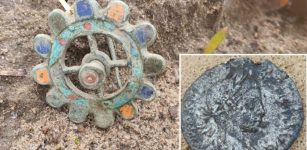 Unique Ancient Fibula Of The Wielbark Culture And Roman, Scythian Artifacts Discovered Near Grudziądz, Poland
-
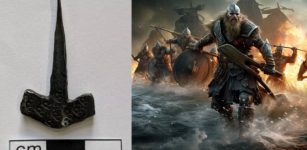 Thor’s Hammer Pendant Found In Norfolk May Be Linked To The Great Heathen Army
-
 Callanish Stone Complex: Sacred Place On The Isle Of Lewis In Scotland
-
 Scathach – The Shadowy One – Legendary Martial Arts Teacher Who Trained Cuchulainn And Other Warriors
-
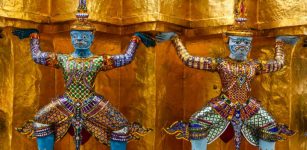 Rakshasas: Night Wandering Race Of Demons And Warriors Fuelled By Kundalini In Hindu Beliefs
-
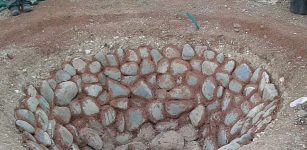 Prastio-Mesorotsos Excavations: Neolithic oven prepared food for 200 guests

