
Napta Playa – Egypt’s Stonehenge And Its Ancient Astronomical Alignments
Thalia Lightbringer – AncientPages.com - Many people gather every year to celebrate the spring equinox at Stonehenge, but did you know there is something similar, but older, in Egypt?
One hundred kilometers west of Abu Simbel in southern Egypt, there are some standing stones with astronomical alignments similar to the famous Stonehenge and other megalithic structures scattered across Europé.
Nabta Playa was constructed approximately 2,000 years before the stone circles of Europe by nomadic peoples of the late Neolithic (Stone Age) period.
These people were probably cattle herders, perhaps some of those who may have contributed to the formation of the Sahara Desert, as noted in another article here.
Ancient Astronomers At Napta Playa
Observation of the stars was essential to ancient people because it helped them navigate, just as sailors used them. Stellar alignments were also used to determine crucial times of the year.

Isis with outstretched wings by Ägyptischer Maler um 1360 v. Chr. - The Yorck Project: 10.000 Meisterwerke der Malerei. DVD-ROM, 2002. ISBN 3936122202. Distributed by DIRECTMEDIA Publishing GmbH., Public Domain - Wikipedia
One of the most significant stellar alignments for these prehistoric people seems to have been the summer solstice. Nabta Playa is a large internally drained basin, which was filled by summer monsoon rains around 11,000 to 5000 years before the present. It was the time when water began to accumulate in this area.
It was an important ceremonial center for prehistoric people who came to water and fed their animals. They erected these structures on the lake's western shore during this time, as the stellar alignments can be traced to a specific time frame.
Based on the analysis, six megalithic alignments radiate from the Napta Playa stone arrangement containing 24 megaliths or megalithic scatters.
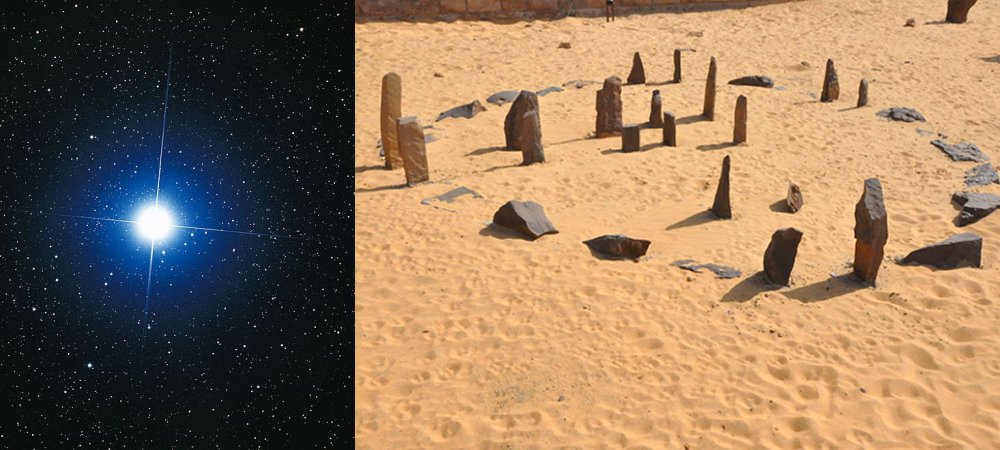
The lines have been shown to coincide with the rising positions of three prominent stars during the period 4800-3700 B. C., the first of these being Sirius, the Dog Star, related to Isis by the Egyptians. Sirius is the brightest star of the night sky and was also crucial to later Egyptians as its appearance heralded the annual Nile floods.
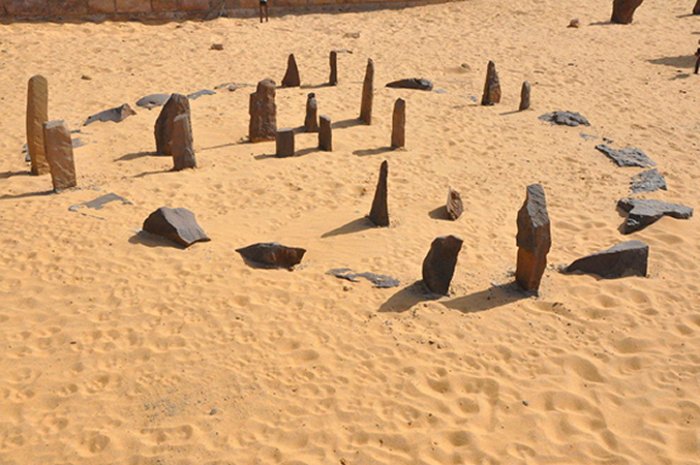
Napta Playa - Image credit: Raymbetz - Own work, CC BY-SA 3.0
The second-star alignment is to Dubhe, the brightest star in Ursa Major, and there are also alignments to stars in the belt of Orion (as with the pyramids at Giza).
Napta Playa And Goddess Hathor
The earliest settlements in the area date to around 11,000-9300 years ago. The people made ceramics and domesticated cattle. Many fire-reddened stones have been found there, remnants of their campfires. There is also evidence of ceremonial sacrifices of cattle.
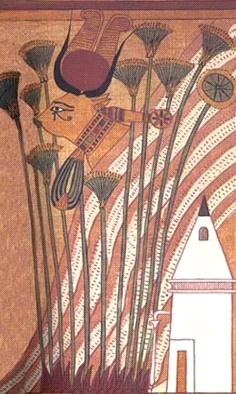
Goddess Hathor as a cow. Image credit: Wikipedia
The people probably came from the south or the Nile Valley in search of pasture and left when the water dried up in the fall.
The early cattle herders probably contributed to the later development of the Apis bull worship and the importance of the goddess Hathor, even though cattle were not so important to the economy.
Cattle in early cultures often represented status and wealth, as is reflected in the first letter of the Runic alphabet, or Futhark.
Feoh means both cattle and wealth. The letter in early alphabets that became our 'A' also originally represented a horned cow.
Written by – Thalia Lightbringer – AncientPages.com Staff Writer
Copyright © AncientPages.com All rights reserved. This material may not be published, broadcast, rewritten or redistributed in whole or part without the express written permission of AncientPages.com
Expand for referencesMore From Ancient Pages
-
 Trentren And Caicai: The Battling Serpents Of Chilote Mythology
-
 Neolithic Monuments, Prehistoric Pits And Anglo-Saxon Cemetery Unearthed In England
-
 Ancient Egyptians Observed Algol’s Eclipses – Cairo Calendar Analyzed
-
 King Sanakht: Mysterious Ancient Egyptian Pharaoh Was A ‘Giant’ – Scientists Say
-
 Dozens Of Elongated Skulls Unearthed In An Ancient Hungarian Cemetery Shed New Light On The Fall Of Rome
-
 Should Scientists Open An 830-Million-Year-Old Rock Salt Crystal With Ancient Microorganisms That May Still Be Alive?
-
 Mississippi’s Mounds Built By The Indigenous People Are Incredibly Important Landforms – Scientists Say
-
 New Images From The Magnificent Dendera Temple Where Restoration Works Continue
-
 Extremely Rare Fossils Of 160-Million-Year-Old Sea Spider And Its Diversity By The Jurassic
-
 Herostratic Fame Relates To Herostratus Who Burned The Beautiful Temple Of Artemis To Become Famous
-
 Brihadeshwara Temple – Outstanding Example Of Chola Architecture In Tamil Nadu, India
-
 Who Were The Satraps Of The Achaemenid Empire?
-
 Ancient Greek Amethyst Ring To Ward Off A Hangover Discovered At The World’s Largest Byzantine Wine Factory In Yavne, Israel
-
 Madagascar Hippos Were Forest Dwellers – New Study
-
 When And Why Was Yakuza, The Japanese Mafia Founded?
-
 Ancient DNA Unravels The Mystery Of Huge 6,500-Year-Old Cemetery And The Tomb Of A ‘Masculine Woman’ In Normandy, France
-
 Ancient Roman Altarpieces Deciphered And New Roman Goddess Uncovered In The Netherlands
-
 Humans May Be The Result Of An Evolution ‘Accident’- Scientists Say
-
 Well-Preserved 1,000-Year-Old Ulfberht Sword Found In The Wisla River, Poland
-
 Ancient DNA Illuminates Unknown ‘Ghost’ Populations In Sub-Saharan Africa

