
Grolier Codex – Oldest, Unique, Genuine Pre-Columbian Maya Manuscript That Survived Spanish Inquisition
A. Sutherland - AncientPages.com - The ancient Maya created many books, but almost all of them were burned by conquistadors and clergy. One of those who significantly contributed to the destruction of the Maya cultural material was the Yucatan bishop Diego de Landa (1524 – 1579).
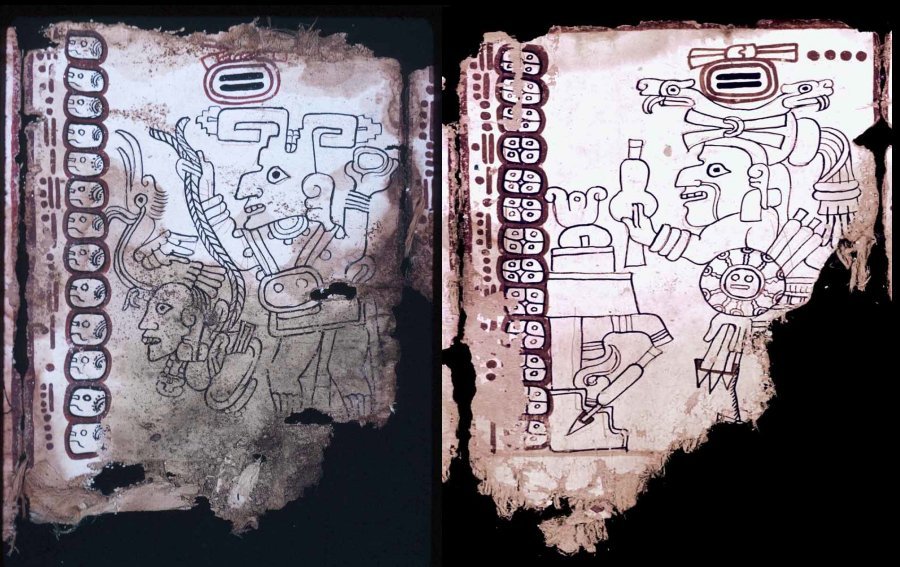
Left: Page 6 of the Grolier Codex, depicting a death god with captive. Image credit: Private Collection via Wikipedia; Right: Codex Grolier. Image credit: Instituto Nacional de Antropología e Historia, Mexico
The original manuscript has been lost in the "Relación de las Cosas de Yucatán" (around 1566), but many copies still exist; de Landa wrote valuable information about the religion, language, and culture of the Maya.
However, during the ceremony on July 12, 1562, many Maya codices (according to Landa, 27 books) and approximately 5000 Maya cult images were destroyed by the Inquisition Tribunal called by the bishop.
It first appeared in a private collection in the 20th century and was displayed at the Grolier Club in New York. The codex consists of a fragment of a Maya book, containing almanacs of Venus represented in a somewhat simplified fashion, compared to the known Maya codices.
The Grolier Codex would be only the fourth surviving pre-Columbian Maya book if genuine. The manuscript would once have measured 250 centimeters (98.4 in), and was approximately the size of the Dresden Codex.

Codex Grolier, page 7. Upploaded by Adamt - Public Domain
Looters discovered it in a cave in Chiapas, Mexico, in the 1960s. After careful studies, this important manuscript has been confirmed as genuine and probably the most ancient of all surviving manuscripts from old America.
tored in the treasury at the National Anthropological Museum, Mexico, the Grolier Codex contains little text and a lot of illustrations.
Only a fragment of the Codex survived. It consists of 10 painted pages ornamented with ritual Maya iconography, tablets of Venus covering 104 years (probably three generations of the Maya priests), and a calendar that charts the movement of the planet Venus.
Venus and its cycles were significant for the Maya and all Mesoamerican peoples, who believed that different gods and deities were strongly associated with these cycles and with the passing of time.
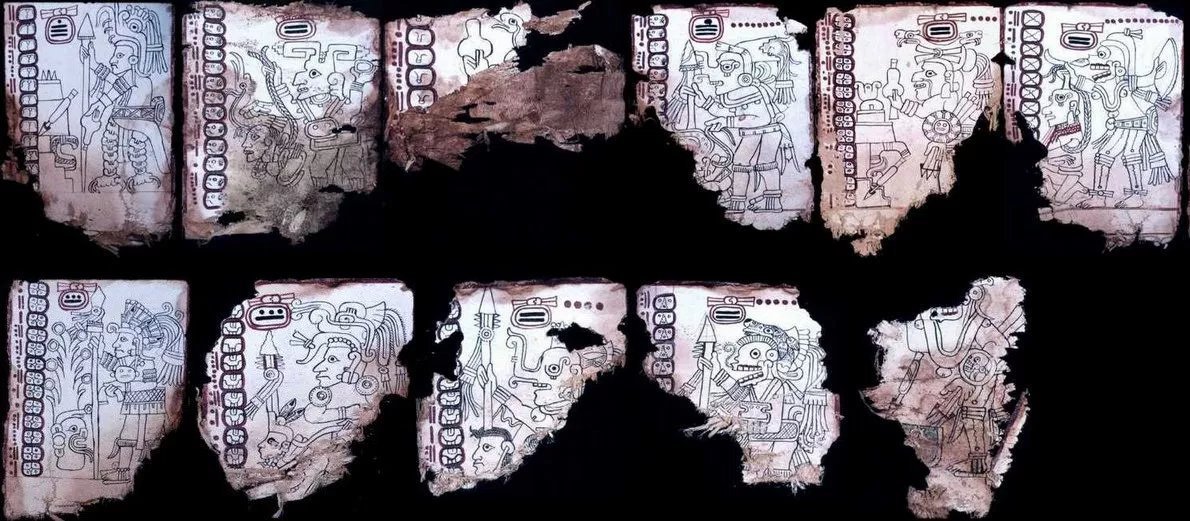
Codex Grolier. Image credit: Instituto Nacional de Antropología e Historia, Mexico
The Maya regularly measured Venus' cycles because it could help them organize ritual cycles based on astronomical phenomena.
The Grolier Codex differs much from the Dresden Codex, which mentions a great variety of Maya gods and consists of many calculations and detailed notes made by its authors.
Instead, the Grolier Codex only describes the gods who are "deities of everyday life" of the Maya people. These gods are responsible for events such as death, sunlight, or lightning phenomenon, strongly associated with K'awiil, a Maya deity identified with lightning, maize, serpents, and fertility.
The Maya were excellent astronomers who recorded and interpreted every aspect of the sky. They had their solar calendar and knew the timing of the eclipses. The stars, moons, sun, and planets were regarded as gods.
These Gods were involved in human affairs, and their movements were watched closely. The Maya dedicated much time to studying celestial objects, and several of their most important buildings were constructed with astronomy in mind.
Written by A. Sutherland AncientPages.com Staff Writer
Updated on January 12, 2023
Copyright © AncientPages.com All rights reserved. This material may not be published, broadcast, rewritten or redistributed in whole or part without the express written permission of AncientPages.com
Expand for referencesMcClellan J. E. Dorn H. Science and Technology in World History
More From Ancient Pages
-
 Vikramashila: India’s Main Intellectual And Learning Center Of Tantric Buddhism
-
 New Theory On “Dry Moat” At The Pyramid Of Pharaoh Djoser
-
 Mysterious Bones May Re-Write History Of North America – Humans Were Present On The Continent 10 Times Earlier
-
 Similarities And Differences Between Living Spaces Of Neanderthals And Homo Sapiens
-
 Reconstrucion Of The 19-Meter-Long Gjellestad Viking Ship In Progress
-
 Mysterious Grave Of King Valdemar IV Atterdag – Will The 600-Year-Old Historical Puzzle Ever Be Solved?
-
 2,000-Year-Old Altar Depicting Snake Figure Unearthed In Lycian City Of Patara
-
 African Skeletons From Early Colonial Mexico And First-Generation Slaves
-
 Ancient Secrets Of Karelia: Mysterious Vottovaara Mountain Was Sacred To The Sami People
-
 Early Māori Settlement On The Subantarctic Islands -Uncovering Some Of The Unknown
-
 Rare Pre-Columbian Archaic Settlement Discovered In The Dominican Republic May Solve A Caribbean Mystery
-
 Homo Longi: Extinct Human Species That May Replace Neanderthals As Our Closest Relatives
-
 Fascinating Portable Art From Torre Cave, Gipuzkoa – One Of The Most Complete Specimens From The Entire Iberian Peninsula
-
 Ancient History Of The Christmas Tree And Its Pagan Roots – How The ‘Forbidden’ Tree Survived Against All Odds
-
 On This Day In History: Battle of Devil’s Hole Was Fought – On Sep 14, 1763
-
 World’s Oldest Burial Site Reveals Homo Naledi Buried Their Dead 100,000 Years Before Humans
-
 Aldworth Giants: Knights Who People Tried To Erase From History
-
 On This Day In History: Robert I, King Of Scots Known As ‘Robert The Bruce’ Was Born – On July 11, 1274
-
 Legacy Of Queen Hatshepsut’s Temple In Luxor – New Valuable Finds Announced
-
 Akrotiri Of Thera: Sophisticated City In The Greek Cyclades Devastated By Volcanic Eruption

