
Antisthenes And Diogenes – Founders Of Cynicism Were Ancient Greek Philosophers
Ellen Lloyd - AncientPages.com - The concept of cynicism comes from the Greek word for dog ( kynos), but originated in a philosophical school established in ancient Greece.
Denoting their denial of luxuries, wealth, and social status, cynics believe the purpose of life is to live in virtue, in agreement with nature.
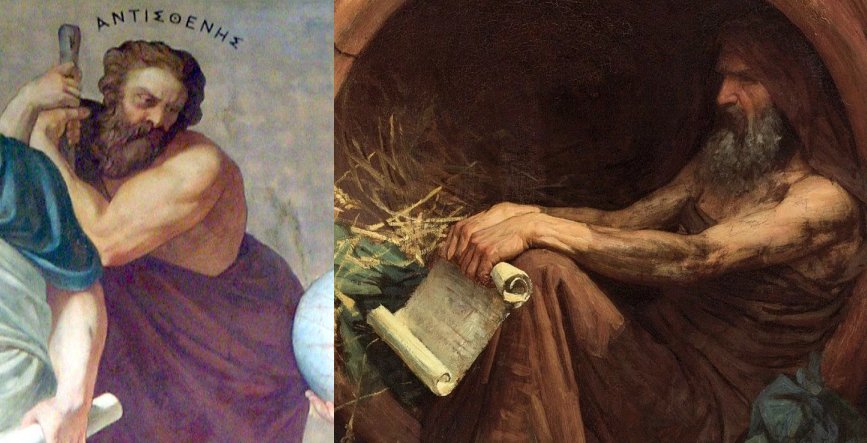
Left: Antisthenes, part of a fresco in the National University of Athens. Right: Diogenes of Sinope lived in a barrel in downtown Athens, (by Waterhouse)
This meant satisfying only the most basic requirements of the body by the simplest means possible.
The Cynic School, founded in Athens about 400 B.C., continued in existence until about 200 B.C. The founder of the school was Antisthenes, (c. 445–365 B.C.) a Greek philosopher who was a pupil of Socrates. The best known among his followers is Diogenes of Sinope (c. 412–323 B.C.)
Antisthenes said that desire leads to pleasure and pleasure to the misery of insufficient and temporal happiness. Antisthenes valued virtue more than anything. In his opinion, virtue is the only good, and pleasure is always evil. Self-control is the essence of virtue.
According to his philosophy, wise people learn to above all things to despise material needs and the artificial comforts in which worldly men find happiness.
Self-control, he said, is the essence of virtue, and a wise man will learn above all things to despise material needs and the artificial comforts in which worldly men find happiness. Virtue was according
Nicknamed ‘the dog’ for his vagrant lifestyle, Diogenes was described as ‘a Socrates gone mad’.

Alexander the Great's meeting with Diogenes.
Diogenes took the concept of cynicism to its highest level. Legends tell Diogenes lived in a barrel (actually a kind of storage jar) on the outskirts of the marketplace. He made his living by begging, refusing to wear anything but the simplest of cloth.
Diogenes was sometimes referred to as “Diogenes the dog”, but he was by no means offended by this. To him, it was almost like a compliment because he believed dogs were more in touch with nature. Dogs do not care for social status or material possessions.
The happiest person, who in Diogenes’ phrase “has the most”, is, therefore, someone who lives in accordance with the rhythms of the natural world, free from the conventions and values of civilized society, and is “content with the least”.
Alexander the Great who was his great admirer met the Greek philosopher in Corinth while he was bathing in the morning sunlight. The King of Macedonia asked Diogenes if there was anything he (a man who seemingly had everything) could do for him.
The philosopher responded, “Yes, stand out of my light”. Alexander the Great was said to have been so impressed with the remark that he then stated “If I were not Alexander, I would wish to be Diogenes”.
As a general philosophic principle, cynicism was highly influential upon the later Stoic philosophers.
Written by Ellen Lloyd – AncientPages.com
Copyright © AncientPages.com & Ellen Lloyd All rights reserved. This material may not be published, broadcast, rewritten or redistributed in whole or part without the express written permission of AncientPages.com and Ellen Lloyd
Expand for referencesMore From Ancient Pages
-
 Massive Roman-Era Column Base Of Limestone Unearthed In The Foothills Of Mount Hermon, Golan Heights
-
 Unique Viking Age Hearths Discovered In Tallinn, Estonia
-
 Mystery Of Moses’ Double Mask, Dramatic Personality Change And The Hidden Prophet – What Did Really Happen On Mount Sinai?
-
 8,000-Year-Old Petroglyphs Discovered In Oldest Impact Crater In South Africa
-
 On This Day In History: Riot Over Wine In Oxford – On Feb 10, 1355
-
 Charlemagne – Most Famous Emperor Of Education And Enemy Of Pagan Worshippers – What Did He Really Mean For Europe?
-
 Ancient DNA Solves The Mystery Of Mitochondrial Eve And Human Evolution?
-
 Amazing Thirteen Ming Tombs: Gigantic Stone Animals And Human Figures Were Symbols Of Royal Power
-
 Suontaka Weapon Grave: New Light On Strong Female Leaders And Warriors Of Late Iron Age Finland
-
 Tusayan Pueblo Ruins And Split Twig Figurines Tell Story Of People Who Once Inhabited The Grand Canyon
-
 Is The Tomb Of Genghis Khan Hidden And Protected In The Khentii Mountains Because Some Fear It’s Cursed?
-
 Patasola: Hideous One-Legged Female Vampire Who Kills Driven By Hatred In Colombian Folklore
-
 Reconstruction Of Five-Story Patara Lighthouse Built By Roman Emperor Nero – Begins
-
 First Chinese Murals Unearthed In Shimao Ruins Are Over 4,000 Years Old
-
 Cooper’s Ferry Site In Western Idaho Was Inhabited 16,000 Years Ago
-
 Researchers reconstructed face of oldest pharaonic mummy ‘Kent’
-
 2,000-Year-Old Lavatory In Turkey’s Denizli Province Will Be Restored
-
 Why Were The Jews Exiled To Babylon?
-
 Remains of Maurya-Era Wall Discovered In Tilaurakot, Kapilvastu, Nepal
-
 Mysterious Ancient Tomb Reveals ‘Impossible’ Human Connection To Cosmos – Human Anomaly? – Part 2

