
Graeae: Three Sisters Of Fate Who Shared One Eye And Tooth In Greek Mythology
A. Sutherland - AncientPages.com - The Graeae were three sisters of fate who shared one eye and one tooth in Greek mythology. They were born as old women and their names were Deino (dread), Enyo (horror), and Pemphredo (alarm).
The number three is of great symbolical meaning in many myths. The Graeae share certain similarities with the three Norns, known as ‘Shapers of Destiny’ in Norse mythology. The Norns were goddesses who ruled the fates of people, determined the destinies and lifespans of individuals.
One might also compare the Graeae with the three spinners of Destiny, the Moirai who were also called the Fates in Greek mythology. The three Moirai determined the span of life of every mortal from birth to death. They were so powerful that no god had the right or the means to alter their decisions.
Although the Fates were the personifications of destiny, no human could blame the fates, as he was the only one responsible for his failures.

The Graeae were three sisters of fate who shared one eye and one tooth in Greek mythology. Image credit: Doorway To Other Worlds
The subject of fate is also reflected in Baltic religion where we encounter Laima, the Baltic goddess of fate who together with Dievs, the sky, and Saule, the sun, Laima determines the length and fortune of human life.
The mythical story of the Graeae has changed over the course of time. In their original conception, they were merely personifications of kindly and venerable old age, possessing all its benevolent attributes without its natural infirmities.
They were old and gray from their birth, and so they ever remained. In later times, however, they came to be regarded as misshapen females, decrepit, and hideously ugly, having only one eye, one tooth, and one gray wig between them, which they lent to each other when one of them wished to appear before the world. So, at times poets described them as "beautiful."
In other legends they are described as being half-swan or old, ugly hags. Their age was so great that a human childhood for them was hardly conceivable.
Born as the daughters of the Sea Gods, sea gods Phorcys and Ceto, and sisters of the Gorgons, the Graeae were powerful creatures and they appear in the myth of Perseus, the hero who killed Medusa, a monster, a Gorgon, generally described as a winged human female with a hideous face and living venomous snakes in place of hair. Gazers on her face would turn to stone.

Perseus Returning the Eye of the Graeae by Henry Fuseli
According to an ancient legend, Perseus was sent by the king to get Medusa's head. Perseus went to the three Graeae, that shared one eye between them, and through stealing it he made them tell him where the nymphs of the north lived. They gave him winged sandals, a magic bag that fit anything put in it, and Hades' cap which made him invisible whenever he wore it. Hermes gave him an unbreakable sword, and Athena a shield.
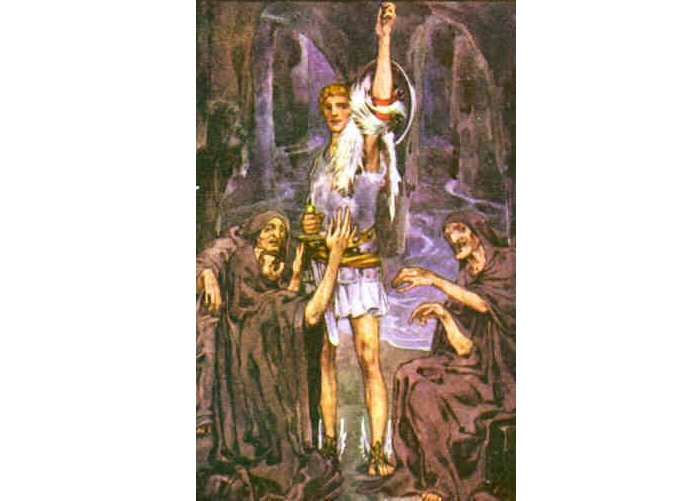
Perseus took the eye from the Graeae to kill Medusa.
With all this equipment, Perseus managed to kill Medusa by looking at her through the reflection of the shield and escaped her sisters by wearing the cap. His winged sandals flew him home. Later he offered Medusa's head to Athena.
The Graeae are also called Grey Sisters, Graiai, and Graiae.
Written by – A. Sutherland AncientPages.com Staff Writer
Copyright © AncientPages.com All rights reserved. This material may not be published, broadcast, rewritten or redistributed in whole or part without the express written permission of AncientPages.com
Expand for referencesEdith Hamilton, Mythology: Timeless Tales of Gods and Heroes
Bernard Evslin, Heroes, Gods and Monsters of the Greek Myths
More From Ancient Pages
-
 ‘Liber Linteus’ – Unique History Of Ancient ‘Linen Book’ Written In Etruscan That Still Remains Poorly Understood
-
 Controversial Sand Mounds In Australia Are 6,000 Years Old Man-Made Burial Mounds – Radar Scans Reveal
-
 Egypt’s Oldest Tomb Oriented To Winter Solstice Discovered In Aswan
-
 Legendary Pirate Black Sam And His Ship Discovered Off The Coast Of Cape Cod
-
 Well-Preserved Fragments Of Epetion’s Wall Discovered At The Hellenistic Site Of Stobreč, Near Split, Croatia
-
 Beavers Had A Big Influence On How Stone Age People Lived
-
 Humans Spread The Black Death – Not Rats – Scientists Say
-
 Mysterious Underground City In Brazil Could Re-Write Ancient History – Unexplained Artifacts And Skeletons – Part 1
-
 Earliest Evidence Of Wine Consumption In The Americas Found In Caribbean
-
 Remarkable 2,000-Year-Old Smoke-Absorbing Lamps Reducing Pollution Discovered
-
 Roskilde 6 – Longest Viking Ship Ever Discovered Was 37-Meters Long And Carried 100 Viking Warriors
-
 Scientists Can Finally Answer What Bronze Age Daggers Were Used For
-
 Oldest Golden Jewel In The Caucasus Unearthed In Azerbaijan
-
 Neanderthals Were Morning People – A New Study Says
-
 For The Ancient Maya, Cracked Mirrors Were A Path To The World Beyond
-
 Mysterious Toaleans – Remains Of Unknown Humans Who Lived 8,000 Years Ago Discovered In The Leang Panninge Cave
-
 8 Billion People: How Different The World Would Look If Neanderthals Had Prevailed
-
 Hundreds Of Highly Unusual Burial Gifts Found In Special Viking Chamber Belonging To Woman In Norway
-
 Deir el-Bahri – Sacred Resting Place For The Pharaohs
-
 Never-Before-Seen 16 Meters Long Ancient Egyptian Papyrus Unveiled To The Public

