
Fin Folk – Mythical Amphibious Sea People On Orkney And Shetland
A. Sutherland - AncientPages.com - The Orkney Islands are situated between the North Sea to the east and the Atlantic Ocean. Due to the Norse settlement of the islands, a unique and fascinating folkloric tradition of the islands has much in common with Scandinavia.

Among many tales of fishermen, mythical creatures emerging from the waters, and sea voyages, there are stories about a curious mythological race of dark, gloomy, distrusted, powerful sorcerers known as the Fin Folk (Finfolk).
Unique to Orkney and Shetland, these strong and athletic amphibious sea people have always been feared by mortals.
Noted shapeshifters with unequal boating skills, the Fin Folk could step out of the water onto land as they choose and live easily between the two worlds.
Both benevolent and threatening, they could punish seamen with terrible storms or reward them with calm sea waters. It also happened that people were asked to do a favor for the Fin Folk.
A reward always came in copper coins, but never silver, because these strange beings valued silver greatly and were reluctant to part with it.
The Fin Folk lived in families, having a wife and children.

The Finfolk of Orkney. Credit: Adobe Stock - Marynkka_muis
On some occasions, they stole humans and brought them to their hidden island homes, where the abducted individuals were forced to remain for the rest of their lives.
Except for their daughters, who were mermaids, the Fin Folk were entirely humanoids. Their bodies were draped by fishlike fins, so cunningly made that humans mistook them for ordinary dresses.
They spent the long Orkney winters in the beauty of Finfolkaheem, a majestic city in an unknown location but usually said to be at the bottom of the sea.
In the summer, however, they returned to Orkney, where they took up residence on their magical island home, Hildaland ('Hidden Land') - one of Orkney's magical vanishing islands.
Legend has it that this mythical Hildaland was later taken from the Fin Folk and is today associated with the uninhabited island of Eynhallow.
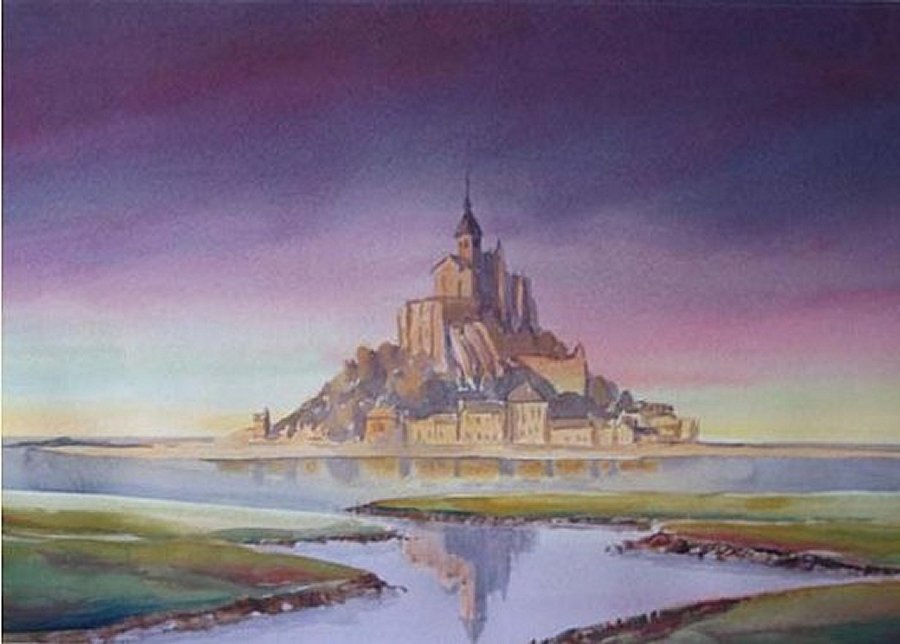
Hildaland by Vicente Lezama Junio. Credit: Public Domain
Mythical islands were believed to be the 'summer home of the Finfolk, or their residence at such times as they chose to live above water.'
See also:
This land was only visible at rare times, and some people had the power to see it far more clearly than others. One old man said, "Hid's only the eye that sees the unseen that can see Hilda-land."
Has this tale its origin in Orkney Islands' not uncommon fog-banks that appear and disappear rapidly?
Can usually occurring sea mists that disappear during the morning be responsible?
Written by A. Sutherland - Ancient Pages.com Staff Writer
Updated on May 21, 2024
Copyright © AncientPages.com All rights reserved. This material may not be published, broadcast, rewritten or redistributed in whole or part without the express written permission of AncientPages.com
Expand for referencesReferences:
Judy Hamilton - Scottish Myths and Legends
Dictionary of the Scots Language
More From Ancient Pages
-
 Attempt To Smuggle Three Artefacts From Alexandria Port – Failed
-
 Pax Assyriaca: Important Time For The Neo Assyrian Empire And Surrounding Regions
-
 Enigmatic Figure Dated Back To 40,000 From Prehistoric Stadel Cave, Germany
-
 Byzantine Sandals With A Nice Message Found In The Harbor Of Eleutherios (Theodosius) – Now On Display
-
 Intact 2,600-Year-Old Etruscan Tomb Opened In Vulci- Exceptionally Rare Artifacts Found Inside
-
 Incredible Technology In Mysterious Huashan Caves, China
-
 Mysterious Rock Inscription Found In Brittany Baffles Experts – Reward If You Can Decipher It
-
 On This Day In History: Samuel Morey Patents The Internal Combustion Engine – On April 1, 1826
-
 How Far South Did Prehistoric Highly Skilled Polynesian Seafarers Sail?
-
 On This Day In History: George Plantagenet Privately Executed At The Tower Of London – On Feb 18, 1478
-
 Drought Reveals 2,000-Year-Old Rock Carvings In Brazil’s Amazon
-
 Chachapoyas Culture: More Than 100 Archaeological Structures Discovered At Gran Pajatén, Peru
-
 On This Day In History: National Hero Paul Revere Warns Of The British Coming – On Apr 18, 1775
-
 Ancestors Of The Irish And Scots Came From Biblical Lands And Ancient Egypt – Myths, History And DNA
-
 Binary System Was Used By Ancient Polynesians 1,000 Years Before The Concept Of A Computer Was Introduced
-
 Fascinating Ancient History Of Roman Shields
-
 Giant Circular Roman Burial Site With No Bones Discovered – Was It A Cenotaph?
-
 Fascinating Millennia Old Natufian Culture: Funerals With Flowers, Food And Pounding Sound Of Mortars
-
 On This Day In History: Antonio Neri Was Born in Florence, Italy – On Feb 29, 1838
-
 Mysterious Ancestor Of All Mammals Identified Through Genome Reconstruction

