
Inchbrayock Stone: Pictish Samson Stone Carved With Biblical Symbols And Scenes
A. Sutherland - AncientPages.com - The Inchbrayock stone, also known as the Samson stone is a remarkable and truly fascinating ancient artifact.
Found in 1849, in the graveyard of St Braoch's Church, Inchbraoch, Montrose, Scotland the Pictish stone is carved with Biblical symbols and scenes. There are also several important Celtic symbols.
The stone combines Celtic and Christian beliefs. The Picts were an Iron Age society that existed in Scotland from ca AD 300–843. Not much is known about the mysterious Picts and yet, they played a vital role in the history of Scotland.
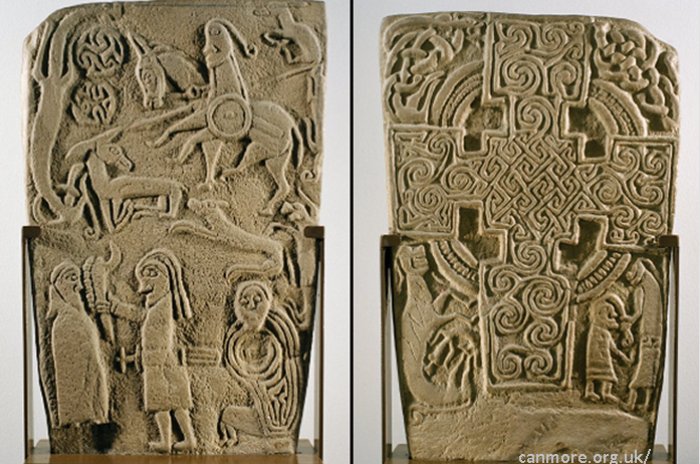
Inchbrayock Stone - Image credit: canmore.org.uk
These brave and determined people repelled the conquests of both Romans and Angles and won one of the most important battles in Scottish history.
Other than a copy of the Picts’ King list, they left no written record of themselves. The Picts used mysterious symbols that still haven’t been properly deciphered and their enigmatic language is now extinct. The carved stones the Picts left behind are today known as ‘Pictish Symbol Stones’.
One of them is the Inchbrayock Stone. The reason why it is also called Samson stone is because the stone depicts the biblical character Samson, as well Delilah. The stone is carved on both sides. The front is carved in a Celtic cross with intertwined beasts at the top.
The carvings depict two confronting figures. One of them is tall with a beast’s head. The person appears to be yanking the overlong hair of the smaller figure. Some have interpreted it as scene showing Delilah cutting off Samsons hair.
Both figures are wearing tunics, that of the smaller figure with a decorative hem and that of the taller figure with a belt decorated with key pattern. There is also a crocodile-like creature with an elongated body and back leg entwined together and two interlaced serpents.
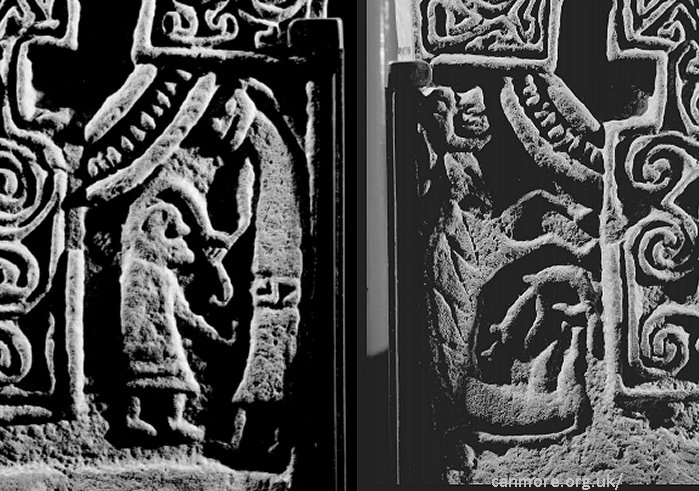
Pictish Carved Stone. The slab has a character of its own and many interesting details. It is carved in relief on both sides with the occasional use of incision. Evidence for discovery: found in 1849 in Inchbrayock graveyard and donated to Montrose Museum in 1859.. 'Image credit: Canmore
A large crocodile seen from above with bulbous eyes and two smaller crocodiles stretch along the right edge of the slab, one seen again from above with bulbous eyes and the other biting the tail of a donkey foal. There is another foal being harassed by a hound across the middle of the slab. Between the foals stands a man armed with spear, circular shield and sword, riding an adult donkey.
At the foot of the slab on the left is a cleric in a cowled cloak being menaced by a man wearing a tunic and sword, with a curiously wrought club raised in his right hand.
At the bottom there are two figure that have been interpreted as Mary and her child.

Samson Putting Stone in Scotland. Image credit: Simon McKeating
The Inchbrayock Stone is an excellent example of how the Picts used a variety of symbols to convey important messages. The stone was donated to Montrose Museum, Angus where is it currently kept.
To avoid confusion, it’s worth mentioning that there is another Samson Stone in Scotland. It goes by the name Samson’s Putting Stone. It’s a giant rock that stands on the summit of one of the eminences of Bochastle, a couple of miles west of Callander.
Samson Putting Stone in Scotland. Image credit: Simon McKeating
According to ancient legends, this huge stone was thrown here by one of the Fingalian giants in ancient times. It was originally located upon Ben Ledi, nearly 3 miles northwest, and was one of several stones being thrown in a competition to see who was the strongest of the giants and Samson was the name of the one who threw this huge rock.
Samson Putting Stone has nothing to do with the Picts. The stone was most likely carried from the Glen Dochart region and left there when the ice retreated at the end of the last ice age.
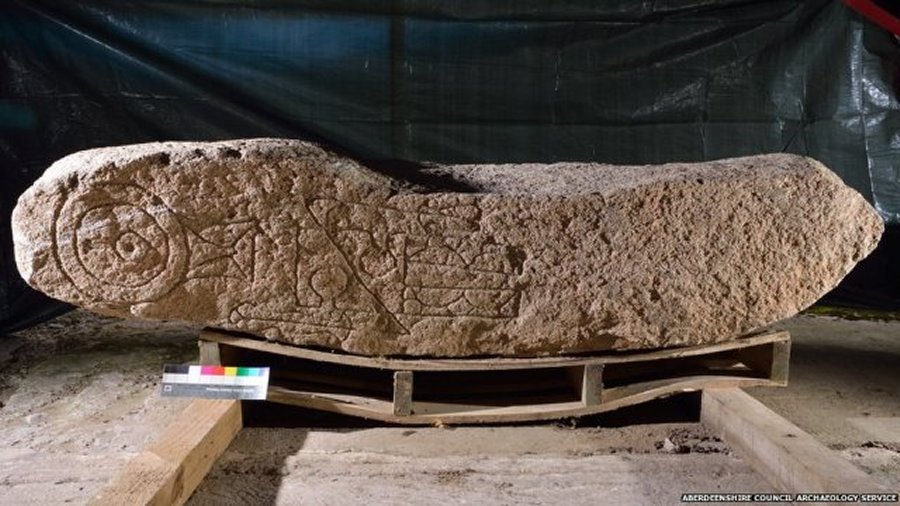
Spanning more than 1.7 meters and weighing more than a ton, the Dandaleith Stone has odd carvings made by the Picts who lived in the north and east of Scotland hundreds of years ago. Credits: Aberdeenshire Council
Over the years, archaeologists have uncovered several intriguing stone created by the Picts, especially in northern and eastern Scotland, but it has not been possible to decipher the symbols and signs. Carved stones represent a unique legacy of the Picts. Many of them give evidence of advanced skills of artists; some of the stones with very complex decorative motifs depict Christian crosses and crescent or birds or animals, both real and mythical.
One of the most extraordinary Pictish stones is the Dandaleith Stone. Spanning more than 1.7 meters and weighing more than a ton, the Dandaleith Stone contains several undeciphered signs.
Written by – A. Sutherland - AncientPages.com Senior Staff Writer
Copyright © AncientPages.com All rights reserved. This material may not be published, broadcast, rewritten or redistributed in whole or part without the express written permission of AncientPages.com
Expand for referencesMore From Ancient Pages
-
 Siberian Neanderthals Were Intrepid Nomads – They Started Their Journey In Eastern Europe
-
 Evidence Ancient Civilizations Had Knowledge About Planets In Our Solar System Thousand Years Ago
-
 Mysterious Mythical City Found In One Of North America’s Beautiful National Parks
-
 Viking Ragnar Lodbrok Wanted To Kill His Son Ivar The Boneless
-
 Viking Treasures Discovered In Chamber Grave In Denmark
-
 3,200-Year-Old Mycenaean Statuette Sheds New Light On The Hittites
-
 Ancient DNA Analysis Shows How The Rise And Fall Of The Roman Empire Shifted Populations In The Balkans
-
 Mystery Of Egyptian Tomb 10A And The Mummy’s Head – A 4,000-Year-Old Crime
-
 Mystery Of The Watchers And Book Of Enoch – Fallen Angels And Their Secret Knowledge
-
 Tomb Of Pharaoh Ramesses II Treasurer Ptah-M-Wia Discovered In Saqqara
-
 On This Day In History: Battle Of Marton, Part Of Viking Invasions Of England Took Place – On Mar 22, 871
-
 On This Day In History: The Name Of America Used For The First Time On World Map – On Apr 25, 1507
-
 Fascinating Discovery – First Female Viking Grave Discovered In Swedish Mountains
-
 Unexplained Behavior In People Found After Being Lost In National Parks – Strange Encounters With Dangerous Humanoids And The Little People
-
 Why Was The Urnes Brooch So Popular At The End Of The Viking Age?
-
 God Dagda – A Powerful Leader Of The Tuatha De Danann In Celtic Mythology
-
 On This Day In History: Sunspot Observed By Chinese Astronomers During The Han Dynasty – On May 10, 28 BC
-
 Great And Never Explained Mysteries Of Nevada’s History
-
 Just 7% Of Our DNA Is Unique To Modern Humans – We Are Not Much Different From The Neanderthals
-
 Roman Copper-Alloy Tortoise Figurine Discovered In Suffolk, UK

