
Cryptic North American Blythe Intaglios Reveal The Creator Of Life: Who Was This Unknown Being?
Ellen Lloyd - AncientPages.com - The Blythe Intaglios are not as famous as the Nazca Lines in Peru, but they are equally interesting and hold many secrets to our puzzling evolutionary past.
In the American Southwest and adjacent Mexico, there are over 300 remarkable intaglios.The most famous is the Blythe Intaglios, located west of the Colorado River about 15 miles north of Blythe, California.
Here we come across gigantic human and animal figures carved on the ground. Just like Peru's wonderful and intriguing Nazca lines, these figures can only be seen properly from the air, which is the reason they weren't discovered by white men until the 20th century.
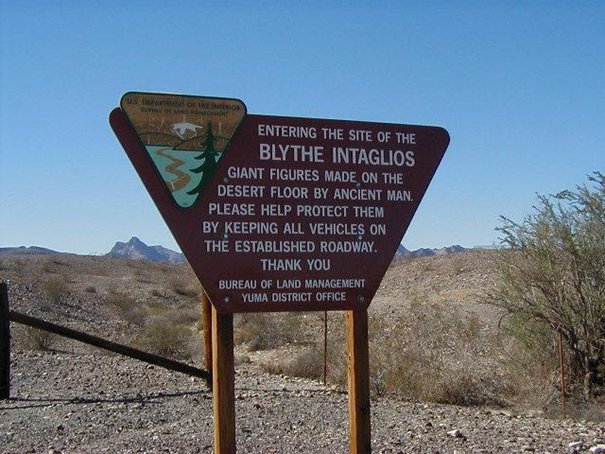
If you plan on seeing the Blythe Intaglios - be careful and watch your steps. The carvings are very sensitive to damage.
In 1930, aviator George Palmer flew over the region and spotted enormous outlines of a man, a woman, a horse, a coiled snake.
He reported his find to the Southwest Museum but lacking funds because of the Depression, they couldn't investigate the figures until 1952. It was first when the National Geographic Society and the Smithsonian Institution sent airborne archaeologists to the site that the world learned about these fascinating huge carvings.
The Blythe Intaglios in the desert of California consist of six distinct figures in three locations, including a human figure at each location and an animal figure at two locations. The largest human figure measures 171 feet from head to toe.
The age of carvings is unknown. However, scientists estimate the Blythe Intaglios to be between 450 to 2000 years old. Ancient artists created the figures using the intaglio process.
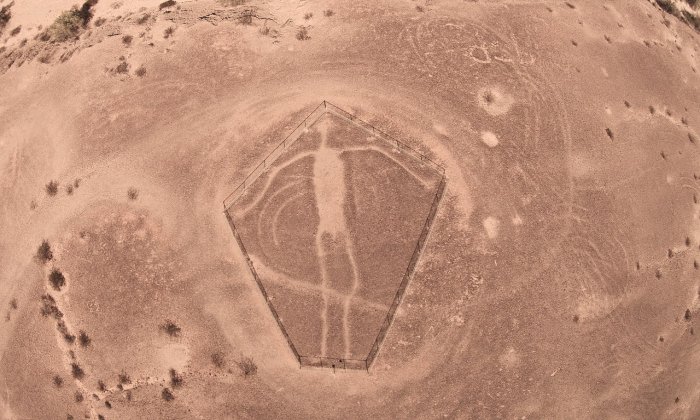
Blythe Intaglios. Image credit: - CC BY-SA 4.0
They scraped away a shallow layer of dark surface soil and rock to reveal light-colored soil underneath, and piled dark gravel around the figures to outline them. Though portions of the effigies can be seen if one is standing right next to them, they are virtually invisible just a few feet away. Neither adjacent hills nor distant mountains offer clear views of the Intaglios.
It is possible to go and see the Intaglios, but one should be careful because these carvings susceptible to damage.
Any mark made on the desert pavement will be visible for many centuries. This is why it was decided they should be fenced to prevent further damage.
The carvings are intriguing because we do not know who or what they represent. We also do not know who their creators were.
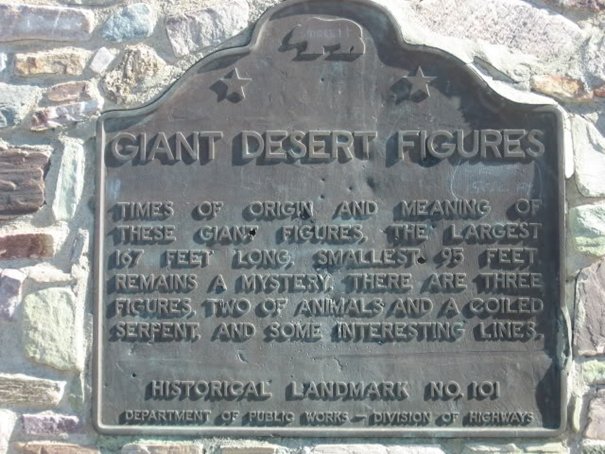
The larger of the figures, thought to be the outline of a woman, is about 175 feet long. Her outstretched arms span 158 feet. Near her is an anatomically correct male figure, about 95 feet tall. There's also a 53-foot-long, four-footed creature that's been alternatively identified as a panther, a coyote, or a horse.
According to the stories told by modern-day Mohave and Quechan Indians the human figures represent Mastamho, the Creator of Earth and all Life, while the animal figures represent Hatakulya, one of two mountain lions who helped in the Creation. Sacred ceremonial dances were held in the area in ancient times to honor the creation.
The creators of these mysterious desert carvings, but are long gone. All we have left is a cryptic message they left to future generations.
The Blythe Intaglios still remains an unsolved mystery. Perhaps the clue to this ancient mystery can be found in the fact that the figures can best be seen from the air. Were they intended to be watched and admired by someone who possessed the ability to fly?
Written by - Ellen Lloyd – AncientPages.com
Copyright © AncientPages.com All rights reserved. This material may not be published, broadcast, rewritten or redistributed in whole or part without the express written permission of AncientPages.com
More From Ancient Pages
-
 2,000-Year-Old Medusa Mosaic Is Considered The Pearl Of Ancient City Of Kibyra
-
 On This Day In History: Riot Over Wine In Oxford – On Feb 10, 1355
-
 New Denisovan Fossil: Extinct Humans Inhabited Tibetan Plateau For 160, 000 Years – Study
-
 New Species Of Stegosaur Is Oldest Discovered In Asia, And Possibly The World
-
 On This Day In History: Tunguska Explosion: Mysterious And Ferocious Impact In Remote Siberia – On June 30, 1908
-
 Ancient Maya Sacred Groves Of Cacao Trees – Located
-
 Largest Ancient Embalming Cachette Ever Found Unearthed At Abusir, Egypt
-
 Longstanding Cultural Continuity At Oldest Occupied Site In West Africa – New Study
-
 Edfu Texts Reveal Secrets Of Predynastic Egypt And Zep Tepi
-
 600-Year-Old Axe Heads Used In The Battle Of Grunwald Found in Poland
-
 Monumental Fortification That Protected The Kings Of Jerusalem Unearthed In The City Of David
-
 Carved Statue Of God Nefertum Unearthed In Egypt’s Saqqara Necropolis
-
 How Did A Major Cooling Event 8,200 Years Ago Affect Hunter-Gatherers?
-
 Is An Ancient Temple Dedicated To The Lioness Goddess Repit Hidden In The Cliffs Of Athribis?
-
 On This Day In History: Harvard University – America’s Oldest Learning Institution Was Founded – On Oct 28, 1636
-
 Discovery Of Unusual Ancient Skeleton Offers Evidence Giants Inhabited California
-
 Mysterious Stone Age Cemetery Found Near The Arctic – Why Are The Graves Empty?
-
 Mysterious Ancient Ruins Of Engaruka – Why Was The Site Abandoned?
-
 Statue Of Unknown Mythical Beast With Four Wings Discovered
-
 Abduction Of Idun, Goddess-Keeper Of Golden Juvenile Apples In Norse Mythology

