
Prehistoric Hi-Tech Nanospirals Barely Visible To The Naked Eye: Still Remain An Unsolved Mystery
A.Sutherland - AncientPages.com - Strange microscopically small nanospirals within the material that had to be at least 100,000 years old have been detected in several places, during a routine investigation of mineral deposits in the Ural Mountains in 1992.
The origin of these extraordinary and strange artifacts that the human eye can barely see - is still not explained.

There were many speculations regarding the nanospirals. Some said they are forgery, but alternative history researchers think the artifacts offer proof of advanced ancient high-tech knowledge.

However, the discovery of these prehistoric artifacts is very interesting, because the sophisticated technology required to make this kind of product - only goes back to the 1970s.
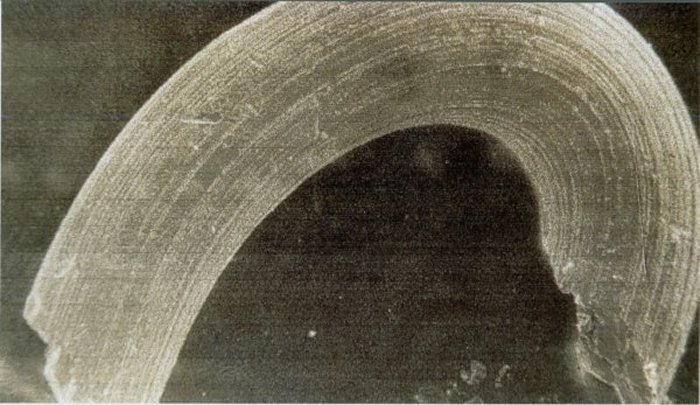
The spirals range between 3 cm and 0.0003 mm in size. Their remarkable regularity in structure and smooth surfaces, perforated in places, are only visible under an electron microscope.

The nanospirals are of copper, tungsten or molybdenum. The latter two metals along with others are used in electronics and rocket technology.
The nanospirals are mainly made of tungsten and their cores are tungsten or molybdenum. Ones discovered at a later date were also made of copper.
Fascinating is the spirals' proportion due to their surprising regularity, which indicates that they could only have been manufactured by mechanical means. So one can say their construction is artificial.
Their date of origin is estimated between 300,000 and 100,000 BC.
Written by – A. Sutherland - AncientPages.com Senior Staff Writer
More From Ancient Pages
-
 La Garma Cave Offers Evidence Of Over 300,000 Years Of Human Activity
-
 Small Figurine Reveals How A Viking’s Hair And Beard May Have Looked
-
 Puzzling Ancient Artifacts Of Unknown Origin And Purpose
-
 Marble Slab Production During Roman Imperial Time Was Much More Efficient Than It Is Today
-
 French Grotte de Cussac Cave Reveals Secrets On Life And Death 25,000-30,000 Years Ago
-
 41,500-Year-Old Ivory Pendant Is The Oldest Evidence Of Humans Decorating Jewelery In Eurasia
-
 Perfectly Preserved Roman Tombs Discovered Near City Of Capua Where Spartacus Trained As Gladiator
-
 Unique Viking Silver Treasure With Beautiful Jewelry And Rare Coins Found In Täby Outside Stockholm, Sweden
-
 The Seal Of Solomon, The Fifth Element And The Andromeda Constellation Reveal An Intriguing Connection
-
 New Cosmic Ray Bombardment Of The Great Pyramid – Search For The Hidden Chamber Continues
-
 America’s Oldest Tombstone: Jamestown’s Black “Marble” Knight’s Tombstone Was Imported From Belgium
-
 A Rare 1,500 Year Old Mosaic That Depicts Ancient Streets And Buildings in Egypt – Discovered
-
 The Aztec Sun Stone And Medusa Reveal An Intriguing Connection – A Different Gorgon And Strange Location – Part 2
-
 African Stonehenge – Extraordinary Stone Circles Of Senegambia – Who Were The Unknown Builders?
-
 Adventurous Viking Woman Who Challenged Social Norms And Whose Fate Was Foretold By A Völva
-
 On This Day In History: Supernova Observed In Constellation Lupus By Chinese And Egyptians – On May 1, 1006 AD
-
 Madagascar Cave Art Hints At Ancient Connections Between Africa And Asia
-
 How The Handbook ‘Hammer Of Witches’ And Then-Existing Networks Inspired Europe’s Witch Craze
-
 Ancient DNA Reveals Hunter-Gatherers From Mexico Moved To California 5,200 Years Ago
-
 Oldest Surviving Drinking Straws Identified – ‘Sceptres’ From The Maikop Kurgan

