
Mysterious Ancient City Of Ebla That Existed Thousand Years Before Biblical Kings David And Solomon
A. Sutherland - AncientPages.com - The mysterious ancient city of Ebla ("White Rock") existed a thousand years before the biblical time of Kings David and Solomon. The Assyrians, led by Sargon of Akkad's grandson Naram-Sin (ca. 2240 BC), destroyed Ebla by putting it to the torch.
The fire destroyed the city and then followed 250 years of impoverishment, after which the Amorites, who dominated Mesopotamia, Palestine, and Syria during the period from about 2000 to 1600 BC., sacked Ebla and established their own dynasty.
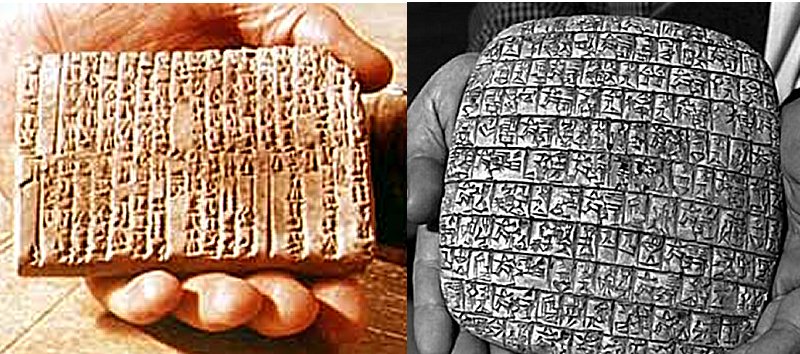
Ancient Ebla tablets. Credit: Wikimedia Commons
The Amorites rebuilt the palace and a temple, and a statue representing one of their kings but only limited prosperity returned to the city, which slowly renewed relations with Egypt, which is based on a decorated bone scepter of the Egyptian king Ḥtp-ib-Re (reigned c. 1750 BC) unearthed at the site of excavated Ebla.
Until today, no one would have known about Ebla if it hadn’t been for an out of sight, almost missed notice in the ancient record made in Assyrian and Akkadian records concerning its fall.
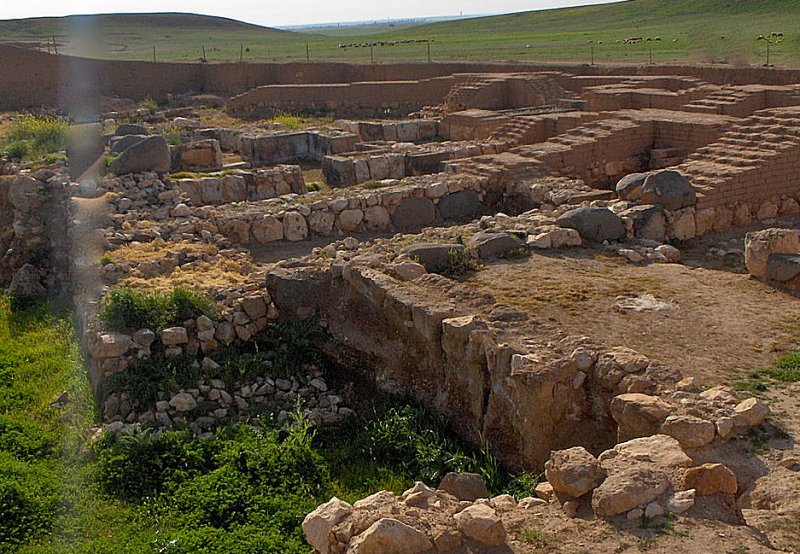
The vizier palace - in the ancient city of Ebla. Image credit: - CC BY-SA 4.0
Inspired by this historical notice, a team of archaeologists led by Dr. Paolo Matthiae, professor of Near East Archaeology at the University of Rome began to excavate Tell Mardikh and a neighboring mound ('tell', in Arabic and 'tel', in Hebrew), located about 33 miles (55 km) southwest of Aleppo, in northwestern Syria.
In 1969, it was the first time the ancient Ebla was recognized, and excavations that uncovered a remarkable royal archive revealed Ebla's importance.
First occupied in 4,000 BC, it had its period of power and wealth in the mid-3,000 BC. It maintained trade relations with Mesopotamia, Egypt, Sumer, and Iran, especially with the ancient city of Kish (the Bible calls Kush).
Ebla had about 250,000 inhabitants - skilled craftsmen in metals, textiles, ceramics, and woodwork - and was administered by a large bureaucracy, according to the ancient royal archive unearthed in 1975 and consisting of 15,000 clay tablets inscribed in cuneiform script and some written in a previously unknown language - now termed Eblaite.
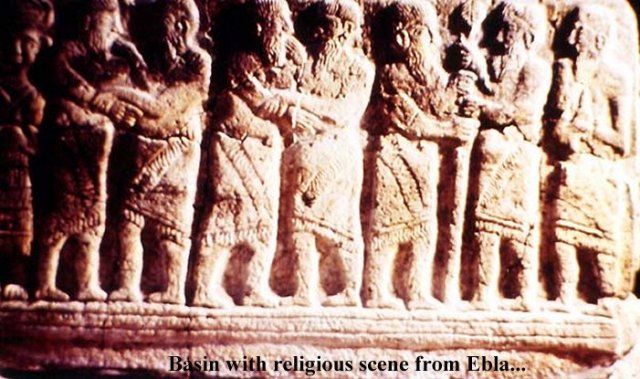
Basin scene on Ebla tablets.
The tablets were found carefully stacked on wooden shelves, which unfortunately had collapsed due to the palace's destruction.
Ebla, which was destroyed by fire and rebuilt several times, existed until about 1600 BC. The evidence indicates yet another destruction by fire, but the place was abandoned this time. Ebla has remained totally deserted except for a small group of monks who lived there temporarily during the Roman or Byzantine time.
Many deciphered tablets inform that the kingdom had trade relations with Megiddo, Byblos, Sidon, Akko, Gaza, Jerusalem, and the Biblical Hazor, the largest biblical-era site in Israel, known as "the head of all those kingdoms".
"Tablet 1860 names the five cities of Genesis 14:2 in the same order, i.e., Sodom, Gomorrah, Admah, Zeboiim and Zoar..." and predates the great catastrophe involving the Prophet Lot and the areas of Sodom and Gomorrah which were destroyed."
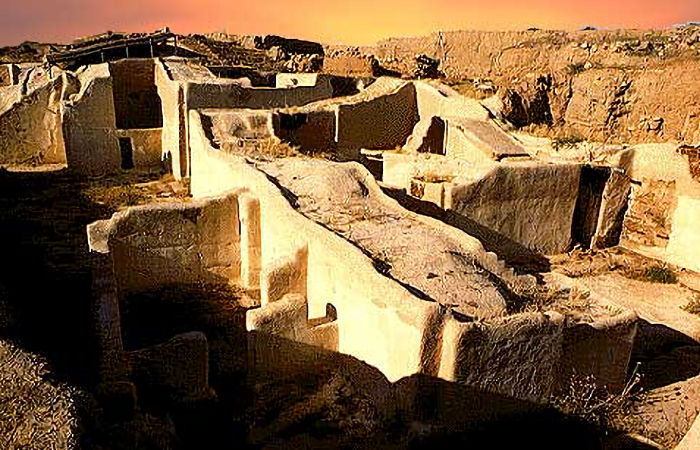
"...And Joshua at that time turned back, and took Hazor, and smote the king thereof with the sword: for Hazor beforetime was the head of all those kingdoms..." (Joshua 11:10). Ruins of the royal palace, in Ebla, Syria. Credit: Wikimedia Commons - CC BY-SA 3.0
On the tablets of Ebla are included:
'very early Canaanite creation and flood stories which very closely resemble that of the Bible..." (D. Rohl, "A Test of Time") and the names of prophets known from the holy scriptures like Ab-ra-mu (Abraham), E-sa-um (Esau), Ish-ma-ilu (Ishmael), even Is-ra-ilu (Israel), and those from later periods, like Da-'u'dum (David) and Sa-'u-lum (Saul). Other texts describe Ebrum, the third and greatest of the six kings of the Ebla dynasty between 2400 and 2250 BC.'
Ebrum was placed on the mighty throne of Ebla by Sargon the Great of Akkad or "Righteous Ruler", who was a close associate of the Sumerian goddess Inanna (Ishtar) known as the "Lady of the battlefield."
Updated on May 13, 2022
Written by A. Sutherland - AncientPages.com Staff Writer
Copyright © AncientPages.com All rights reserved. This material may not be published, broadcast, rewritten or redistributed in whole or part without the express written permission of AncientPages.com
More From Ancient Pages
-
 Sacred Artifact With Mystical Powers – The Discovery – Part 2
-
 Tantalus – Evildoer Who Violated Divine Laws And Was Responsible For The Greatest Offence One Could Commit
-
 Unknown Biological Entities And Disturbing Weather Phenomenon In Washington Still Baffle Scientists
-
 Strange Ancient Underwater Yellow Brick Road Discovered Of The Hawaiian Islands
-
 ‘Something’ Ancient And Strange Was Found Hidden Inside A Huge Underground Structure – What Happened Next Is A Mystery
-
 Unique Wooden Stave Churches Were Built Without Nails – Remarkable Technology Helped Them Survive
-
 Mysterious Unknown Beings Who Walked The Earth With Humans
-
 Frigg: Chief Norse Goddess Who Knew Secrets Of Humans’ Fates
-
 Where Is One Of Colorado’s Most Mysterious Long-Lost Artifacts? Have New Clues Emerged?
-
 Strange Prophecy Of Viking Ruler Oleg Of Novgorod’s Death And Mysterious Burial Place
-
 Amazing Adventure Of The Viking Who Escaped A Death Sentence Using His Artistic Talents
-
 Atacama Desert And Its Ancient Lakes Can Rewrite South American History – Is An Ancient Lost Civilization Buried Beneath The Sand?
-
 Surtshellir Cave Reveals How Vikings Attempted To Prevent Ragnarök – Doom Of The Gods
-
 Bulla Felix: Legendary Italian Leader Of Outlaws Who Robbed The Rich And Gave To The Poor
-
 Precious Lost Ancient Book Of Wisdom Could Solve Biblical Mysteries
-
 Spir Mountain Cairns: Prehistoric Ancient Monuments To The Dead In Northern Sweden
-
 Mummy Of Unidentified Official Discovered In 3,500-Year-Old Tomb In Luxor, Egypt
-
 Strange Ancient Mechanical Flying Animals – Mystery Of The Air Castle – Part 2
-
 5,000-Year-Old Perga City And Kommagene Civilization: Most Of Treasures Are Still Underground
-
 Traces Of An Ancient Near East Civilization In America – Lost Tribes And Unorthodox Discoveries – Part 1

