
Tomb Of Nicolaus Copernicus: Is The Mystery Surrounding Astronomer’s Burial Place Really Solved?
A. Sutherland - Ancient Pages.com - The Polish astronomer, Nicolaus Copernicus (1473 -1543) made crucial observations in Rome in 1500. Copernicus's heliocentric worldview was revolutionary and ended the old perceptions. His world view, however, was ignored by the Catholic Church.

For centuries, the tomb and leftovers of Nicolaus Copernicus were sought at the Frombork cathedral, the alleged burial place of the great astronomer.
It was also a place where the great Polish astronomer spent two-thirds of his adult life and was buried.
The first unsuccessful attempts to find the grave of Copernicus were undertaken in 1809 by the Warsaw Scientific Society. Later in 1807, Napoleon Bonaparte after the battle of Prussian Ilawa (now Bagrationowsk, about 75 km east of Frombork), ordered one of his officers, Gerard Gley, to find the grave of Nicolaus Copernicus. No positive results for this search were reported.
Also the next research (also fruitless) was carried out as part of the celebrations of the "Week of Kant and Copernicus", which was to take place at the University of Königsberg in February 1939.
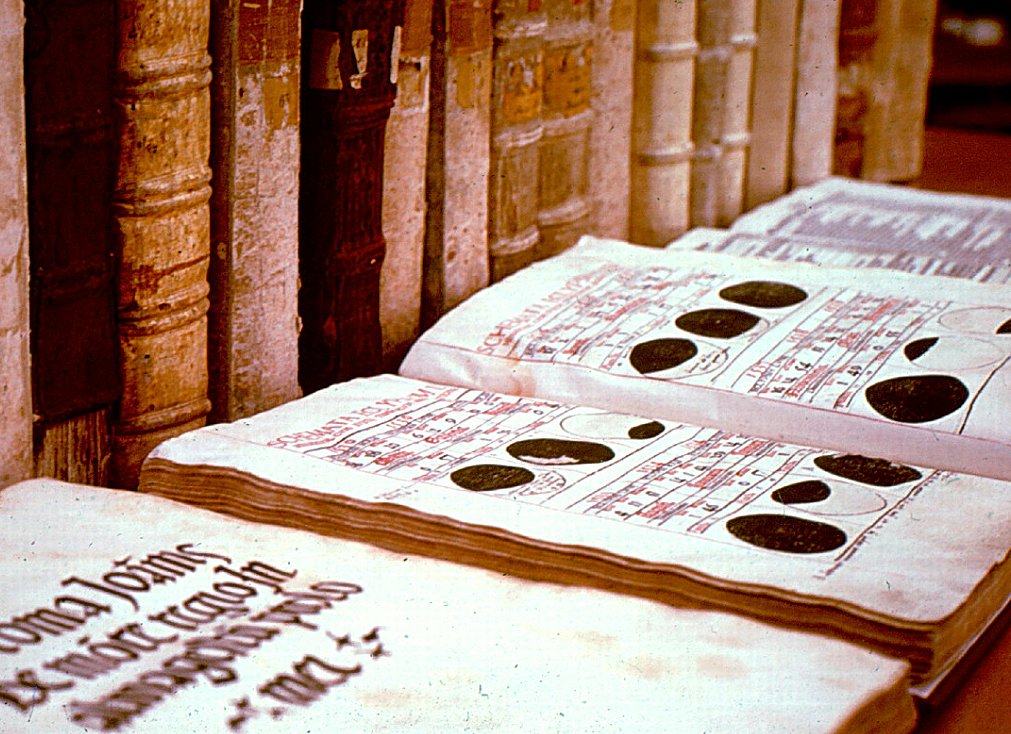
Copernicus' annotated copy of the Calendarium Romanum magnum takes a central place in this photograph of his books at the Uppsala University Library. In the foreground is a Regiomontanus title known to have been used by Copernicus but not located, so a substitute copy completes the picture. Photograph by Owen Gingerich
Under the high altar
Copernicus’ last resting place remained a mystery for a very long time.
In 2004, a group of Polish scientists launched a new search for Copernicus' grave. The exact location was uncertain, but it has been thought that the grave could be located near the St. Cross Altar because Copernicus was in charge of this altar during his tenure as priest at the Cathedral.
See also:
Copernicus’ s Book Banned By Catholic Church – On Mar 5, 1616
Emilia Plater: National Female Hero Of Polish And Lithuanian People
In 2005, the meticulous almost detective work finally yielded positive results and Polish archaeologists found what they were looking for. Copernicus remnants were discovered under the floor of the Frombork cathedral in northern Poland and it was a Swedish DNA analysis that finally made the whole picture complete.
At first, the remains of a 70-year-old man, who could possibly be identical to the great Copernicus, were kept anonymous. Later, researchers used computer graphics to build an artificial face. This face turned out to be very similar to Copernicus's portrait, including even a scar above the right eyebrow and evidence of a broken nose.
But it wasn’t enough to convince the researchers that the remains did really belong to Nicolaus Copernicus.

Casket with Copernicus' remains, St. James' Cathedral Basilica, Olsztyn, Poland
A DNA test was needed to gain greater certainty and surprisingly a suitable material was delivered by Swedish researchers in form of one of the books the Polish cosmologist had annotated.
This valuable book (now stored at the library of the University of Uppsala in Sweden) was the Calendarium Romanum magnum, in which 9 hairs were found, of which 4 were suitable for careful extracting of DNA.
Two of the hairs matched the DNA segments from a well-preserved cranial tooth.

Frombork Cathedral and the Monument of Nicolaus Copernicus in Frombork, Poland
There are still some doubts
The dispute of scientists seems to be serious, and also there are arguments undermining the identification of the findings in 2005. Many believe that the exact place of burial should still be considered an unresolved issue.
In order to discuss the controversies associated with the discovery of Copernicus' grave and identification of the remains, a scientific conference entitled "The Mystery of the Tomb of Nicolaus Copernicus, A Dialogue of Experts", was organized for all interested in the issue.
Unfortunately, most people involved in the search and research did not accept the invitation to participate in the conference.
Is the mystery surrounding Copernicus ‘ burial place really solved?
Copernicus was born in Polish Torun 1473 and eventually became the priest and the catholic canon at Frombork. He was also a scientist who shocked the world with his controversial thesis that the sun and not the earth was the focal point of the universe. He lived and died in Frombork.
Written by – A. Sutherland AncientPages.com Staff Writer
Copyright © AncientPages.com All rights reserved. This material may not be published, broadcast, rewritten or redistributed in whole or part without the express written permission of AncientPages.com
Expand for referencesMore From Ancient Pages
-
 Ancient Egyptian Women Had Equal Rights As Men – Egyptian Cosmology And Goddess Maat Reveal Why
-
 Scipio Africanus – Rome’s Greatest General Who Defeated Unbeatable Hannibal
-
 Mask Of Shame: Worn In Ancient Times As Punishment For Gossiping
-
 Bronze Age Metal Cauldrons Show What Ancient People Ate
-
 Cretaceous Fossil From Antarctica Reveals Earliest Modern Bird
-
 William Marshal Earl Of Pembroke: Master Of Tournaments And Best Example Of Medieval Chivalry And Knighthood
-
 Mysterious Watson Brake: Old Mound Complex In North America With Earthworks Raised For Unknown Purpose
-
 Last Of The Giant Camels And Archaic Humans Lived Together In Mongolia Until 27,000 Years Ago
-
 Giant Ancient Egyptian Fortress Discovered Along The Route Of Horus In The Sinai Desert
-
 Unique Glimpse Into The Secrets Of Mysterious Ancient Egyptian Manuscripts And Sacred Tablets Deliberately Hidden From The Outside World
-
 Dangerous Magnetic Anomaly And Unexplained Events In Mysterious And Dark Valley Trouble Scientists – Why Must The Stone Gate Not Be Crossed?
-
 Supernatural Beliefs Of Medieval People – From Elves And Fairies To Abductions And The Undead
-
 Ancient Dance And Games Offer Glimpses Of Life And Death In Italy 2,500 Years Ago
-
 Beautiful Legend Of Giant Olentzero Who Brings Christmas Presents To Basque Children
-
 Revealing Relatives In Ancient DNA With Unprecedented Precision
-
 Hidden Ancient Message About Humans’ Future Found Inside San Miniato Al Monte Basilica?
-
 On This Day In History: Sack Of Rome Took Place on May 6, 1527
-
 Tiglath Pileser III: Neo-Assyria’s Strong King Who Built A Mighty Empire
-
 Dancing Around The Throne: Networking In The Time Of King William I
-
 On This Day In History: Michael Servetus Burned At The Stake ‘Atop A Pyre Of His Own Books’ – On Oct 27, 1553

