
Shepherd’s Graffiti Sheds New Light On Acropolis Lost Temple Mystery – New Research
AncientPages.com - The Acropolis of Athens, the rocky hill in the Greek capital that is home to the iconic Parthenon temple, is one of the world’s most visited and well-known archaeological sites – but new insights about it are still emerging.
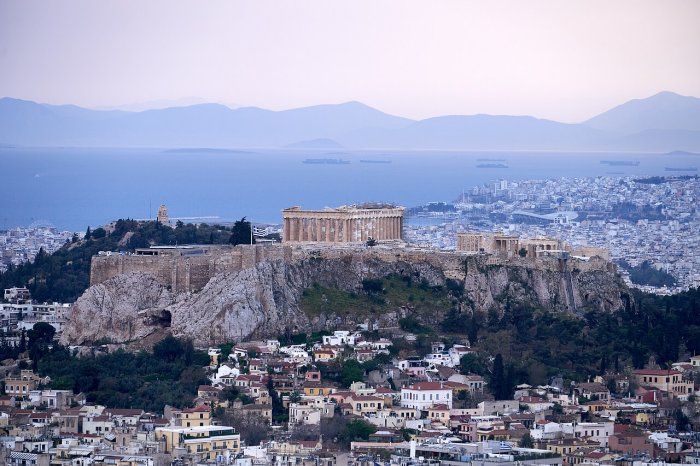
The Acropolis of Athens as seen from Mount Lycabettus The wooded Hill of the Nymphs is half-visible on its right, and Philopappos Hill on the left, immediately behind. The Philopappos Monument is seen here where, in the distant background, the coast of Peloponnese meets the waters of the Saronic Gulf. Image credit: George E. Koronaios - CC BY-SA 4.0
A new publication in the American Journal of Archaeology, by Merle Langdon (University of Tennessee) and me, tells a historical detective story of a lost temple on the site of the Parthenon. It all began with the discovery of ancient graffiti.
The shepherd’s graffiti
The tiny work was found on a marble rock outcrop at Vari, 20km southeast of Athens. It is part of a larger group of more than 2,000 graffiti made by shepherds and goatherds, discovered and studied by Merle Langdon in recent years. They feature text as well as drawings that include ships, horses, and erotic scenes. They all date to the sixth century BCE.
The newly discovered work is a rough rock-cut drawing of a building. Though the details of the drawing are not fully understood, it can be identified as a temple due to the columns and steps.
Snaking around the building there is a Greek inscription reading To Hekatompedon … Mikonos (The 100-foot building … of Mikon). Mikon is not otherwise known, but he was most likely a shepherd who made the graffito while grazing his flocks. The version of the Greek alphabet used is very ancient, making it clear that the drawing was made as early as the 6th century BCE.
Of great archaeological significance is the inscription’s word Hekatompedon, a Greek name meaning “100-footer”, referring to a structure of enormous size. The term is known to be the official ancient name of the famous temple dedicated to the Greek goddess Athena – later known as the Parthenon.

The ancient graffiti points to the lost temple on the Acropolis. Image credit: Janric van Rookhuijzen (American Journal of Archaeology)
It is likely that Mikon wanted to depict a building on the Acropolis of Athens. However, because the alphabet he used can be firmly dated to the 6th century BCE, the drawing must be at least 50 years older than the Parthenon, which was begun around 450 BCE.
A lost Greek temple
The Parthenon may be a very ancient temple, but it was not the first. It has long been thought that even older temples formerly stood on the Acropolis – though archaeologists have fiercely debated their dates, appearance, and exact locations on the hill. There is also a historical calamity that impedes our understanding: in 480 BCE, during the Greek-Persian wars, a Persian army arrived in Athens and destroyed all the buildings that then stood on the Acropolis.
In fact, the Acropolis Museum in Athens is home to large broken sculptures portraying scenes of Greek myth, as well as bulls being devoured by lions. They were once part of temple decorations but were badly damaged, perhaps in the Persian attack of 480 BCE, if not before. Could one of the lost temples be the Hekatompedon drawn by Mikon?
A temple for storing treasure
A crucial part of the puzzle is an Ancient Greek democratic decree dating from the time before the Persian attack and the building of the Parthenon. This decree also mentions a Hekatompedon on the Acropolis, which was used for the somewhat ambiguous purpose of “treasure storage”. The decree has been known for a long time, but archaeologists had debated what the Hekatompedon mentioned in it could have been.
Some think the Hekatompedon mentioned in the decree was a temple, as Greek temples normally served as the storage of treasures offered to the gods. But many others argue that the word Hekatompedon cannot refer to a temple at all, and must have been an open courtyard on the Acropolis.
The newly published graffito of Mikon’s drawing is significant. If Mikon called his drawn temple a Hekatompedon, then it is likely that the term Hekatompedon in the decree referred to a temple too. Indeed, the Parthenon that stands on the hill today was once called the Hekatompedon.
Even though the Hekatompedon drawn by Mikon has disappeared, it is likely that some of the temple sculptures in the museum belong to it, as it once stood on the site where the Parthenon stands today.
Graffiti shows shepherds’ literacy
The inscription is also significant because it shows that, contrary to what is normally thought, shepherds could read and write, even at this early date when literacy in the Greek world was still spreading. Why the shepherds produced so many graffiti is not known – it may have simply been a form of escapism during the dull moments of their job.
However, the graffito made by Mikon shows how a small scribble may be the key to tackling the historical riddles behind one the world’s most iconic archaeological sites.
Provided by The Conversation
This article is republished from The Conversation under a Creative Commons license. Read the original article.
More From Ancient Pages
-
 Iron Wood’s Secret: Mysterious Norse Witch-Goddess Who Provoked The Gods – Did She Hide In Járnviðr?
-
 Excavations In Keezhadi, Tamil Nadu, India Shed Light On Life During Sangam Age
-
 Rare Animal-Shaped Mounds Discovered In Peru
-
 Bouboulina: Heroine, Wealthy Widow And Shipowner Who Commanded A Greek Fleet Against The Ottoman Empire
-
 Mystery Of The Sphinx – A Guardian Of Knowledge And Symbol Of Riddles And Intrigue
-
 Brokkr And Eitri – Norse Dwarves Who Fashioned Magical Artifacts For The Gods
-
 Dangerous Underground Secret In The Valley No-One Dares To Enter
-
 Chilling Tale Of The Tailor And Odin’s Wild Hunt – Why The Norse God Warns Against Going Out On Christmas Eve
-
 Bulla Felix: Legendary Italian Leader Of Outlaws Who Robbed The Rich And Gave To The Poor
-
 Secrets Of The Long-Lost Kingdom Of Strathclyde Explored By Archaeologists
-
 Tower Of Babel Story As Told By The Choctaw Indians And The Cherokee
-
 Sam Bass – Texas’s Beloved Bandit Who Was Admired By The Poor
-
 Ice Age Engraved Stones, Tools Unearthed At Jersey Hunter-Gatherer Site Dated To Magdalenian Culture
-
 Tomb Of Maia, Tutankhamun’s Wet Nurse In Egypt’s Saqqara Opens To Public
-
 Scottish Settler’s Ominous Encounter With A Mysterious Being In West Virginia
-
 Unexplained Ancient Wars In America – Knowledge Of Ancient High-Tech Weapons? – Part 1
-
 Nurarihyon: Powerful Demon Of Obscure Origin, Chief Of All Yokai
-
 Chaco Canyon’s Piedra del Sol Petroglyph Depicts An Ancient Total Eclipse Visible In The Year 1097
-
 DNA Says You’re Related To A Viking, A Medieval German Jew Or A 1700s Enslaved African? What A Genetic Match Really Means
-
 Unexpected Hero Saved The Gods And Humanity From An Evil Force – Rare Mesopotamian Myth Revealed On Ancient Sumerian Tablet

