AncientPages.com - In 2022, we reported the DNA sequences of 33 medieval people buried in a Jewish cemetery in Germany. Not long after we made the data publicly available, people started comparing their own DNA with that of the 14th-century German Jews, finding many “matches.” These medieval individuals had DNA fragments shared with thousands of people who have uploaded their DNA sequence to an online database, the same way you share DNA fragments with your relatives.

But what type of a relationship with a medieval person does a shared DNA fragment imply?
It turns out, not too much that will help with your family roots research.
We are population geneticists who work with ancient DNA. We understand how exciting it can be to find a genetic link to particular people who lived many generations ago. But these DNA matches aren’t the tight ties you may be imagining. Here’s how it works.
Sequencing DNA from those who lived long ago
Ancient DNA is a new and rapidly growing field, with a Nobel Prize awarded in 2022 to Svante Pääbo for his foundational work.
Using samples taken from skull bones or teeth, aDNA researchers can sequence the DNA of people who lived as far back as 100,000 years ago. More than 10,000 ancient DNA sequences, or genomes, are currently available. These genomes, which come from all corners of the world, have dramatically revolutionized scientists’ understanding of human origins.
A new trend in ancient DNA is sequencing the genomes of “historical” individuals: those who have lived during the past millennium.
Examples include genomes from Sweden, Norway, Denmark, Iceland, Poland, Southeastern Europe, and London, Cambridge and Norwich in the U.K. Outside Europe, scientists have sequenced historical genomes from East Asia, the Swahili coast, South Africa, the Canary Islands, Lebanon, Machu Picchu, the Caribbean and the San Francisco Bay area. Genomes of enslaved Africans from Delaware, Maryland, South Carolina and St. Helena are also available.
Some historical genomes belong to named individuals, including Ludwig van Beethoven, the family of the last Russian czar, medieval Hungarian royals, the Lakota Sioux leader Sitting Bull and King Richard III of England.
How could you compare your own DNA with that of these historical people?
Several direct-to-consumer genetic testing companies, such as 23andMe, MyHeritage or Ancestry, make reading your own genome sequence simple and affordable. They compare your DNA with that of their other customers. They identify relatives who share with you long, continuous stretches of identical DNA and report to you these matches – from the closest to the more distant.
After initial deliberation, 23andMe now lets customers compare their genomes with historical people. Other genetic testing companies don’t yet, but passionate genealogists can take matters into their own hands. For example, the service GEDmatch lets users upload their own DNA data, along with published DNA sequences of any historical people. Once uploaded, GEDmatch will identify any user with whom you share genetic material.

So, what does a genetic match with a medieval person mean for your genealogy?
Surprisingly, very little.
Where genealogy and genetics diverge
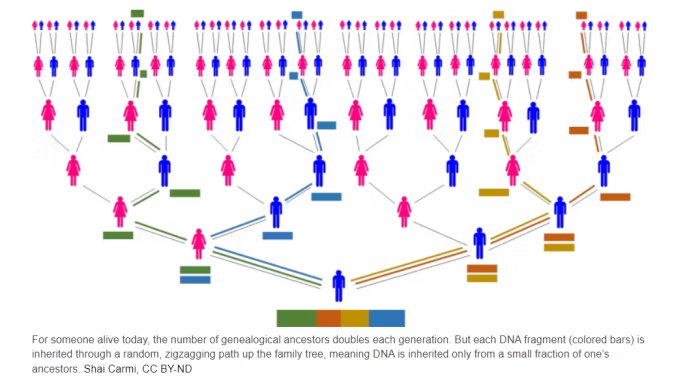
The first thing to understand is how many ancestors you have in each past generation. One generation back, you have two ancestors. Two generations back, that doubles to four. Then eight, and 16. By 30 generations ago, around the 12th century, you have over one billion ancestors.
Clearly, at this point, your ancestors include most people from your population who lived back then, excluding a small fraction who left no long-term descendants. This includes, if you have European origins, notable people such as Charlemagne or Edward I, but equally also people of every medieval social class. Your family tree reaches each of these ancestors through numerous lines.
Mathematical research demonstrates the following surprising fact. In any given population, the number of lines in your family tree that reach any specific medieval person is about the same between you and everyone else who belongs to the same population you do. In other words, everyone alive today is equally related, genealogically, to all medieval people from that population.
The next step is to understand how many ancestors you actually inherit DNA from. Surprisingly again, very few.
Despite your millions or more medieval ancestors, you inherit DNA from only a tiny fraction of them. So, we’re sorry, you probably didn’t inherit any DNA from Charlemagne or Edward I. For example, you have only about 2,000 genetic ancestors from the 12th century. In other words, your DNA sequence is a mosaic of approximately 2,000 “fragments,” each tracing back to a single 12th-century person.
Who are the medieval people whose DNA you inherited? Each fragment of your DNA descends from a random line up your family tree – father’s mother’s mother’s father and so on – at each generation in the past, selecting at random one of two parents. The more lines in your family tree that reach a certain medieval person, the more likely you are to inherit DNA from that person.
But remember, the number of family lines that reach a medieval person is about the same for all present-day individuals from a given population. Therefore, all individuals inherit DNA from any medieval person with very similar probabilities. So, sharing genetic material with one particular medieval person or another is just a matter of chance, and everyone is playing the same game.
Here’s an analogy. Going to a casino and rolling a roulette ball onto 24 does not mean 24 is your special number. Anyone else might have rolled 24 as well. Similarly, sharing a DNA fragment with any one out of your millions of medieval genealogical ancestors does not mean any special relationship – beyond sharing a DNA fragment.
And if you don’t have a shared segment, you just didn’t get lucky. It doesn’t mean you’re any less genealogically related to that medieval person than anyone else from your population who does have a shared segment.
As a side note, a “population” is not always well defined, but these arguments hold generally for people with similar origins.
How to interpret a historical DNA match
Consider again the medieval German Jews. Some present-day Ashkenazi (European) Jews will share DNA with one particular medieval Jew. Some will share with another. Some will share with none. It’s a lottery draw. And given that most Ashkenazi Jews today are genealogically related in a very similar way to the medieval German Jews, seeing that shared DNA fragment does not imply any unique genealogical relatedness.
On the other hand, if you’re willing to consider more recent ancestors, DNA matches can be informative. The same mathematical models show that the number of family lines reaching a particular historical person living around 200 or 300 years ago will be very different across present-day people. Therefore, a DNA match with an 18th-century person implies a more specific genealogical relationship, one that most other present-day indviduals do not have.
This pattern was demonstrated in a recent 23andMe study. Comparing the genomes of 18th-century enslaved Africans from Maryland to more than 9 million of their customers, 23andMe discovered over 41,000 living relatives, including a few nearly direct descendants.
How far back in time does a DNA match still have genealogical meaning? For example, are DNA matches informative in the period between the late Middle Ages and the 17th century? We don’t know yet. Future research will be needed to clarify this question, as well as deviations from the simple model of a single, freely mixing population.
In the meantime, as scientists rapidly accumulate more and more historical genome sequences, keep the quirky behavior of human genealogies in mind when interpreting a DNA match.
Provided by The Conversation
This article is republished from The Conversation under a Creative Commons license. Read the original article.