
Vast Fortification Enclosing Walled Oasis Dating Back 4,000 years In North-Western Arabia – Unearthed
Conny Waters - AncientPages.com - A vast fortification, which is one of the longest known going back 4,000 years was just discovered by a team of scientists from the CNRS1 and the Royal Commission for AlUla (RCU).
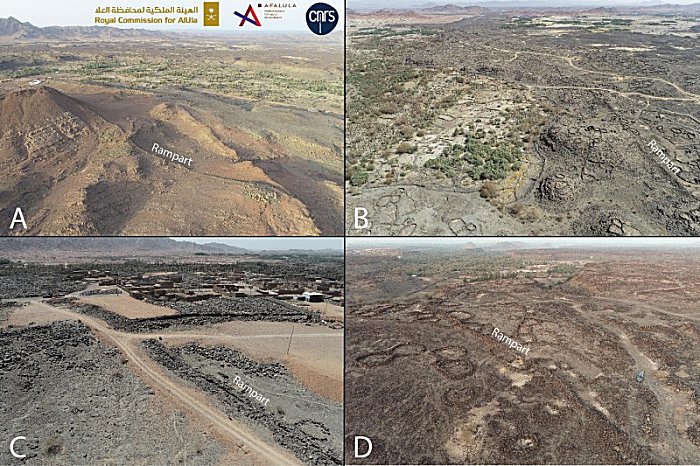
Location map of the Khaybar walled oasis (red and white circle) and other major sites in north-western Arabia, © G. Charloux, ESRI.
This new walled oasis is, along with that of Tayma, one of the two largest in Saudi Arabia. While a number of walled oases dating back to the Bronze Age had already been documented, this major discovery sheds new light on human occupation in north-western Arabia, and provides a better grasp of local social complexity during the pre-Islamic period.
The fortification is enclosing the ancient Khaybar Oasis, home to a wealth of plant and animal life.
The North Arabian Desert oases were inhabited by sedentary populations in the 4th and 3rd millennia BCE.

Digital reconstruction of the rampart network from the northern section of the Khaybar walled oasis 4,000 years ago. Credit: Khaybar Longue Durée Archaeological Project, M. Bussy & G. Charloux
Cross-referencing field surveys and remote sensing data with architectural studies, the team estimated the original dimensions of the fortifications at 14.5 kilometres in length, between 1.70 and 2.40 metres in thickness, and approximately 5 metres in height.
Preserved today over a little less than half of its original length (41%, 5.9 km and 74 bastions), this colossal edifice enclosed a rural and sedentary territory of nearly 1,100 hectares.
The fortification’s date of construction is estimated between 2250 and 1950 BCE, on the basis of radiocarbon dating of samples collected during excavations.
While the study confirms that the Khaybar Oasis clearly belonged to a network of walled oases in north-western Arabia, the discovery of this rampart also raises questions regarding why it was built as well as the nature of the populations that built it, in particular their relations with populations outside the oasis.
This archaeological discovery, whose results will be published on 10 January in the Journal of Archaeological Science: Reports (JASREP), paves the way for major advances in understanding the prehistoric, pre-Islamic, and Islamic past of the north-western Arabian Peninsula.
Paper: Journal of Archaeological Science : Reports, January 10, 2024.
DOI : https://doi.org/10.1016/j.jasrep.2023.104355
Provided by CNRS
Written by Conny Waters - AncientPages.com Staff Writer
More From Ancient Pages
-
 New Clues About The Fascinating Ancient Roman City Falerii Novi Revealed By Scientists
-
 How Did The Early Rapa Nui People Put Huge Hats On Giant Statues Of Easter Island?
-
 1,300-Year-Old Avar Warrior Tomb With Rare Well-Preserved Treasures Discovered In Hungary
-
 Archaeologists Excavate Two Roman Bath Hidden In A Dark Passage Below The Streets Of Bath
-
 Stone Slab c. 9,000-Year-Old Used In Making Fire Discovered Not Far From Jerusalem, Israel
-
 Last Homo Erectus Lived 117,000 Years Ago At Ngandong
-
 Evolution Mystery – Mini-Proteins In Human Organs Appeared ‘From Nowhere’
-
 Mystery Of The Giant Gjellestad Viking Ship Burial Deepens – Unknown Structures, Pre-Existing Mound And Rituals – Investigated
-
 9,500-Year-Old Baskets And 6,200-Year-Old Sandals Found In Spanish Cave
-
 Ptolemaic-Era Tomb With Mummies, Paintings Found In Upper Egypt
-
 Medieval Music Wasn’t Only Supposed To Be Beautiful To Listen To – A New Study Suggests
-
 Wooden Coffin With Greco-Roman Mummy Wearing Mask Depicting Sky God Discovered In Egypt
-
 1,500-Year-Old Roman Settlement Destroyed By The Goths Discovered In Bulgaria
-
 142,000-Year-Old Shell Beads Found In A Cave Are The Oldest Known Evidence Of Human Communication
-
 First 5th Century Mosaic Found Near Cirencester Once The Second-Largest Roman-British Town In England
-
 2,400-Year-Old Metalworking Workshop Discovered In Africa
-
 Mysterious Denisovans – New Study Offers New Evidence
-
 Lost City That May Have Defeated King Midas’ Kingdom Phrygia – Found Accidentally
-
 Societies In Iberian Peninsula Deployed “Escape Economics” 4,000-Year-Old
-
 The Helgö Treasure: Bronze Buddha Statue, Coptic Scoop And A Crozier Depicting Biblical Tale Of Jonah

