
5 Most Common Misunderstandings About Evolution
AncientPages.com - Given its huge success in describing the natural world for the past 150 years, the theory of evolution is remarkably misunderstood. In an episode of the Australian series of “I’m a Celebrity Get Me Out of Here,” former cricket star Shane Warne questioned the theory – asking “if humans evolved from monkeys, why haven’t today’s monkeys evolved”?

Similarly, a head teacher from a primary school in the UK stated that evolution is a theory rather than a fact. This is despite the fact that children in the UK start learning about evolution in Year 6 (ten to 11-year-olds), and have further lessons throughout high school. While the theory of evolution is well accepted in the UK compared with the rest of the world, a survey in 2005 indicated that more than 20% of the country’s population was not sure about it, or did not accept it.
In contrast, there are not many people questioning the theory of relativity, or studies on the acceptance of the theory of relativity; possibly reflecting an acceptance that this is a matter for physicists to settle. Many studies have tried to determine why evolution is questioned so often by the general public, despite complete acceptance by scientists. Although no clear answer has been found, I suspect the common misconceptions described below have something to do with it.
1. It’s just a theory
Yes, scientists call it the “theory of evolution”, but this is in recognition of its well accepted scientific standing. The term “theory” is being used in the same way that gravitational theory explains why, when an apple falls from your hand, it goes towards the ground. There is no uncertainty that the apple will fall to the ground, in the same way that there is no uncertainty that bugs resistant to antibiotics will continue to evolve if we do not curb our general use of antibiotics.
Although people use “theory” in everyday conversation to mean a not necessarily proven hypothesis, this is not the case in scientific terms. A scientific theory typically means a well substantiated explanation of some aspect of the natural world that sits above laws, inferences, and tested hypotheses.
2. Humans are descended from monkeys
No, your great-great-great-ancestor was not a monkey. Evolution theory indicates that we have common ancestors with monkeys and apes – among the existing species, they are our closest relatives. Humans and chimpanzees share more than 90% of their genetic sequence. But this common ancestor, which roamed the earth approximately 7m years ago was neither a monkey nor a human, but an ape-like creature that recent research suggests had traits that favoured the use of tools.
3. Natural selection is purposeful
There are many organisms that are not perfectly adapted to their environment. For example, sharks don’t have a gas bladder to control their buoyancy (which bony fish typically use). Does this refute the theory of evolution? No, not at all. Natural selection can only randomly favour the best of what is available, it does not purposefully turn all living organisms into one super creature.
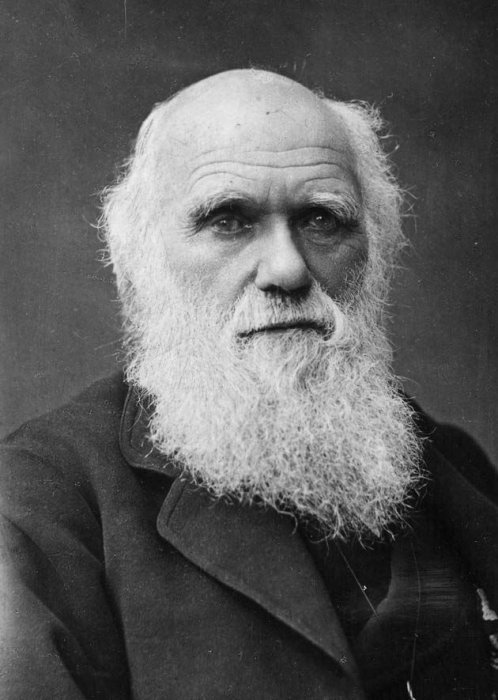
Portrait of Charles Darwin by Herbert Rose Barraud (1845 - 1896) taken in 1881, thought to be the last photograph of Darwin before his death. Credit: Public Domain
It would be really convenient if humans could photosynthesise; hunger could be immediately cured by standing in the sun (and the much-sought miracle diet would have been found: stay inside). But alas, the genetic ability to photosynthesise has not appeared in animals. Still, selection of the best option possible has led to an amazing diversity of forms remarkably well adapted to their environments, even if not perfect.
4. Evolution can’t explain complex organs
A common argument in favour of creationism is the evolution of the eye. A half developed eye would serve no function, so how can natural selection slowly create a functional eye in a step-wise manner? Darwin himself suggested that the eye could have had its origins in organs with different functions.
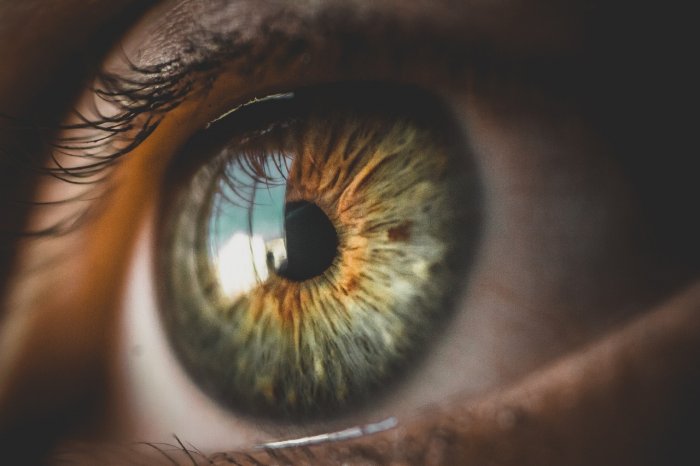
The eye seems to have evolved from primitive, light-sensing organs. Credit: Pixabay - bniique Public Domain
Organs that allow detection of light could then have been favoured by natural selection, even if it did not provide full vision. These ideas have been proven correct many years later by researchers studying primitive light-sensing organs in animals. In molluscs like snails and segmented worms, light-sense cells spread across the body surface can tell the difference between light and dark.
5. Religion is incompatible with evolution
It is important to make it clear that evolution is not a theory about the origin of life. It is a theory to explain how species change over time. Contrary to what many people think, there is also little conflict between evolution and most common religions. Pope Francis recently reiterated that a belief in evolution isn’t incompatible with the Catholic faith. Going further, the reverend Malcom Brown from the Church of England stated that “natural selection, as a way of understanding physical evolutionary processes over thousands of years, makes sense.” He added: “Good religion needs to work constructively with good science” and vice-versa. I fully agree.
Written by Reader in Biology and Biochemistry, University of Bath
Provided by The Conversation
This article is republished from The Conversation under a Creative Commons license. Read the original article.
More From Ancient Pages
-
 Never-Ending Haunting Of A Dangerous Viking Draugr Who Terrorized A Whole Community – Scary Story From A Norse Saga
-
 Golden Stool Of Ashanti People And Legend Of The Black Cloud Appearing In The Sky
-
 Ancient Secrets Of Sacred Towers And Stone Circles In Colorado Where Spirits Of Native Americans Still Live
-
 Meidum ‘Collapsed’ Pyramid Of Great Builder Pharaoh Snefru
-
 Ancient Runestones Reveal A Surprising Viking Secret – Scientists Say
-
 Prehistoric Heavy Machinery Of The Ancient Times Or A Piece Of Jewelry?
-
 The Great Pyramid And Ancient Egyptian Knowledge Shed Light On Biblical Mysteries – Surprising Information – Part 2
-
 Impressive Column Of Emperor Marcus Aurelius – War Monument From Ancient Rome
-
 Thor: Brave And Mighty Thunder God In Norse Mythology
-
 Horrible Ancient Massacre On The Island Of Chios Led To Greek Independence
-
 Andlang – Spiritual Heaven And Shelter For The Dead After Ragnarok In Norse Mythology
-
 When Science, Spirituality and Magic Meet – Re-Discovering Old Ancient Knowledge
-
 Sacred Regalia Of Japanese Emperor: Sword, Mirror And Jewel In Ancient Japanese Tradition
-
 John Hawkwood ‘John Sharp’: Feared, English Mercenary And His White Company In 14th Century Italy
-
 Evidence Of A Lost Advanced Ancient Civilization In Cincinnati – Remarkable Artifacts And Ancient Bodies That Shouldn’t Exist
-
 Mystery Of The Lost Continent Destroyed By An Ancient Cataclysm – Mysterious Islands – Part 2
-
 How Can AI Affect Human Evolution? Predicting Changes In Brain Size And Social Behaviors
-
 They Spoke The Language Of The Gods – Secret Symbols, Unknown Books And Manuscripts – Part 2
-
 Who Is Secretly Keeping A Watching Eye On Tibetan Monasteries?
-
 Perchta: Evil Witch Of The Alps – An Old Tradition That Still Continues

