
Bacho Kiro Cave: Early Homo Sapiens Groups In Europe Faced Subarctic Climates
Conny Waters - AncientPages.com - Using oxygen stable isotope analysis of tooth enamel from animals butchered by humans at the site of Bacho Kiro Cave, Bulgaria, Max Planck researchers show that human groups belonging to an early wave of dispersal of our species into Europe were faced with very cold climatic conditions while they occupied the cave between about 46,000 and 43,000 years ago.
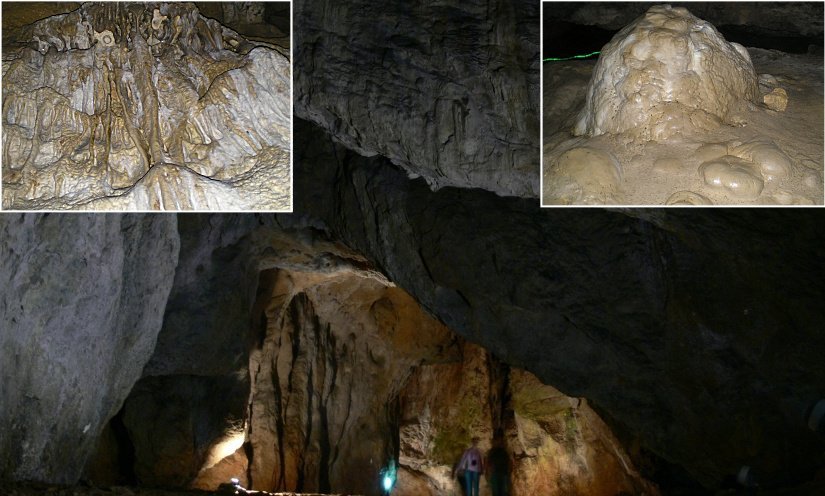
Bacho Kiro cave - interior, Bulgaria. source
Archaeological remains at Bacho Kiro Cave currently represent the oldest known remnants of Upper Paleolithic Homo sapiens in Europe, and thus open a unique window into the time when our species started to move out of the Levant and establish itself across the mid-latitudes of Eurasia as part of an archaeological phenomenon called the Initial Upper Paleolithic.
The process how our species dispersed into new environments at that time represents an important evolutionary turning point that ultimately led to Homo sapiens populating all continents and a large diversity of climate zones and environments. The mechanisms that facilitated initial waves of the expansion remain debated, but a majority of models based on the correlation of archaeological sites with spatially distant climatic archives has so far indicated that human groups relied on warmer climatic conditions to spread into new, more northern, environments.
See also:
Bacho Kiro Cave: Genomes Of The Earliest Europeans – Sequenced
Using evidence directly from the archaeological layers of Bacho Kiro Cave the Max Planck team was now able to show that humans have been enduring very cold climatic conditions, similar to the ones typical for present-day northern Scandinavia, for several thousand years.
"Our evidence shows that these human groups were more flexible with regard to the environments they used and more adaptable to different climatic conditions than previously thought," says lead author Sarah Pederzani, a researcher at the Max Planck Institute for Evolutionary Anthropology and the University of Aberdeen.
Jean-Jacques Hublin, director of the Department of Human Evolution at the Max Planck Institute, adds: "Using these new insights, new models of the spread of our species across Eurasia will now need to be constructed, taking into account their higher degree of climatic flexibility."
Archaeological materials from Bacho Kiro Cave in Bulgaria
By directly using archaeological materials, such as the remains of herbivores butchered by humans, to generate climatic data the palaeoclimate research team—led by Pederzani and Kate Britton, also a researcher at Max Planck Institute for Evolutionary Anthropology and the University of Aberdeen—was able to establish a very robust record of local climatic conditions that specifically relates to the times when humans were inhabiting Bacho Kiro Cave.
"This technique enables a more confident assignment of local climatic context compared to the more commonly used chronological correlation between archaeological data and climatic archives from different localities that formed the basis of much of the existing research on human climatic adaptability—it really gives us insight into what life was like 'on the ground'", says Britton.

Current excavations at Bacho Kiro Cave of the 2021 season are unearthing new artifacts from the Middle Palaeolithic Neanderthal occupations. The Initial Upper Palaeolithic Layer I can be seen as a dark band in the sediment profile. Excavators are wearing masks and gloves to minimize contamination of samples that are regularly taken for molecular analyses. Credit: MPI-EVA/ Tsenka Tsanova
"However, due to the time-consuming nature of the analysis and the reliance on the availability of particular animal remains, oxygen isotope studies or other ways of generating climatic data directly from archaeological sites remain scarce for the time period when Homo sapiens first spread across Eurasia," adds Pederzani. Indeed, this Max Planck study is the first study conducted in the context of the Initial Upper Paleolithic and could therefore yield such surprising results.
Highly resolved record of past temperatures spanning more than 7,000 years
Pederzani spent one year conducting lab work from drilling series of small samples from the animal teeth through wet chemistry preparation and stable isotope ratio mass spectrometry to obtain all the necessary data.
"Through this time intensive analysis that included a total of 179 samples, it was possible to obtain a very highly resolved record of past temperatures, including summer, winter and mean annual temperature estimates for human occupations spanning more than 7,000 years," says Pederzani.
See also: More Archaeology News
Renewed excavations at Bacho Kiro Cave yielded a rich archaeological record of human activity at the cave including the remnants of occupations that represent the earliest known occurrence of Upper Paleolithic Homo sapiens in Europe. Deposits in the lower portion of the site contained a large number of animal bones, stone tools, pendants, and even human fossils and formed the basis of the climatic study to investigate the environmental conditions that humans experienced when they first spread into Southeast Europe from the Levant.
Source - Phys.org
Written by Conny Waters - AncientPages.com Staff Writer
More From Ancient Pages
-
 Silver Jewelry Buried In Leather Purse Discovered In Bulgaria
-
 Ancient DNA Of Segorbe Giant Reveals A Brutal Event In Medieval Spain
-
 Baba Yaga Lego Created By Russian Artist Brings Classic Slavic Mythological Figures To Life
-
 Exceptional Precision And Technical Mastery Of Iberian Archery From 7,000 Years Ago
-
 Maize-Based Diet Of Ancient Maya, Vulnerability To Drought And Collapse Of Society
-
 Lifestyle And Face Of 7th-Century Anglo-Saxon Teen – Reconstructed
-
 What Happened To Britain’s Economy After The Romans Left?
-
 On This Day In History: Massacre In Great Temple Of The Aztec Capital Tenochtitlan – On May 20, 1520
-
 Treasure Of 1,753 Roman Silver Coins Accidentally Discovered In Poland
-
 AI Tool ‘Aeneas’ Helps Historians Restore Damaged Latin Texts By Accelerating Complex And Time-Consuming Work
-
 Vikings’ Self-Image Was Influenced By Ancient Rome – Intriguing Grave And Artifacts Reveal
-
 Long-Lost Roman Bridge Re-Discovered In Chepstow River Wye Mud, UK
-
 Huge Folklore Map With Supernatural Beings And Mythical Monsters Created – Available For Free Online
-
 New Evidence Of The Destruction Of The Second Temple In The City Of David
-
 Archaeologists Focus On Greek Poet Aratus’ Memorial Tomb And Ruins Of Soli Pompeiopolis
-
 Mysterious Unknown Caves And Tunnels Discovered Beneath The Olsztyn Castle
-
 How Human Ancestors Used Fire – New Methods Give Answers
-
 Unique Ancient Half-Mummy Unearthed In Luxor, Egypt Mystifies Archaeologists
-
 Ancient People In Peru Had A Unique Response To The Looting And Destruction Of Their Ancestors’ Graves
-
 Stone Age Friendship Ornaments Examined By Scientists

