
Carthage: Prosperous Phoenician Colony That Became Dominant Power In The Western Mediterranean
A. Sutherland - AncientPages.com - The ruins of Carthage (its Phoenician name means 'Kart-hadasht '("new town")) are located approximately 18 km northeast of Tunis on the coast of North Africa and are surrounded by modern residences and beautiful gardens.

Modern reconstruction of Punic Carthage. The circular harbor at the front is the Cothon, the military port of Carthage, where all of Carthage's warships (Biremes) were anchored. Image credit: - CC BY-SA 2.0
An ancient legend strongly associates this place; it tells the story of the great city of Carthage, founded here nearly 3000 years ago.
This beautiful legend attributes the founding of Carthage to Elissa (Dido), a Phoenician princess from Tyre, sister of the King of Tyre - Pygmalion. Astonishingly, much of this story is historically accurate.
When Pygmalion killed Dido's husband, she and her children fled to North Africa.
Dido asked the Berber king Iarbas for a small bit of land for temporary refuge until she could continue her journey. Iarbas agreed to give her only as much land as could be encompassed by an oxhide. A clever woman had cut the skin into thin strips so that she had enough to encircle an entire nearby hill, which was afterward named Byrsa ('hide').

Carthage ruins. Image: Wikimedia commons
She founded Carthage on this piece of land. Many of the local Berbers joined the settlement, and both Berbers and envoys from the nearby Phoenician city of Utica urged the building of a city.
According to historical records, Carthage was not the Phoenicians' first colony, but in its early days, it became the largest and most famous city. It was an important political and commercial center, but researchers questioned the date of the foundation of Carthage.
Archaeological data indicate that the last quarter of the 8th century BC has yet to be discovered, an entire century later than the traditional foundation date.
The location of Carthage was very convenient and safe; it offered access to the Mediterranean but was shielded from violent storms. The city was well-protected and easily defensible. The ancient citadel, the Byrsa, was on a low hill overlooking the sea.
Some of the earliest tombs have been found there; the Byrsa area was once adorned with a large temple dedicated to Juno, Jupiter, and Minerva, and near it stood a temple to Asclepius. Also on the Byrsa site stood an open-air entrance, from which the finest Roman sculptures at Carthage have survived.

Baths of Antoninus, Carthage. Image: Wikimedia Commons
Surrounding Carthage were walls "of great strength," said in places to rise above forty feet (13 m) and be almost thirty feet (10 m) thick. To the west, three parallel walls were built. The walls encircled the city for about thirty-three kilometers.
The heights of the Byrsa were additionally fortified, this area being the last to succumb to the Romans in 146 BC.
No remains of Carthage's domestic and public buildings were unearthed. The city experienced its peak power in the third century BC. At the same age, however, Carthage was engaged in a series of wars with Rome, which ended with the city's destruction in 146 BC during the Third Punic War.
The First Punic War (264 - 241 BC) was a complete disaster for Carthage, causing it to lose the island of Sicily.
In the second Punic War (218 - 202 BC), Hannibal famously led his army and elephants over the Alps to attack the Romans on their soil. For many years, he led his victorious army up and down what is known today as Italy. On every battlefield, Hannibal defeated the Roman legions. Finally, he was lured for alleged peace negotiations to North Africa, and the Romans were able to beat him.
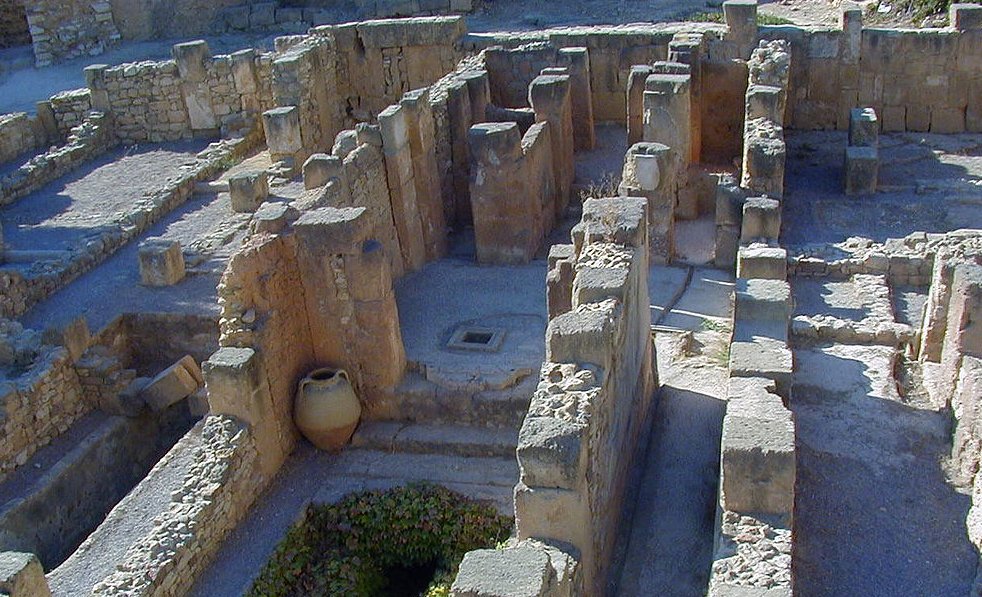
Punic ruins of Byrsa, Carthage. Image via Wikimedia commons
The third and final Punic War (149 - 146 BC) led to Rome's destruction of Carthage. That devastating defeat ended Carthage's brilliant time of glory. The city returned once more to the peaceful cultivation of its colonies and sea trade.
After decades, Carthage was reborn as a Roman colony; more precisely, the Roman province of "Africa" (with its capital in Carthage) became the granary of Rome and experienced another period of flowering until the fall of the Empire.
Throughout history, the city passed from hand to hand. After the Romans, the Byzantines came. In the year 439, Carthage was plundered by the Vandals, who, ten years earlier, had appeared in North Africa and made it to his capital. In 534, the city was recaptured by the Byzantine army of Belisarius. In the seventh century, the Arabs appeared in the regions, and in the sixteenth century, Carthage was in the hands of the Ottoman Empire.
Written by – A. Sutherland - AncientPages.com Senior Staff Writer
Updated on March 28, 2024
Copyright © AncientPages.com All rights reserved. This material may not be published, broadcast, rewritten or redistributed in whole or part without the express written permission of AncientPages.com
Expand for referencesReferences:
Polybius: The Histories
Goldsworthy Adrian, The Fall of Carthage: The Punic Wars 265-146BC
More From Ancient Pages
-
 Roman Cosmetics Shop Discovered In The Ancient City Of Aizanoi, Turkey
-
 1,000-Year-Old Palace Kitchen With A Cannonball Inside An Oven Found At Harput Castle In Elazig, Turkey
-
 Imhotep: Ancient Genius And Architect Of The Sakkara Pyramid
-
 Obsidian Flake From 45,000-Year-Old Tool Unearthed In Armenia
-
 On This Day In History: Battle Of Naulochus Was Fought Off The Coast Of Sicily – On Sep 3, 36 BC
-
 Ancient Greek Seven-Room Building And Treasures Found Underwater Off The Coast Of Salamis
-
 On This Day In History: Spanish Priest Diego de Landa Burned The Sacred Books Of Maya – On July 12, 1562
-
 Prehistoric Temperatures Of North America’s Oldest Archaeological Sites Shed New Light On Ancient Human Migration
-
 Modern Humans Inherited DNA From A Mysterious And Unidentified Ancestor
-
 Sumerians Built A Huge ‘Anti-Drought Machine’ To Save Ancient City Of Girsu From Destruction
-
 Magnificent Etruscan Underground Burial With Beautiful Artifacts Discovered In Aleria-Lamajone, France
-
 Reliefs And Engravings Of Celestial Bodies And A Zodiac On Walls And Ceilings Of Luxor’s Esna Temple
-
 3D Scans Reveal Thousands Of Never-Before-Seen Ancient American Rock Art Images In Alabama Cave
-
 Aztecs’ Five Suns Creation Myth And Prophecy
-
 Secrets Of Ninja Swords – Favorite Weapon Of The Shinobi
-
 Another Franklin Expedition Crew Member Identified
-
 Incredible Find – 3,000-Year-Old Canoe Found In Wisconsin’s Lake Mendota
-
 How The Kimono Became A Symbol Of Oppression In Some Parts Of Asia
-
 On This Day In History: Sunspot Observed By Chinese Astronomers During The Han Dynasty – On May 10, 28 BC
-
 Traces Of Ancient Near East Civilization In America – An Out-Of-Place Ancient Inscription – Part 2

