
Calakmul Was Powerful Ancient Maya Seat Of The Snake Kingdom
A. Sutherland - AncientPages.com - One of the three largest and most important Mayan city-states, next to Tikal (Guatemala) and Palenque, was Calakmul ("City of the Two Adjacent Pyramids"). The ruins of this once-powerful Maya city-state were discovered in the 1930s.

Calakmul is one of the finest representations of the Maya Culture. Credit: Adobe Stock - Jon Ortiz
In the days of splendor, Calakmul was ruled by the dynasty of the Serpents. The city was once the capital of a large regional power in the Classic period in Maya history.
It was also one of two superpowers. The other was - Tikal. For several centuries, Calakmul represented the seat of the Snake Kingdom because of its important snake head dynastic glyph (written now as "Kaan" and pronounced as "chaan").
Today, it is an ancient Maya archaeological site located 35 km (22 miles) from the Guatemala border, surrounded by the jungle of the greater Petén Basin region in the Mexican state of Campeche.
In its center, Calakmul had probably a population of about 50,000 people and was the seat of the Snake (Kaan) Kingdom, of which rulers reigned during most of the Classic period. It has recently been suggested that Dzibanche was their first capital, which was later relocated to the site of Calakmul.
These rulers identified themselves as Divine Lords of the Snake ("k'uhul kaanal ajaw"). Generally, the Mayas did not have expansive military ambitions, but the Lords of the Snake were rather unique. Their first capital was Dzibanche, and from there, they expanded to present-day north Guatemala, Belize, and the Mexican state of Campeche. Still, they were eventually stopped and defeated by the Tikal rulers.
The 1930s surveys mapped Calakmal and recorded 103 stelae (carved, commemorative stone slabs) at the site. It also has a number of very beautiful murals depicting scenes of the Maya inhabitants giving, receiving, and consuming food products, as well as displaying and transporting other goods. The murals of Calakmulare are believed to be the most unique pieces of art that can be found in the Maya world.

The front of the house of the mouth of the snake. Credit: Adobe Stock - ahau1969
Until now, as many as 6250 different ancient structures have been identified at the site, which covers an area of about 2 square kilometers (0.77 sq mi).
Calakmul was probably first established around 600 BC. According to sources, Calakmul's two monumental pyramids were built between 300 BC and 250 AD. One is over 45 meters (148 ft) high, a north-facing structure with a base measuring 120 meters (390 ft) square. The other is 50 meters (165 feet) high and measures over 130 meters (400 feet) in circumference.
Like many temples or pyramids within Mesoamerica, the pyramids at Calakmul were built on earlier pyramidal structures.
Reservoirs And Water Canals Of Calakmul
A wide network of canals and water reservoirs surrounds Calakmul. In the Maya times, Calakmul and its surroundings had the perfect conditions for farming because crops were cultivated near surrounding lowlands known as “bajos” (swamps).
However, it did not mean that Calamul’s inhabitants had enough drinking water; the ancient Maya were a resourceful culture. They constructed “aguadas” to store seasonal rainwater. As many as thirteen such surface reservoirs have been discovered, the largest of which is the structure measuring 242 by 212 meters (794 by 696 feet).
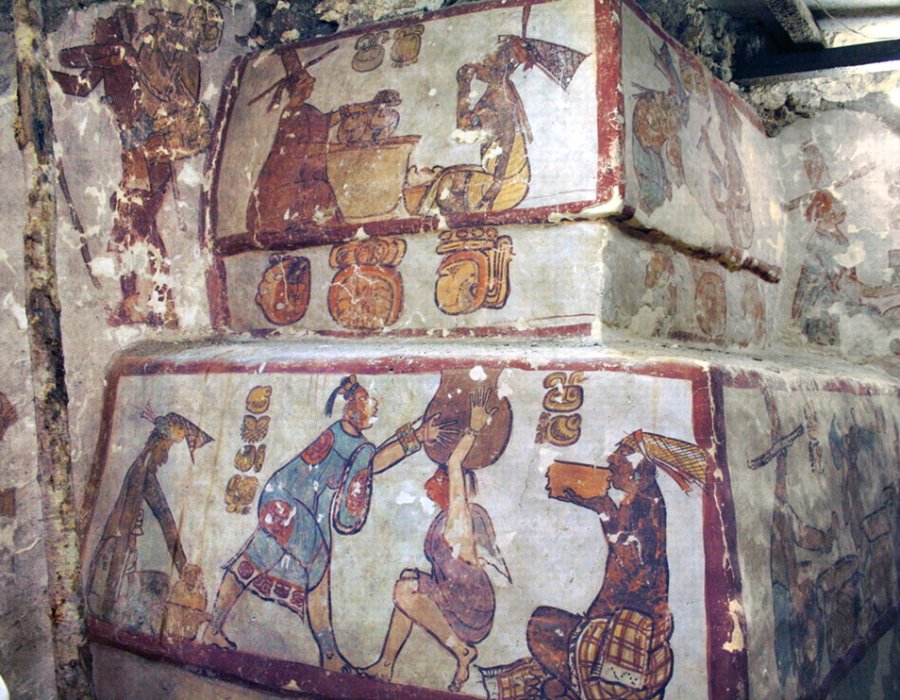
The southeast corner of Structure Sub 1–4 of the Chiik Nahb complex, Calakmul. Credit: Pnas
Calakmul’s sacbes are another interesting idea of the ancient Maya. Eight causeways (sacbe) have been discovered around Calakmul. Two of these have been mapped, three have been identified visually on the ground, and three more identified with remote sensing. The sacbes connected Calakmul with suburban neighboring sites and with other places like El Mirador and El Tintal.
Until recently, not much was known about it. Now, thanks to the work of archaeologists, more and more new facts have come to light. We have to remember that it’s not easy to excavate in this part of the world because of the hot climate and deep, dense jungle that disturb archaeological works.
Updated on November 30, 2023
Written by – A. Sutherland - AncientPages.com Senior Staff Writer
Copyright © AncientPages.com All rights reserved. This material may not be published, broadcast, rewritten or redistributed in whole or part without the express written permission of AncientPages.com
Expand for referencesMore From Ancient Pages
-
 Mysterious 2000-Year-Old Carved Vishap Stone Monuments Of Armenia
-
 Spectacular 6th Century Sword With Runes Found In Anglo-Saxon Grave Near Canterbury In Kent
-
 Large Earthwork At Wichita Site In Kansas – Is It Long-Lost Native American City Of Etzanoa?
-
 Sandstone Statue Of A Sphinx Discovered In Kom Ombo Temple
-
 Yuezhi Civilization: Ancient Nomadic People Who Once Ruled Bactria
-
 Cato The Younger – Mortal Enemy Of Julius Caesar Was A Man Who Hated Luxury, New Ideas And Was Immune To Bribes
-
 Long-Lost Wreck Of Crusader Ship And Gold Coins Discovered
-
 Why Were Medieval People Easily Offended And Scared Of Rumors?
-
 Fragments Of 6,500-Year-Old Figurine Of ‘Venus of Egerszeg’ – Unearthed
-
 Rare Phoenician Necropolis Discovered In Andalucia, Spain Is Extraordinary, Scientists Say
-
 Medieval Paradise Cockaigne – Land Of Extreme Pleasure And Luxury
-
 Ancient Chinese Version Of Quipu -Tradition Of Tying Knots Dates Back To Antiquity
-
 80,000-Year-Old Neanderthal Footprints Discovered On The Algarve Coast In Portugal
-
 Thousands Of Remarkable Megaliths On The Sumba Island
-
 Ceiba Tree: Sacred Tree Of Life Of Maya People And Universal Concept In Ancient Beliefs
-
 New Photos Of The Puzzling 7,000-Year-Old Circular Structure Near Prague And New Attempt To Solve The Neolithic Mystery
-
 Cenomani People: Their Pre-Roman Celtic Cemetery Reveals Funerary Customs
-
 Ancient Burial Tomb Of A Noble Mongol Warrior With Weapons Unearthed In The Moldavian Village
-
 Chain Mail Reveals Roman Soldiers Recycled And Repaired Their Own Armor
-
 Lemko People – European Minority That Lost Their Homeland And Still Live In Exile

