
Glory And Fall Of Babylon Dedicated To The Cult Of Marduk
A. Sutherland - AncientPages.com - More than a thousand years, Babylon (in Akkadian "Babilim" means "Gate of God") was the symbol of power, greatness, and destruction.
For over one thousand years, Babylon was also the center of worship of the god Marduk.
The ruins of the city (the canal system, gardens, walls, and the remains of some temples) are located approximately 80 kilometers south of Baghdad on the east bank of the Euphrates River.
 A mural near the reconstructed Ishtar Gate shows the palace quarter during the early 600s BC. The ice gate is visible in the upper left corner of the image. Image credit: photo CM, Iraq - CC BY-SA 3.0
One of the most prominent buildings of Babylon was the ziggurat Etemenanki, which means "temple of the foundation of heaven and earth").
The structure - initially Etemenanki was 91 high - was dedicated to Marduk in the city of Babylon of the 6th century BC Neo-Babylonian dynasty. Etemenanki may have been an inspiration for the biblical story of the Tower of Babel.
In ancient times, Babylon was considered almost the “center of the world”. Even, Alexander the Great was charmed by its beauty and power. One day, Babylon became the capital of his gigantic empire and became a place where he died.
In 331 BC, Alexander the Great captured Babylon and ordered repairs to the Etemenanki but he noticed no progress in repairs when he returned to Babylon in 323 BC. On Alexander’s orders, his army destroyed the entire Etemenanki to prepare a final rebuilding.
It never happened, Alexander the Great died in Babylon.
For the ancient people, Babylon was the "sacred city" dedicated to the cult of Marduk, who had there his temple and a golden statue, which unfortunately was looted several times by attacking Hittites, Elamites, Assyrians.
The first historical records that mention Babylon date back to c. 23rd century BC and the reign of Sargon of Akkad and c. 1900 BC, Babylon was occupied by Amorites.
However, the most famous ruler of Babylon was Hammurabi, the sixth king of the First Babylonian Dynasty, reigning from 1792 BC to 1750 BC and famous for his code, known as the Code of Hammurabi.
Hammurabi made Babylon the center of his kingdom, as the capital with flourishing trade and economy, and the power center of worship.
Babylon lost its independence many times and was destroyed by its conquerors. Somehow, the city could still recover and be stronger and stronger, with the help of Nebuchadnezzar II, a Chaldean king of the Neo-Babylonian Empire, who reigned c. 605 BC – c. 562 BC and constructed the Hanging Gardens of Babylon but unfortunately, also destroyed the temple of Jerusalem.
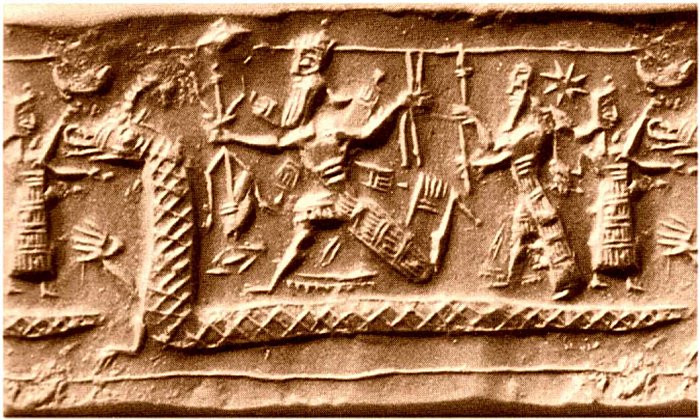
Cylinder closure that possibly depicts Marduk's battle with Tiamat. image credit: Ben Pirard - CC BY-SA 3.0
One day Babylon’s glorious times had to end.
In 539 BC, the Neo-Babylonian Empire fell to Cyrus the Great, king of Persia but under Persian rule, the town still flourished; it became a center of learning and science. In Achaemenid Persia, the ancient Babylonian arts of astronomy and mathematics were revitalized, and Babylonian scholars completed maps of constellations.
The city became the administrative capital of the Persian Empire and remained very important for more than two centuries.
"... the new monarchs of the realm chose not to locate their capital in Babylon but were content to rule from their original homeland, which meant from Pasagard, from Ecbatana (modern Hamadan), from Persepolis (modern Takht-e-Jamshid), and from Susa (modern Shush), former chief city of Mesopotamia’s ancient enemy Elam. Somehow Babylon had lost its overwhelmingly glamorous allure.
"Can we say then that it is here that we have reached the end of Mesopotamian civilization? Not really. A tradition more than 2,000 years old does not vanish overnight, in a year, in a decade, or even in a single century. For a long time yet, among the many peoples of what had been the Neo-Babylonian Empire, business would continue to prosper, the gods would continue to be served and lauded, the heavens continue to be observed, the omens to be read, the ancient texts to be studied, and the cities to be thronged by multinational, multilingual, multicultural crowds of Anatolians, Egyptians, Greeks, Judaeans, Persians, and Syrians. Though Mesopotamia was reduced to the status of a mere province – albeit retaining the still prestigious name Assyria – in an empire that now extended over four million square miles, the Persians never made any attempt to substitute their own traditions for those of their provincial subjects." 1
The Persian kings made several attempts to protect religious ceremonies in the city of Babylon but, the Babylonian people protested against the Persian dominance. The walls of Babylon and the ziggurat Etemenanki were destroyed and the golden statue of Marduk – disappeared. Then, Alexander the Great became the ruler of Babylon, who as we mentioned earlier, tried to restore the city’s glory. He never did it because he died in Babylon.
According to a tablet dated 275 BC, the inhabitants of Babylon were deported to Seleucia, and thus, Babylon became insignificant as a city.
Written by A. Sutherland AncientPages.com Staff Writer
Copyright © AncientPages.com All rights reserved. This material may not be published, broadcast, rewritten or redistributed in whole or part without the express written permission of AncientPages.com
Expand for referencesReferences:
- P.Krivaczek, Babylon, Mesopotamia and the Birth of Civilization (pp. 276-277).
G.S. Goodspeed, History of Babylonians and Assyrians
More From Ancient Pages
-
 The Caesar Cipher: Ancient And Simple Yet Effective Cipher Used By Julius Caesar
-
 Harput Relief: 4,000-Year-Old Artifact Pushes Back History Of Region By 1,000 Years
-
 Fearsome Aztec Eagle And Jaguar Warriors Of Mesoamerica
-
 An Intact 4,000-Year-Old Burial Chamber Found In Aswan
-
 Mysterious Voynich Manuscript Was Written In Two Languages – Scientists Say
-
 Diver Says He Found Mysterious Underwater Ancient Tomb, Ruins And Artifacts Of An Unknown Advanced Civilization
-
 Concept Of Fate In The Eyes Of Slavic People
-
 Amazing World’s Largest Mosaic Piece Made By 13 Different Ancient Civilizations At Museum Hotel Antakya
-
 Oseberg Ship: Amazingly Well-Preserved Viking Burial Ship
-
 Why Pharaoh Seti I’s Tomb Had To Be The Most Glorious And Largest Ever Built In Valley Of The Kings
-
 How Ancient Scientists Calculated The Circumference Of The Earth
-
 The Thunder Stone: World’s Largest Monolith Moved By Man
-
 Medieval Pilgrim’s Badge (‘Pilgrim’s Sign’) Depicting A Basilisk Dragon In A Circle Discovered In Southeastern Poland
-
 Mycenaean Culture Used Lignite For Their Kilns 3,000 Years Ago – Surprising Discovery Reveals
-
 A Researcher’s Life’s Work Uncovers First Ancient DNA From Swahili Civilization
-
 Giant 7,000-Year-Old Astronomical Calendar Discovered In Poland?
-
 Enigma Of The Mysterious Ancient Shining Twins – Were They With Humans From The Beginning Of History? Part 1
-
 Stone Age Infants Received Care For Nine Hours Per Day From Up To 15 Different Caregivers – Study Informs
-
 Viking Sword Unearthed In Grave Excavated by Archaeologists In Central Norway
-
 ‘Homo Erectus’ From Gongwangling Could Have Been One Of The First Human Beings 1,6 Million Years Ago

