Eddie Gonzales Jr. - AncientPages.com - About 100 to 66 million years ago, during the Late Cretaceous, the climate was warmer than the present. Many new species appeared on all continents, including the giant Quetzalcoatlus that lived in North America.
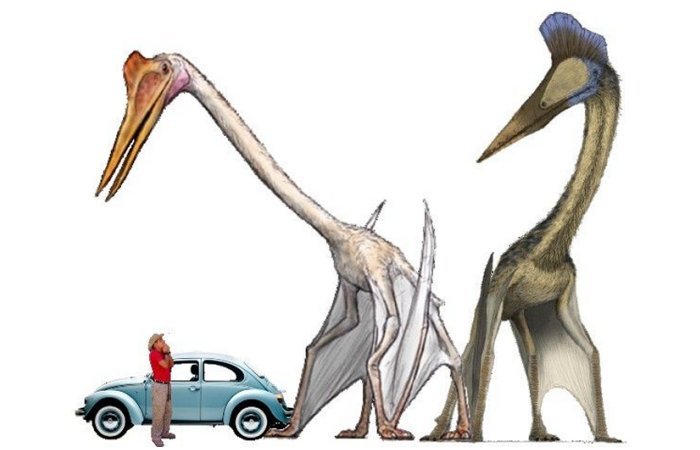
The Quetzalcoatlus compared to a man, car, and pterodactyl. Source Pinterest
With a wingspan reaching as much as 15.9 m (52 ft), Quetzalcoatlus is one of the largest known flying animals ever. This giant animal was named after the Mesoamerican feathered serpent god, Quetzalcoatl, who was well-known under different names in the region.
The Aztecs called him Quetzalcoatl, and the ancient Maya called him Kukulkan.
The first Quetzalcoatlus fossils were discovered in Texas, the United States, from the Maastrichtian Javelina Formation at Big Bend National Park in 1971 by Douglas A. Lawson. Later, Lawson discovered a second site where he found fragmentary skeletons of much smaller individuals.
It was how we learned about this giant flying animal's existence.
Quetzalcoatlus lived among dinosaurs, but the animal was not a dinosaur. Quetzalcoatlus was the most famous member of the azhdarchids, a family of pterosaurs, a flying reptile.
"The pterosaurs and the dinosaurs appear to have evolved on divergent paths from earlier reptilian life forms. It also seems clear that the pterosaurs did not evolve into the birds.
In this regard, the anatomy is that of the wing. In a pterosaur, the fourth finger of each forelimb was considerably elongated. It supported the front edge of a membrane that stretched from the flank of the body to the farthest tip of the finger. The other fingers were short and reptilian., with a sharp claw at the end of each one.
In a bird, the second finger is the principal strut of the wing, and in the bird, much of the wing consists of course of feathers," Wann Langston explained.
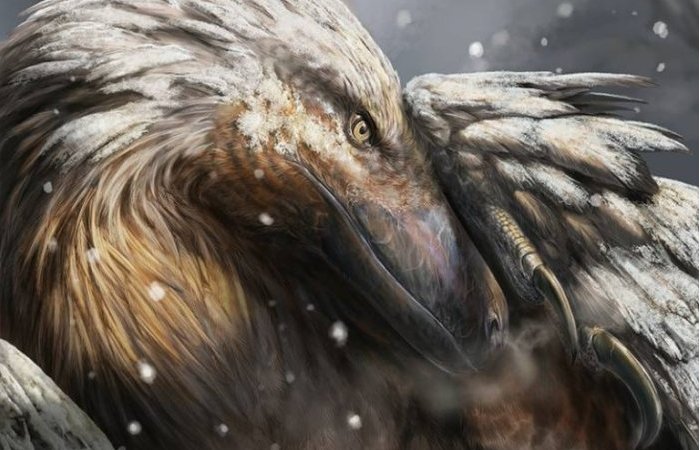
The animal is often depicted with feathers, but researchers think Quetzalcoatlus was covered with pycnofibres, hair-like fibers that differ from animal hair. When Quetzalcoatlus stood on the ground, it was as tall as a giraffe, more than five meters tall (16.4 ft), and weighed 250 kilograms.
Quetzalcoatlus soared the skies, and the animal could see many giant animals walking on our planet. Then, everything ended because about 65 million years ago, about three-quarters of Earth's plant and animal species went extinct.
This event is known as the K-T mass extinction because it occurred at the boundary between the Cretaceous (K) and Tertiary (T) periods. The dinosaurs were the most famous animals to perish, and the Quetzalcoatlus did not survive either.
Updated on October 30, 2024
Written by Eddie Gonzales Jr. - AncientPages.com - MessageToEagle.com Staff Writer