
Fairies Weren’t Always Cute – They Used To Drink Human Blood And Kidnap Children
AncientPages.com - When most people think about fairies, they perhaps picture the sparkling Tinker Bell from Peter Pan or the other heartwarming and cute fairies and fairy god mothers that populate many Disney movies and children’s cartoons. But these creatures have much darker origins - and were once thought to be more like undead blood-sucking vampires.

A painting by John Anster Fitzgerald who was well known for his work featuring fairies. Wikimedia, CC BY-SA
In The Secret Commonwealth of Elves, Fauns and Fairies (1682), folklorist Robert Kirk argued that fairies are “the dead”, or of “a middle nature betwixt man and angels”. This association is particularly prominent in Celtic lore. Writing in 1887, Lady Jane Wilde popularised the Irish belief that:
fairies are the fallen angels who were cast down by the Lord God out of heaven for their sinful pride…and the devil gives to these knowledge and power and sends them on earth where they work much evil.
At first sight the current innocent idea of fairyland seems as far away from the shadowy realms of the dead, and yet there are many resemblances between them. Despite their wands and glitter, fairies have a dark history and surprisingly gothic credentials. So why did we lose our fear of fairies and how did they come to be associated with childhood?
How fairies lost their bite
When JM Barrie’s Peter Pan debuted in the early 1900s, it was widely believed in society at that time that fairies were inhabited a shadowy spirit world. Fascinated by angels, ghosts and vampires Victorians (subsequently Edwardians) increasingly saw fairies as the souls of the dead. Rather than dispelling fairies, the first world war and the loss of many loved ones heightened a belief in airy spirits and occult methods of communicating with them.
However, due to Peter Pan’s great success and the prominent “pixie” character of Tinker Bell the creatures would eventually lose their malevolence as they became confined to the nursery.
Barrie famously equated the origin of fairies with children:
When the first baby laughed…its laugh broke into a thousand pieces…that was the beginning of fairies.
This is far from the malevolent fairies and their shadowy history in folklore. In these stories they steal children, drive people insane, blight cattle and crops – and drink human blood. Barrie, of course, was aware of their dark side. Despite the fairy dust and glamour, Tinker Bell is dangerous and vengeful like a deadly fairy temptress. At one point in the story, she even threatens to kill Wendy.
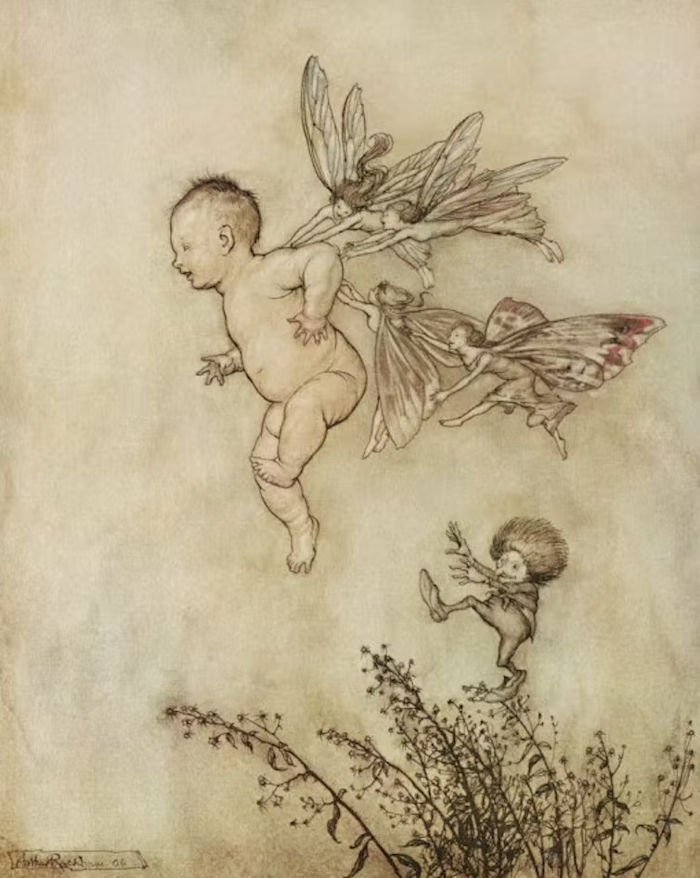
An illustration for Barrie’s Peter Pan book by Arthur Rackham. Credit: Public Domain
Peter Pan, or the Boy Who Would Not Grow Up, debuted on stage at Christmas in 1904. It was inspired by performing fairies in popular shows such as Seymour Hicks’s Bluebell in Fairyland. Peter Pan was canonised by Disney in 1953 and the sentimental celluloid fairy was born. The cutesy and youthful fairies of contemporary children’s TV are a result of this Disneyfication.
Blood hungry demons
But in folklore, fairies are often a demonic or undead force; one which humans need to seek protection against. As folklorist Katharine Briggs has noted. In her Dictionary of Fairies, she wrote:
"People walking alone by night, especially through fairy-haunted places, had many ways of protecting themselves. The first might be sacred symbols, by making the sign of a cross, or by carrying a cross, particularly one made of iron; by prayers, or the chanting of hymns, by holy water, sprinkled or carried, and by carrying and strewing Churchyard mould in their path. Bread and salt were also effective, and both were regarded as sacred symbols, one of life and the other of eternity."
What is more, fairyland has a hunger for human blood. This links fairies to the vengeful dead and to vampires. In early accounts, vampires are defined as the bodies of the dead, animated by evil spirits, which come out of their graves in the night, suck the blood the living and thereby destroy them – as an entry in the Oxford English Dictionary from 1734 noted.
Diane Purkiss’s history of fairies, includes a Scottish Highland legend which warns that you must bring water into the house at night, so the fairies don’t quench their thirst with your blood. Very old fairies, like vampires, were said to wrinkle and dry up without fresh blood.
The Baobhan Sith are vampiric Scottish fairies. These beautiful green banshees have hooves instead of feet, they dance with and exhaust their male victims then tear them to pieces. Like many fairies, they can be killed with iron.
Dearg-Due are Irish vampiric fairies or “Red Blood Suckers”. They were thought to be influential on Sheridan Le Fanu’s female vampire tale Carmilla (1871).
Halloween is supposedly a time when the veil between our world and the shadow world is extremely thin. A time when you are more likely to hear stories of encounters between humans and fairies. So if this Halloween you go seeking winged friends, a warning to the curious, they might not be as sweet as you think.
Tread carefully and never enter a fairy ring. Circles of mushrooms, they are believed to have been created by fairies dancing in rounds. According to folklore, if you do happen to step into such a circle of mushrooms, you may become invisible and be made to dance around until you die of exhaustion. So a healthy fear of fairies is always wise.
Written by Sam George, Associate Professor of Research, University of Hertfordshire
This article is republished from The Conversation under a Creative Commons license. Read the original article.
More From Ancient Pages
-
 The Forgotten Finnish Vikings: Why Their Story Is Rarely Told
-
 Meskhenet: Egyptian Goddess Of Household And Childbirth Who Governed Over Fate And Destiny
-
 Beautiful Legend Of The Wise Couple Who Shapes The World’s Dreams In A Secret Cave
-
 Ancient Mystery Of The Enigmatic ‘Cat Men’ – Advanced Prehistoric Machines Or Humanoids? – Part 2
-
 Toltecs’ Intriguing And Forgotten Ancient Wisdom Of Dreaming Can Change How We Perceive Ourselves And Everything Around Us
-
 Stele Of Tell al-Rimah And Deeds Of Assyrian King Adad-nirari Against Rebellious Kings
-
 ‘Dates Add Nothing To Our Culture’: Everywhen Explores Indigenous Deep History, Challenging Linear, Colonial Narratives
-
 Who Were The Picts, The Mysterious People Of Northern Scotland?
-
 Arizona’s And Washington’s Baffling Beehive-Shaped Coke Ovens
-
 LIDAR Discovery Of Valley Of Lost Cities In The Amazon
-
 Mysterious Advanced Underground Civilization And A Secret Society – Dangerous Knowledge And Verdict – Part 3
-
 Ancient Beliefs About The Soul
-
 Mysterious Old Ship With No Crew Reaches The Canadian Coast
-
 Unusual Ancient Roman Miniature Spear Puzzles Archaeologists – A Unique Find In Britain
-
 Mystery Of The Langeid Viking Sword And Its Undeciphered ‘Magical’ Inscriptions
-
 Ceiba Tree: Sacred Tree Of Life Of Maya People And Universal Concept In Ancient Beliefs
-
 Termessos: City Where History And Mythology Marked People’s Daily Lives
-
 Mysterious Ancient People Who Mastered Thought-Transmission Through Space And Spoke At Distance
-
 History Of Jarlshof – Thousands Of Years Of History With Traces Of Picts, Vikings And Scots
-
 Why Was Grette The Strong, Icelandic Poet And Warrior Afraid Of Darkness?

