
Ancient Roman Laws Give Us A Window Into A World Of Abuse
AncientPages.com - Domestic violence was endemic in the Roman world.
Rome was a slave-owning, patriarchal, militarized culture in which violence (potential and actual) signaled power and control.
Tragically, but predictably, the names of most of the victims of domestic violence do not show up in the historical record. And yet the identities of a handful of victims survive.
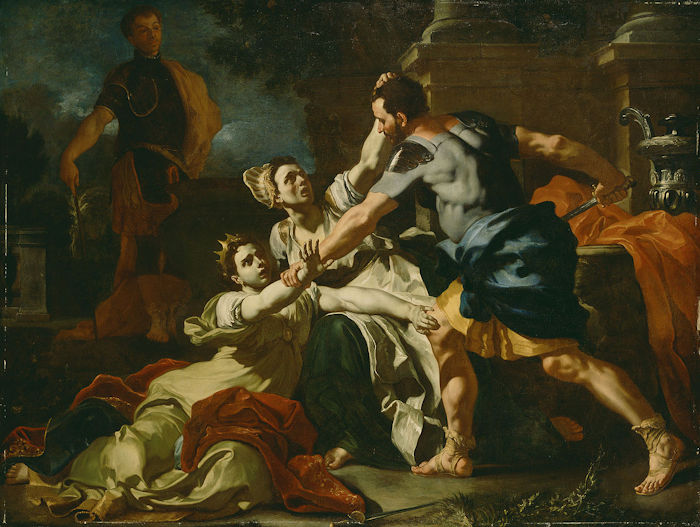
Death of Messalina by Francesco Solimena (1657–1747). Credit: Public Domain
Nero's second wife Poppaea Sabina was kicked to death while pregnant. His first wife Octavia and his mother Agrippina were murdered on his orders.
According to her epitaph, Julia Maiana was killed after 28 years of marriage. Appia Annia Regilla, an aristocratic woman and wife of the Greek author Herodes Atticus, was murdered while pregnant. Prima Florentia was drowned. Apronia was thrown from a window.
The love poets Ovid and Propertius depicted relationships with "Corinna" and "Cynthia" involving physical abuse.
John Chrysostom, a church father, described the nightly shrieks of women echoing through the streets of Antioch.
The Roman household
Relationships between members of the Roman household (both free and enslaved) were characterized by significant power imbalances—a scenario ripe in possibilities for physical, sexual and psychological abuse and coercive control.
The head of the Roman household, the pater familias, was famously powerful. His power included the so-called "power of life and death" and ownership of the property of even adult children within his control.
His wife might exercise violence and coercion (for instance against slaves, lovers, or children) and be its victim.
With a society-wide belief in correctional education, children were often victims of violence. There is also scattered evidence for elder abuse and the routine sexual and physical abuse of slaves.
Legal responses to domestic violence
The autonomy and authority of the pater familias, the comparative ease with which a Roman marriage could be dissolved and endemic inequality have been viewed as reasons why Rome did not develop specific domestic violence legislation.
But a patchwork of Roman laws (including Rome's complex murder laws) sought to address coercive and violent behavior.
The first Roman emperor, Augustus (27 BCE until 14 CE), brought in anti-adultery legislation, criminalizing extra-marital sexual activity. This legislation was a deliberate and unprecedented intrusion into the realm of the family, including limits on circumstances under which a father could kill his daughter.
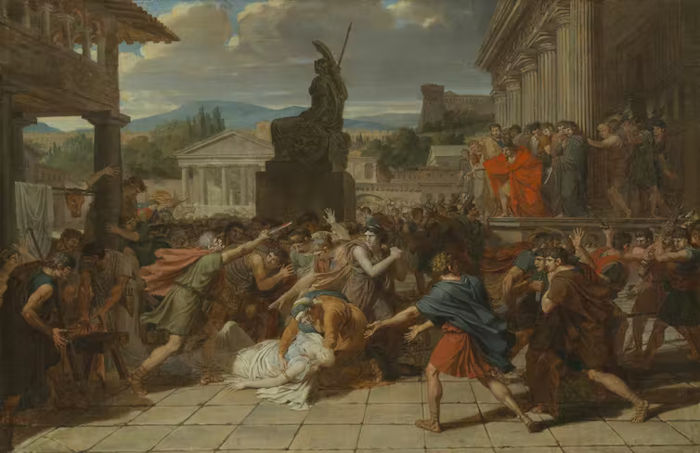
Guillaume-Guillon Lethière, The Death of Virginia (circa 1800) Los Angeles County Museum of Art
Stalking and sexual harassment were illegal—although the law focused on preserving a woman's chastity, not on the perpetrator's desire to control or terrify his victim.
The emperors Theodosius (379 to 395) and Valentinian (364 to 375) accepted physical abuse as a just cause for divorce—but this appears to have been revoked under the emperor Justinian (542).
The emperor himself was known on occasions to have taken an interest in specific domestic murder cases, but his intervention probably depended on the status and connections of the complainants.
Laws which incidentally addressed abuse and coercive control were much more common. Roman laws offered extensive and detailed legal provision for dowries, wills and inheritance. Laws provided recourse for a child wrongfully disinherited and worked against a pater familias who intentionally cheated a wife out of her dowry.
The need for these laws opens a window on a world of abuse.
'Good fatherhood'
If the law rarely directly addressed domestic violence, a public rhetoric of "good fatherhood" did seek to speak to family duties and relationships.
Exemplary fathers exercised self-control and restrained their anger. They showed severity and pietas (familial duty) rather than cruelty.
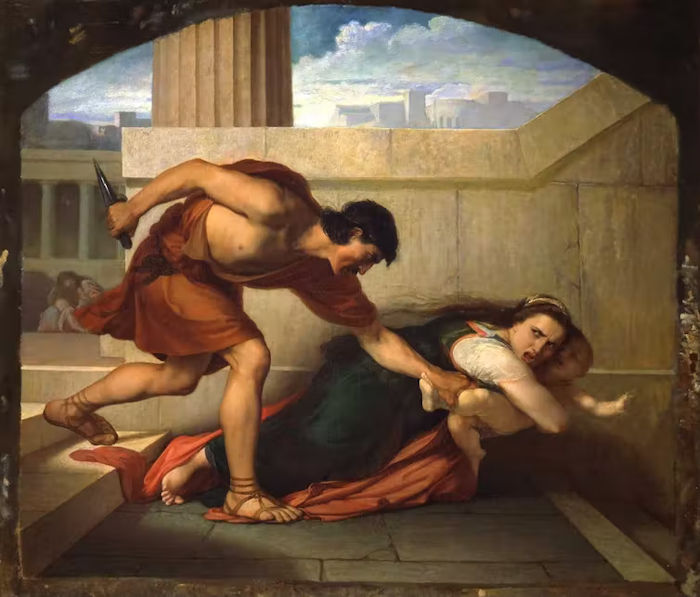
Angelo Visconti, The Massacre of the Innocents (1860 - 1861) Asciano, Cassioli Museum
This rhetoric was made use of by the emperor Hadrian (117 to 138) who exiled a father who had killed his son.
The emperor Trajan (98 to 117) also ordered a father who was maltreating his son to set him free since he viewed the treatment as a breach of pietas.
Of course, not all acts of violence were punished. When Egnatius Mecenius beat his wife to death with a club for being drunk (a story dating back to the legendary days of Romulus), he was commemorated for his exemplary severitas (acceptable strictness).
The voices of women
Roman matrons could be respected and influential figures within both household and state.
The ancient Roman historian Livy gave an account of the public murder of Verginia by her father, who killed her in order to protect her chastity from an abuser.
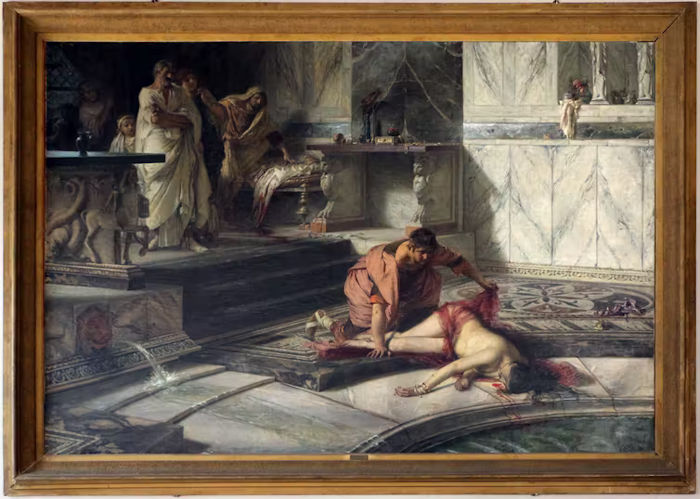
Nero and Agrippina, painted by Antonio Rizzi (1869-1940). Credit: Public Domain
In his telling of the story, Livy examines the public presence of women during the incident. He depicts a crowd of respectable matrons standing with Verginia throughout her ordeal, jostling her accuser.
Their weeping moved the crowd of onlookers more than her father's complaints.
After her murder, Livy reports the women lamented loudly and publicly: the actions of the male protagonists are highlighted through the protesting voices of the matrons.
The presence of domestic violence in ancient Rome may not be surprising. But of interest is how Romans formulated limited legal and non-legal challenges to cultures of violence and how we can continue to interrogate such responses today.
This article is republished from The Conversation under a Creative Commons license. Read the original article.
More From Ancient Pages
-
 Oh, Whistle, And I’ll Come To You, My Lad – A Christmas Ghost Story
-
 Mysterious Advanced Underground Civilization And A Secret Society – Astonishing Discovery And Connection – Part 1
-
 4 Things Ancient Greeks And Romans Got Right About Mental Health
-
 Legend Of Evil Spearfinger And The Cherokee Who Were Guided By Celestial Beings
-
 Tazza Farnese (Farnese Cup) – Mysterious, Never Explained And Debated Ancient Gemstone
-
 Mystery Of Paracelsus’s Magical Sword Azoth – Rumors Or Truth?
-
 Cats In The Middle Ages: What Medieval Manuscripts Teach Us About Our Ancestors’ Pets
-
 Nicolas Bourbaki: The Greatest Mathematician Who Never Was
-
 5 Lessons From Ancient Civilizations For Keeping Homes Cool In Hot, Dry Climates
-
 Illuminati: Facts And History About The Secret Society
-
 Baffling Unexplained ‘Alien’ Condition – Evidence Of Unknown DNA?
-
 Viking Site L’Anse Aux Meadows Confirms Norse Vinland Sagas Were Based On Real Events
-
 Dolmen de Soto: Unique Millennia-Old Underground Structure Remains A Puzzling Enigma
-
 Enigmatic Human Fossil Jawbone May Be Evidence Of An Early Homo Sapiens Presence In Europe
-
 Mythical Norse Artifacts Discovered In Viking Graves Confirm Icelandic Sagas Once Again
-
 Legend Of Marguerite de Bressieux: Brave Noblewoman Who Sought Revenge For Sexual Assault
-
 Shieldmaiden Hervör’s Dangerous Quest For The Cursed Tyrfing Sword
-
 Strange Ancient And Medieval Encounters With Unusual Beings Reported And Documented
-
 Secrets Of Mount Shasta – One Of The Most Sacred Places On Earth
-
 The Mysterious Whispering Voice – A Beautiful Story Of Trust And Love

