
‘Tonina Chiapas’ Mayan Pyramid In Southern Mexico Is Among The Largest Yet Found
A. Sutherland - AncientPages.com - The representation of the Sacred Mountain of the Mayas, is located only ten kilometers from a village Ocosingo in Chiapas between the famous Palenque and San Cristobal de las Casas, in the middle of the Lacandona jungle.

Fragment of glyphic text on the wall in the Tonina Palace. Image credit: INAH
Five years after its discovery, it has now been revealed the pyramid is among the largest yet found. The acropolis of Tonina Chiapas in southern Mexico has 208 stone steps leading from its base to its apex and is 75 meters or 65 meters tall.
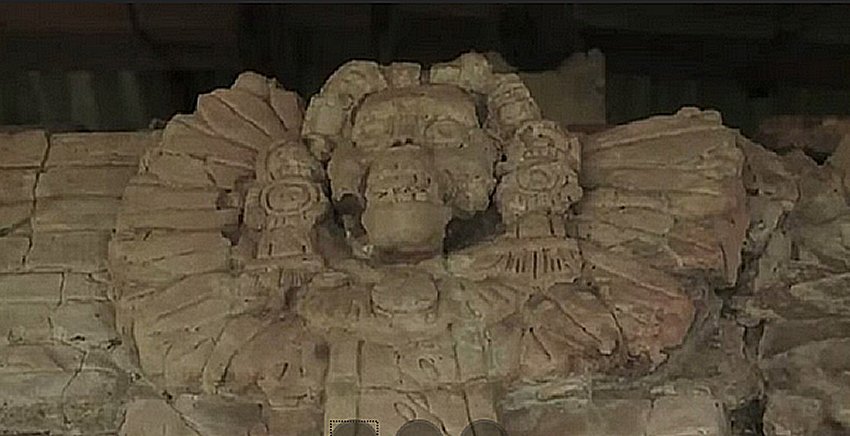
A wall with a rich glyphic text including the complete name of the ruler that founded one of the most powerful Maya military seigniories was found in Tonina Archaeological Zone, in Chiapas, in southern Mexico.
The structure was constructed on a hill with seven platforms that made up a labyrinth.
The Mayans built palaces, temples, and altars to honor the sky, death, and the underworld. Between the 6th and 10th centuries, in Tonina lived warrior princes who ruled the cities in the basin of the River Usumacinta, including Palenque, Bonampak, and Yaxchila. This contradicts the idea of the Mayan world as being peaceful and mathematical.
The bas reliefs in stone and stucco, like the 'Four Suns' (Los cuatro soles) (and the 'Mural of skulls' (El mural de las calaveras), have clearly Toltec influences and represent particularly outstanding features.

Recent excavations have proven the Mayan city at Tonina to be double the size previously anticipated.
It is also being described as unique in that the city has seven clearly defined districts within its 10-12 ha boundary, each dedicated to a different purpose — such as palaces, temples, housing and administration.
The site has been classified as one of Mexico’s most important, with more than 300 hieroglyphic texts so far identified.
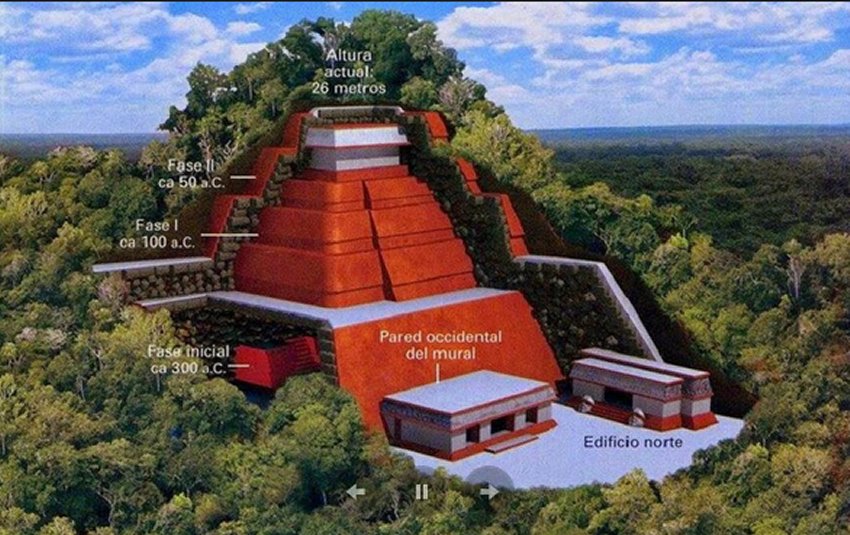
Tonina Chiapas according to an earlier impression of what the temple may look like. Image credit: INAH
The magnificent Tonina temple was not built on a hill as it was previously believed. Instead, the structure is artificial because it was almost entirely constructed by the ancient Maya architects.
A stone sarcophagus unearthed at the site of Tonina, has been dated by researchers to 840-900 AD. Inside were found the remains of bones and pottery, though an identity has not yet been established.
However, a hieroglyphic text found on a wall a few months ago has been found to carry the full name and a portrait of the Mayan chief who built the most important fortified house in the city, K’inich B’aaknal Chaahk — the sixth ruler of the 14 known to have ruled the city.
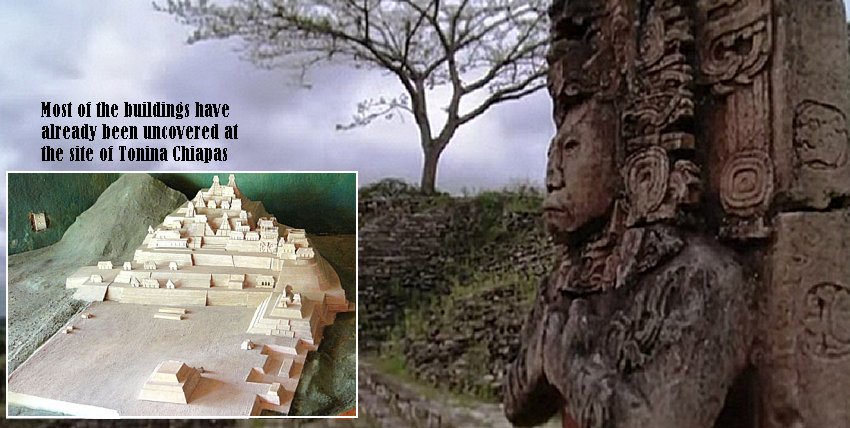
It is important to mention that according to archaeologist Dr Carlos Pallan Gayol from the National Institute of Anthropology and History (INAH), the wall is fundamental because it sheds more light on a chapter of Tonina history between 680 and 715 AD when the 6th seignior appears in the dynastic sequence of the site.
Until now, it is known that K’inich B’aaknal Chaahk was the ruler with greater political and hegemonic power in Tonina, a city known in its times as Po’ (white - in Mixe-Zoque language).”
Behind the wall was found a throne and inscriptions holding the dates of March and June of AD708.
Further translation of hieroglyphs will give a much better understanding as to why the Mayan civilization collapsed.


Written by – A. Sutherland - AncientPages.com Senior Staff Writer
Copyright © AncientPages.com All rights reserved. This material may not be published, broadcast, rewritten or redistributed in whole or part without the express written permission of AncientPages.com
Expand for referencesMore From Ancient Pages
-
 Secrets Of Legendary Viking Crystal Sunstones And The Mysterious Uunartoq Artifact Unraveled
-
 Unusual And Well-Preserved Skeleton Discovered In Ancient Pompeii Sheds New Light On The Cultural Life Of The City
-
 2,000-Year-Old Herculaneum Scrolls Will Be Unwrapped And Deciphered
-
 Bizarre Ancient Capuchin Crypt ‘Decorated’ With The Bones Of 4,000 Monks
-
 10 Aztec Symbols Explained
-
 Where Is One Of Colorado’s Most Mysterious Long-Lost Artifacts? Have New Clues Emerged?
-
 Enigma Of The Solutrean People: Were First Americans European Stone Age People?
-
 Oldest case of leukemia found on 7,000-Year-old skeleton
-
 Arizona’s Enigmatic Beehive-Shaped Stone Coke Ovens
-
 Ancient Road Used By The Teutonic Knights Discovered In A Lake In Poland
-
 New Reading Of Mesha Stele And Consequences For Biblical History
-
 Man Finds A Viking Sword In His Garden – A Viking Grave Could Also Be Nearby – Scientists Say
-
 Fascinating Portable Art From Torre Cave, Gipuzkoa – One Of The Most Complete Specimens From The Entire Iberian Peninsula
-
 Evidence Of Ancient Gigantic Tsunami That Struck Tel Dor Maritime City Mound, Israel
-
 Fragarach: Supernatural Sword That Controlled Winds, Cut Through Wood, Metal And Bricks In Irish Myths And Legends
-
 Indian Black Earth And Biodiversity Of The Amazon – New Study
-
 Oldest Recently Discovered Fossil of Bird ‘Archaeopteryx’ That Lived 150 Million Years Ago
-
 Mystery Of The Lost Beverina Castle – Did Knights Templar Know Where It Was?
-
 2,700-Year-Old Sarcophagus Of ‘High Priest Of God Amun’ Discovered In Luxor
-
 Rare Byzantine Gold Coin Discovered In Norway – Was It Brought By Harald Hardrada From Constantinople

