


Jan Bartek - AncientPages.com - Archaeologists examining a medieval cemetery in the Old Town near Dabrówno have discovered an unusual burial: the deceased had an iron knife under his neck and a nail in his chest. The grave's contents do not indicate pagan anti-vampiric practices, believes Dr. Arkadiusz Koperkiewicz, who led the research.
A team of scientists from the University of Gdansk is conducting research at the site of the first settlement of Dabrówno. They previously confirmed the existence of relics of a medieval town there. They also discovered, among other things, a 14th/15th-century cemetery, where the first generation of settlers, likely including Prussian natives, are buried.
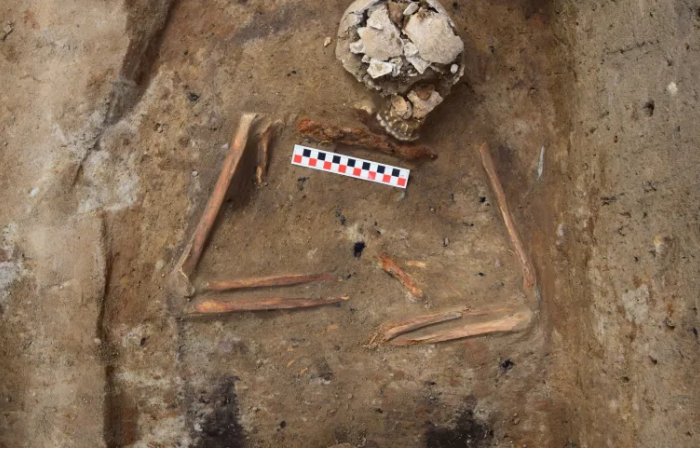
Credit: Kamil Niedźwiecki
The cemetery is partially damaged by plowing, so archaeologists were able to determine its origins last fall by finding various distinctive objects on the surface. The necropolis indirectly indicates the location of a likely wooden church, which, according to historical sources, was destroyed during the war with the Teutonic Order in 1414.
In recent days, excavations have uncovered skeletons beneath the surface, some of which are mechanically damaged. The deceased were buried according to the Christian customs of the time, i.e., with their heads facing west and their arms crossed over their chests or pelvises. Knives, flints, belt buckles, and a few coins dating back to the first half of the 14th century were found with some of them.
Mysterious Burial Practices Concealed From The Teutonic Order?
Dr. Koperkiewicz reported that one unusual burial drew the researchers' attention. A large iron knife was placed just below the deceased's neck, with the blade facing upward. A nail was found on the chest, and a large ceramic vessel fragment was located above the pelvis.
"The latter of these objects is not surprising, as the custom of placing a fragment of a broken vessel in a grave had already been identified as a characteristic element of the funeral customs of Prussian neophytes. This may be a kind of symbolism of 'vanitas', the futility of man compared to the greatness of God and the fragility of life," the archaeologist noted.
He also noted that the placement of apotropaic, or protective, objects in graves is documented in early medieval Slavic cemeteries and folklore. These items, often sharp iron objects like sickles or knives, reflect beliefs in magic and fears of the deceased returning.
One of the most notable atypical burials in recent years is that of the so-called vampire Zosia, a young woman interred in the 17th-century cemetery in Pien with a sickle around her neck and a padlock on her toe.
In the case of the first Dabrówno burial, it remains unclear whether these findings indicate mysterious burial practices, anti-vampire measures, or a continuation of traditional Prussian beliefs concealed from the Teutonic Order.
"Probably not. I'm not convinced by that interpretation. While we cannot rule out the Prussians maintaining certain traditional behaviors, consider how our grandmothers covered mirrors and overturned chairs after a death. Yet, we would not claim they practiced pagan anti-vampire rituals," explained the archaeologist.
He noted that the example from Dabrówno is among the most significant in medieval archaeology within the Teutonic lands. By the late 14th and early 15th centuries, the Prussian population had abandoned ancient funeral customs, with ceremonies regulated by church law. As early as the mid-13th century, the Treaty of Dzierzgon required the Prussians to cease cremating their dead and to bury them only in cemeteries adjacent to churches.
"We know, however, that this agreement was not always honored, something the clergy complained about long afterward. It's hard to imagine anyone associated with evil being buried in the church cemetery, as it was a sacred, particularly protected area. Its desecration required the site to be reconsecrated," said Dr. Koperkiewicz.
Focus On The Deceased's Soul
In his view, these practices may have communicated the nature of death or served as elements of a rite of passage. It is also possible they reflected concerns about the return of the deceased's soul.
"Actions that seem irrational to us today may have had practical purposes, possibly influenced by folk beliefs. For example, people would place a candle on the chest or warm earth under the doorstep to confirm whether someone had truly died," said the archaeologist.
See also: More Archaeology News
Researchers and archaeology students from the University of Gdansk conducted excavation training in the Old Town, the site of the original Dabrówno, which marks its 700th anniversary this year. Non-invasive and survey research on the plateau below Zamkowa Góra, near Lake Dabrowa, confirmed the presence of medieval architectural remains. Conservation services and local authorities plan to establish a cultural park at the site.
Source: Nauka w Polsce (Science in Poland)
Written by Jan Bartek - AncientPages.com Staff Writer


