
Prince Wenceslaus Of Bohemia Murdered On Order Of His Own Brother
Angela Sutherland - AncientPages.com - The Sword of Saint Wenceslas, also known as the Coronation Sword of Bohemia, has its beginnings in the Kingdom of Bohemia, and it tells the tragic story of two brothers.
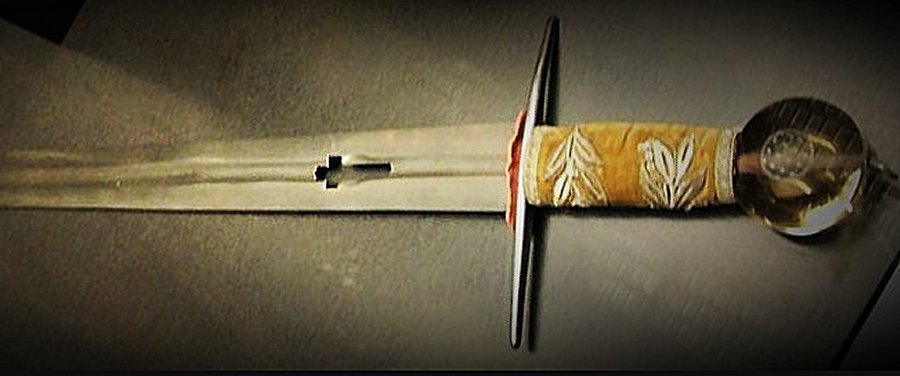 The iron blade is 76 cm long, at the widest point is 45 mm and has a ripped hole in a cross shape (45 x 20 mm). The wooden handle is covered with brown-yellow fabric, embroidered with the ornament of laurel twigs with thick silver thread. The cross on the blade was most likely made later in the Middle Ages. Source
The relic is a ceremonial sword with a blade whose age and history go back to the 10th century, to the times of St. Wenceslaus, the Duke of Bohemia, from 921 until his assassination in 935.
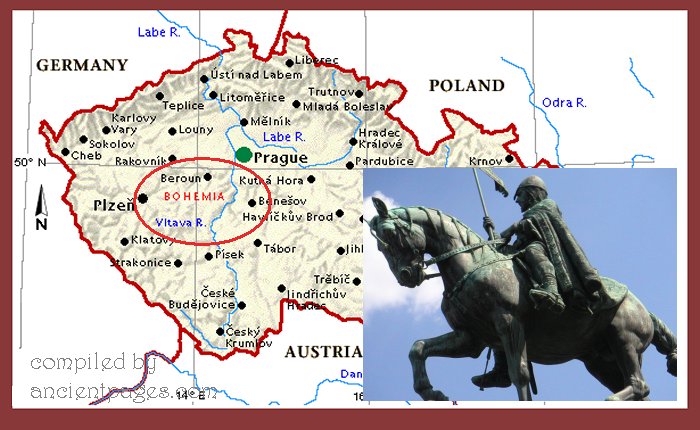
Wenceslaus (Polish: Waclaw) was born in 907 in Stochov and was Duke of Bohemia, a medieval and early modern monarchy in Central Europe. He was the son of Prince Vratislav and the pagan princess Drahomira, the daughter of a Veletian chieftain.
The Veletians were a Baltic Slavic tribe known as fierce or wild ('Ljutici') for their long and violent resistance to Christianity. It is rather curious that Drahomira was given in marriage to the Christian ruler of Prague.
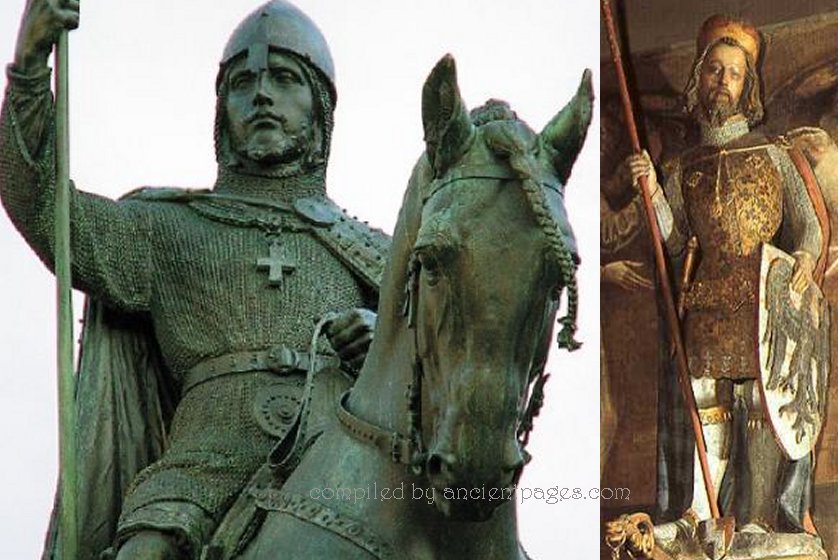 Left: Prince of Bohemia, Wenceslaus; Right: Wenceslaus, probably by Peter Parler, in St. Vitus Cathedral, Prague. (Public Domain)
St. Wenceslaus was a Czech prince from the Przemyslid dynasty. This royal dynasty reigned in the Duchy of Bohemia and later the Kingdom of Bohemia and Margraviate of Moravia (from the 9th century to 1306 AD) and parts of Poland (including Silesia), Hungary, and Austria.
When Wenceslaus was thirteen, his father, Vratislav, died, and the government and two boys (Wenceslaus and Boleslaus) were entrusted to their grandmother, Ludmila of Bohemia.
However, there is conflicting information about whether Ludmila raised one or two boys. Some sources say that the boys' mother, Drahomira raised Boleslaus while Ludmila devoted her attention to Wenceslaus.
Pagan And Christian Tensions In The Family Of Wenceslaus
Ludmila taught Wenceslaus the Christian faith and was determined that Wenceslaus would do two things in his life. At first, he needs to become a Christian, and second, rule his country instead of his pagan mother.
In the opinion of the Czech chronicler Cosmas of Prague, Drahomira remained a pagan even while living among the Czechs. It gave rise to the devastating conflict between the daughter-in-law and mother-in-law. Why did a devoted pagan such as Drahomira marry a Christian ruler? How could the church allow this union? Did Drahomira have a hidden agenda?
In the opinion of the Czech chronicler Cosmas of Prague (c.?1045 –1125), Drahomira remained a pagan even while living among the Czechs.
Wenceslaus I Killed On Order Of His Brother
Shortly after the kingdom's rule was passed to the young prince Wenceslaus, Ludmila was strangled on September 15, 921, most likely by Drahomira, who hired assassins.
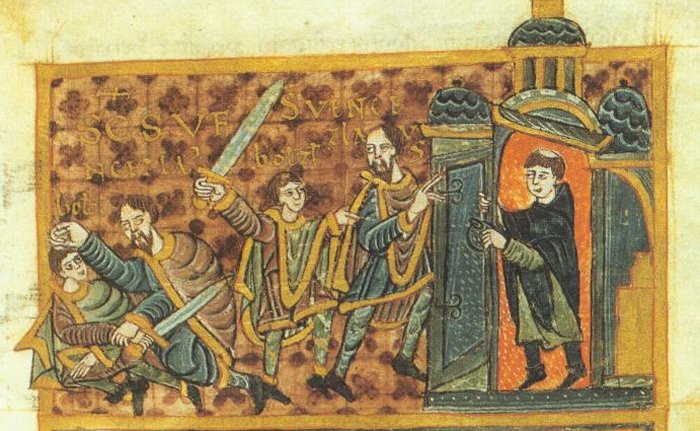 Wenceslaus' assassination: the duke flees from his brother (with sword) to a church, but the priest closes the door. Gumpold von Mantua, 10th century) Public Domain
Hatred, rivalry, and jealousy are destructive feelings that often destroy families. Drahomira, the brothers' mother, arranged to have Ludmila killed.
Wenceslaus banished his pagan mother and Boleslaus, starting the process of consolidating the Christianization of Bohemia.
Still, some of the powerful noblemen supported the banished Boleslaus, and they formed an opposition. They grew angry because a Christian king ruled the Kingdom of Bohemia.
On September 28, 935 AD, Boleslaus invited his brother to the ceremony honoring two saints, Cosmas and Damian (in Roman: Kuzmas and Dimyan), twin brothers and physicians from the Cilicia region, Asia Minor. These physicians practiced curing patients, especially the poor ones, without charging any fees for their treatment. In this way, they also attracted many people to the Christian faith. The brothers became early Christian martyrs.
During the Cosmas and Damian feast, a quarrel broke out between Wenceslaus and Boleslaus of Bohemia. The latter grabbed his dagger, and Wenceslaus escaped to the church. Unfortunately, before he arrived, three knights of his younger brother killed him at the chapel door.
Wenceslaus was murdered precisely when a son of Boleslaus was born. The child was given a bizarre name: 'Strachkvas,' which means "a dreadful feast."
In the iconography, Wenceslaus is depicted in armor and a royal costume. His attributes are a dagger - the tool of his death, an angel giving him a spear and a coffin carried by angels.
Before Wenceslaus died, he asked God's mercy for his brother, and thus he was recognized as a martyr. He was declared patron of Bohemia, now the Czech Republic.
Many legends described his life and martyrdom, including the "First Old Slavonic Legend" that originated in the tenth century.
Wenceslaus means in Slavic' great glory'.
Written by – A. Sutherland - AncientPages.com Senior Staff Writer
Updated on May 25, 2023
Copyright © AncientPages.com All rights reserved. This material may not be published, broadcast, rewritten or redistributed in whole or part without the express written permission of AncientPages.com
Expand for referencesReferences:
BORON Piotr, Kniaziowie, królowie, carowie
Ingham, Norman W. "Structure as Meaning in the "First Slavonic Life of St. Wenceslas"." Harvard Ukrainian Studies 28, no. 1/4 (2006)
Alban Butler A., Burns P. Butler's Lives of the Saints
Lusk Steven R. Descendants of Godwulf
More From Ancient Pages
-
 Bizarre Old Ring With License To Kill
-
 Advanced Ancient Irrigation Network Discovered In Mesopotamia
-
 Does A Renaissance Painting Offer Proof Of Unknown Advanced Technology?
-
 Norse Kingdom Of Dublin Was Founded By The Vikings In 839 A.D.
-
 How Did Mesopotamia Change The World?
-
 Beautiful Tudor Gold Pendant Linked To Henry VIII And Katherine Of Aragon Discovered By A Metal-Detectorist
-
 Mysterious And Unexplained Encounter With Unusual Tiny Beings In Italy – A Strange Connection – Part 2
-
 Beautiful Legend Of The Christmas Rose – A Symbol Of Love And Hope
-
 Secret Kumari Kandam Continent And Links To Lemurians
-
 Statue Of Apollo Discovered in Ancient City Of Prusias ad Hypium, Turkey
-
 Mictlan – Underworld Realm Of The Dead In Ancient Aztec Beliefs
-
 On This Day In History: Robert I, King Of Scots Known As ‘Robert The Bruce’ Was Born – On July 11, 1274
-
 World’s Oldest Depiction Of A Ghost Discovered On 3,500-Year-Old Babylonian Tablet
-
 Hidden Records Of A Civilization Frozen In Time – Mysterious Time Capsules
-
 10 Mysterious Undeciphered Ancient Scripts, Tablets, Codes And Maps
-
 Njord: Norse God Of The Seas And Seafarers And His Unhappy Marriage To Skadi
-
 Physical Violence In Ancient Mesopotamia Much Less Common Than Ancient Texts Suggest – New Study
-
 Unexplained 17th Century Encounters With A Malevolent Entity That Defy Rational Explanation
-
 Rock-Cut Chambers In “House of Muses” Of Zeugma, Home To Numerous Mosaics
-
 Were Other Humans The First Victims Of The Sixth Mass Extinction?

