
Amaterasu: Shinto Goddess Of The Sun And Priestess-Queen Sister To Controversial Susanoo God Of Storms
A. Sutherland - AncientPages.com - The Sun Goddess, Amaterasu is known as 'the great divinity illuminating heaven'. She is the elder daughter of Izanagi –no-Mikoto (“The August Male”), a deity born of the seven divine generations in Japanese mythology and Shinto.
According to most myths, Amaterasu appeared on earth with two brothers when their father, Izanagi, returned from Yomi, the underworld where he unsuccessfully tried to retrieve his deceased wife Izanami–no-Mikoto (“The August Female”).
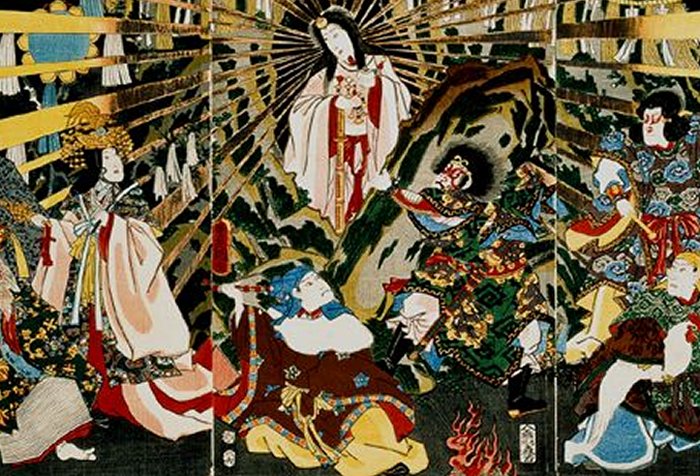
Amaterasu Cave. Image credit: wikipedia
Three Divine Siblings Were Born
After returning to the earth, Izanagi washed his left eye, and so gave birth to the great goddess Amaterasu, goddess of the Sun; he then washed his right eye and brought into the world the god of the Moon, Tsukiyomi. Then he washed his nose, and gave birth to the god Susanoo, the third of his noble children.
Then, he appointed Amaterasu, the goddess of the sun and the ruler on the High Plain of Heaven. Her brother, Susanoo became the ocean ruler and the god of storms while her second brother, Tsukuyomi was appointed the god of the moon.
Incident Between Amaterasu And Her Brother Tsukuyomi
Amaterasu and her brother Tsukuyomi took over the sky, but when Tsukuyomi killed Uke Mochi, the goddess of food, their relations worsened significantly.
It took place, when Amaterasu sent Tsukuyomi to represent her at a feast presented by Uke Mochi. The goddess prepared the food by turning to the ocean and spitting out a fish, then facing a forest and spitting out game, and finally turning to a rice paddy and coughing up a bowl of rice. Tsukuyomi was utterly disgusted by the fact that, although it looked exquisite, the meal was – according to Tsukuyomi - made in a disgusting manner, and so he killed her.
Amaterasu drove his brother away and thus, the day was forever separated from the night.
Amaterasu, Bringer Of Agriculture, Feminine Deity And Brave Warrior
Amaterasu is a beautiful and kind divine being. She is also a brave warrior with principles. Her sacred bird is Yatagarasu, the eight-handed (footed) crow, which may be identified with Yangwu, the sun-crow of China.
She is considered the bringer of agriculture, particularly inventing the cultivation of rice and wheat, the use of silkworms, and weaving with a loom.
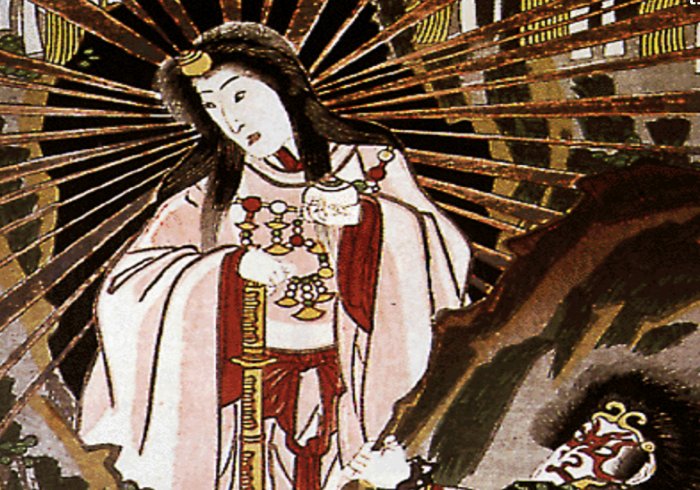
Amaterasu, the goddess of the sun. Image credit: Wikipedia
She is an ideal type of divine being. She is very feminine, delicate, and sensitive: She is also benign, and compassionate and likes gazing in her Sacred Mirror (Yata no Kagami), which is believed to be kept at her shrine as one of the imperial regalia objects of Japan.
On the other hand, she changes to a brave warrior preparing for warfare and building fortifications.
Continuous Worship Of Amaterasu - Only In Japan
Amaterasu is the culture-hero goddess of Japan and the most prominent member of the Shinto Pantheon. She is worshiped both as a spiritual divinity and as a sacred ancestor of the imperial family of Japan. She was once worshiped in the imperial palace but later a shrine was erected to her. The main shrine to Amaterasu is at Ise, in Mie Prefecture on Honshu Island.
Although traditionally, she probably was worshiped widely throughout Asia, only in Japan, there is a continuous worship of Amaterasu as a central figure, but several other religious movements including Taoism and Buddhism discouraged the adoration of solar goddesses.
See also:
Interestingly, researchers point out that the worship of Amaterasu is relatively late and most probably comes from pre-existing solar myths. Examinations of ancient sources reveal that only the Amaterasu family can be traced to the imperial line. This explains why they had a unique position in the society.
Conflict Between Amaterasu And Her Brother Susanoo
One of the myths, tells us of the struggle between Amaterasu and her brother Susanoo. This story is probably a reflection of a long-standing rivalry between a brother and his priestess-queen sister. Many stories tell that Susanoo insulted Amaterasu, claiming she had no power over the higher realm. In reality, Susanoo was never happy in Heaven, he desperately wanted to join his mother in Yomi, the Underworld.
When Izanagi ordered him to leave Heaven, he went to bid his sister goodbye.
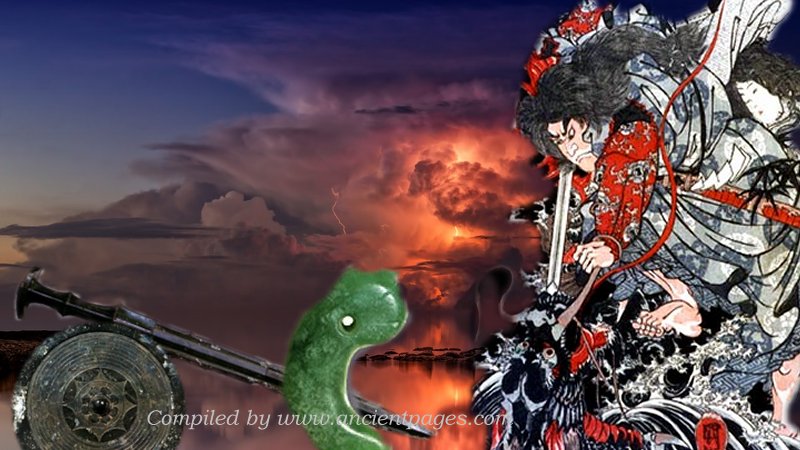
Susanoo-no-Mikoto – Shinto god of the sea and storms was banished from heaven. Read more
Amaterasu was suspicious, but when Susanoo proposed a challenge to prove his honesty, she accepted. Each of them took an object belonging to the other and from it, birthed deities. Amaterasu birthed three women from Susanoo's sword while he birthed five men from her necklace.
Claiming the gods were hers because they were born of her necklace, and the goddesses were his, Amaterasu claimed the victory because his sword produced women.
Angry after defeat, Susanoo destroyed rice-fields, uprooted trees, and even tore down sacred buildings. As a final provocation, he broke a hole in the roof of her weaving-hall, frightened to death her ladies, and drove the sun goddess herself into a cave. Amaterasu, who was in fury and grief, hid inside the "heavenly rock cave", plunging the earth into darkness and total chaos.
Finally, the goddess was persuaded to leave the cave. Initially, eight hundred deities organized a party outside of the cave to lure Amaterasu out. One of the goddesses performed a joyous and somewhat obscene dance, outside the cave.
At last, Amaterasu came out. Susanoo was punished by being banished from heaven. Both later amended their conflict when Susanoo gave her the Kusanagi-no-Tsurugi sword as a reconciliation gift.
When they both reconciled the sun became visible again and people were happy again.
Written by – A. Sutherland - AncientPages.com Senior Staff Writer
Copyright © AncientPages.com All rights reserved. This material may not be published, broadcast, rewritten or redistributed in whole or part without the express written permission of AncientPages.com
Expand for referencesReferences:
Hadland Davis. Myths & Legends of Japan
Guirand, F. New Larousse Encyclopedia of Mythology
Cotterell, A. World Mythology
More From Ancient Pages
-
 Table Manners And First Code Of Correct Behavior Were Introduced In Egypt 2,500 B.C. By Ptahhotep
-
 Legendary Bladud: The Flying King And Historical Founder Of Bath, England
-
 Strange History Of Safety Coffins: From Ancient To Modern Times
-
 Ancient Secrets Of The Theopetra Cave: World’s Oldest Man-Made Structure And Home To Humans 130,000 Years Ago
-
 Ancient Roman Altarpieces Deciphered And New Roman Goddess Uncovered In The Netherlands
-
 Ancient Cosmic Sanctuary Unearthed In Sogmatar, Turkiye, Where Moon God Sin Was Worshipped
-
 Second Gate Of Bazira And Unique Artifacts Discovered In The Ancient City Of Alexander The Great
-
 Ancient Cave Church Complex In Basarabi, Romania
-
 Three 1850-Year-Od Stone Ossuaries Prevented From Looting Near Kafr Kanna In Galilee
-
 3,500 Underground Man-Made Maresha/Beit Guvrin Caves And Tunnels In The Holy Land
-
 Bizarre Towering Pillars Of Externsteine: Myths, Legends And Sacred Rituals From Times Long Gone
-
 On This Day In History: Samurai Final Battle of Shiroyama Was Fought – On Sep 24, 1877
-
 Neolithic Mendik Tepe Site Discovered In Southeastern Türkiye Is Older Than Gobeklitepe
-
 Megalith Tombs Were Family Graves In Stone Age Europe
-
 35,000 Unique Artifacts Discovered In 720-Year-Old Iroquoian Village In Canada
-
 Justinianic Plague Struck England Before It Reached Constantinople And It Did Not Wipe Out The Roman Empire
-
 Sedna: Inuit Goddess Sacrificed By Selfish Father Fearing For His Own Life
-
 Mystery Of The 2,000-Year-Old Grave On The Isles Of Scilly Solved!
-
 Rare And Tiny Ancient Stamps Found In Falster May Show The Way To An Unknown King’s Home
-
 Cassandra: Greek Goddess Who Foretold Cursed Prophecies

