
Lunar Society: Great Scientists Of The 18th Century Who Changed The World
Cynthia McKanzie - AncientPages.com - The Lunar Society consisted of great scientists whose ideas and inventions changed the world forever. Not everyone could become a member of the Lunar Society. This club served as a gathering place for scientists, inventors, and natural philosophers during the second half of the 18th century.
Members of the Lunar Society met regularly on the Monday nearest the full Moon between 1765 and 1813 in Soho House in Birmingham, England.

These gifted polymaths used to joke and call themselves lunatics, but this could not have been much further from the truth. They met nearest the full Moon simply because the light was better at night and thus ensured the members a safer journey home along the dangerous, unlit streets.
The Lunar Society never had more than 14 core members. Each member was noted for their particular area of expertise, including the most outstanding engineers, scientists, and thinkers of the day.
They were not only interested in science but especially in applying science to manufacturing, mining, transportation, education, medicine, and much else. It would be more appropriate to describe them as a revolutionary committee of that most far-reaching of all the eighteenth-century revolutions, the Industrial Revolution. Supremely confident, they were changing the world forever, and they knew it. They firmly believed that what they were doing would benefit humanity.
Visits and correspondents often swelled the ranks of the dozen regular members of the Lunar Society from more peripheral members, including Thomas Jefferson, Benjamin Franklin, Sir Richard Arkwright, Thomas Bedoes, Anna Seward, John Smeaton, etc.

Statue of Matthew Boulton, James Watt and William Murdoch in Broad Street, Birmingham. Credit: Public Domain
Among the members were great thinkers like:
Joseph Priestley, a minister of religion and amateur scientist who discovered oxygen, the indiarubber eraser and much else, invented carbonated water.
William Murdock, inventor of gas lighting.
William Small, doctor of medicine who had taught mathematics to the young Thomas Jefferson and who had interests in engineering, chemistry and metallurgy.
Jonathan Stokes, botanist.
James Watt, inventor of the condensing and rotary steam engines, an early copying process and much else; maker of musical and scientific instruments, canal surveyor, and more.
Josiah Wedgwood, celebrated potter, canal promoter and Charles Darwin's other grandfather.
John Whitehurst, maker of clocks and scientific instruments, and a pioneering geologist who did much to work out how the earth had been formed.
William Withering, another medical doctor, also a botanist with interests in metallurgy and chemistry. He is most famous for discovering the medicinal properties of the foxglove in treating heart disease, and took the place of William Small following the latter's untimely death in 1775.
The American statesman Benjamin Franklin was a corresponding member of the society, as were others including John Smeaton, the great civil engineer.
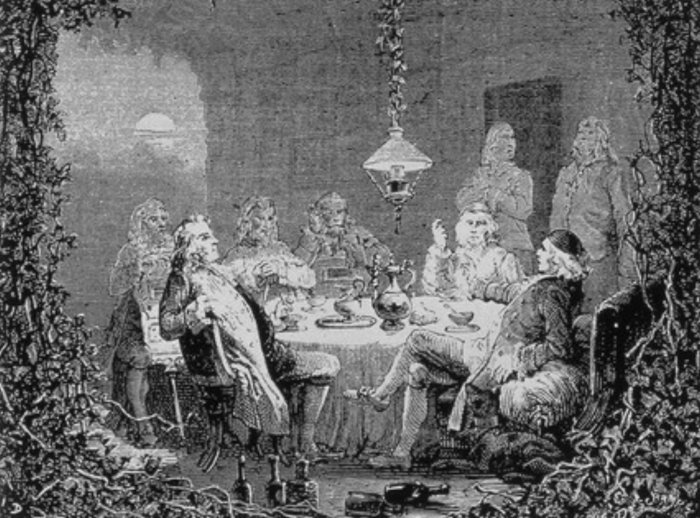
Meeting of the Lunar Society at Soho House late 18th century. Science Museum
What is not commonly known is that the Lunar men instigated the anti-slavery movement, with Thomas Bicknell writing an anti-slavery poem, 'The Dying Negro’ (1773), and Wedgwood produced medallions showing a chained slave with the motto "Am I not a man and a brother."
They wanted to bring poverty, science, and social consciousness to the debate and improve our world.
These passionate, optimistic, idealistic individuals marked their place in the world as the new class, the nonconformists and reformers whose domination we feel now.
Although their informal meetings were a mixture of social gatherings, experiments, and discussions, they led to significant progress and scientific achievements that significantly improved our society.
Updated on August 3, 2022
Written by Cynthia McKanzie - AncientPages.com Staff Writer
Copyright © AncientPages.com All rights reserved. This material may not be published, broadcast, rewritten or redistributed in whole or part without the express written permission of AncientPages.com
Expand for referencesMore From Ancient Pages
-
 Ullikummi – Genderless, Blind, Deaf Rock Monster Created For Strategic Purposes In Beliefs Of Hurrian People
-
 Gold Spiral In Early Bronze Age Grave – Unearthed
-
 An Expert Explains Why Tutankhamun’s Tomb Remains One Of The Greatest Archaeological Discoveries
-
 How Individuals With Disabilities Were Treated During The Late Middle Ages – Advanced Techniques Give Answers
-
 Earliest Evidence Of Evolutionary Trait That Enabled Dinosaurs To Become Giants – Brazilian Fossil Reveals
-
 Excavations Revealed Evidence That Early Humans Lived In Britain More Than 700,000 Years Ago
-
 India’s Mysterious Stonehenge: Prehistoric Complex Of Gigantic Standing Stones Of Willong Is An Enigma
-
 Rare 3,300-Year-Old Sword Accidentally Discovered In Jesenicko, Czech Republic
-
 Striking Ancient Stone Idols: The Forgotten Polovtsian Statues Of Eastern Europe
-
 On This Day In History: Napoleon Exiled To Elba – On Apr 11, 1814
-
 On This Day In History: Howard Carter Discovered King Tut’s Tomb In The Valley Of The Kings – On Nov 4, 1922
-
 Ancient City Of Troy Was Destroyed By An Earthquake That Ended The Trojan War – Archaeologists Say
-
 Kültepe: Once Part Of The Kingdom Of Hittites And The Center of a complex network of Assyrian trade colonies in the 2nd millennium B.C.
-
 Secret Writing On Mummy Papyrus Revealed – Scan Technique Will Shed Light On Daily Life In Ancient Egypt
-
 Egyptian Artisans In The Valley Of The Kings Had Permanent Jobs In The Time Of The Pharaohs
-
 Rare Hidden Copy Of Shakespeare Sonnet 116 Discovered In A 17th-Century Poetry Collection
-
 Mysterious Ancient Circular Structure Discovered In Turkey – Has Zippalanda, The Lost City Of The Hittites Been Found?
-
 Etzanoa: Long-Lost Native American City Discovered In Kansas After 400 Years
-
 Thousand-Year-Old Farming Techniques And Irrigation Systems Can Be Used To Mitigate Climate Change
-
 Sacred Number One: Very Powerful Symbol Equated With The Mystic Center

