

Conny Waters - AncientPages.com - Researchers recreated a damaged ancient scroll to test a new method for examining historical texts.
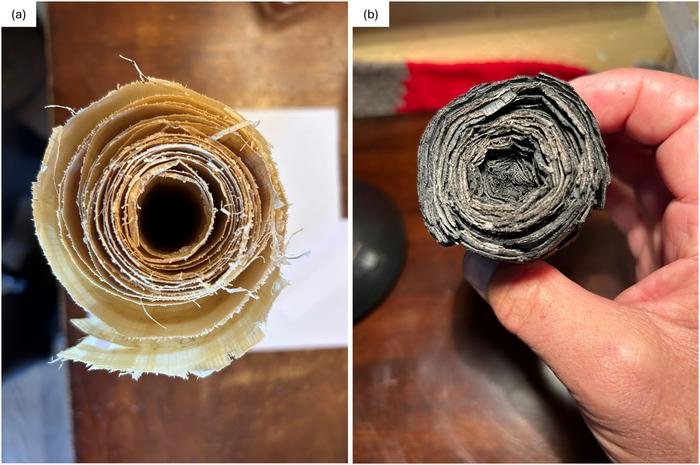
A model carbonized papyrus scroll opens a novel path to identifying readable scrolls of the Herculaneum Library. a) One of several papyrus scrolls before carbonization and (b) after carbonization. The carbonized scroll is produced with tightly packed layers and waviness that will challenge unrolling algorithms. Image credit: Seiler et al., 2026, PLOS One, CC0 1.0 Universal
According to a new study, X-ray technology and artificial intelligence, combined with the discovery of lead in the ink of ancient Roman scroll fragments, could soon help scientists read texts buried by the eruption of Mt. Vesuvius in 79 CE.
Scientists found the Herculaneum papyrus scrolls in the ruins of Herculaneum near Naples, Italy. The eruption covered the scrolls with 65 to 70 feet of rock and ash, carbonizing them and making them extremely brittle.
Some scrolls have been opened and read, revealing previously unknown works by Epicurus and other ancient thinkers, but many remain too fragile to study.
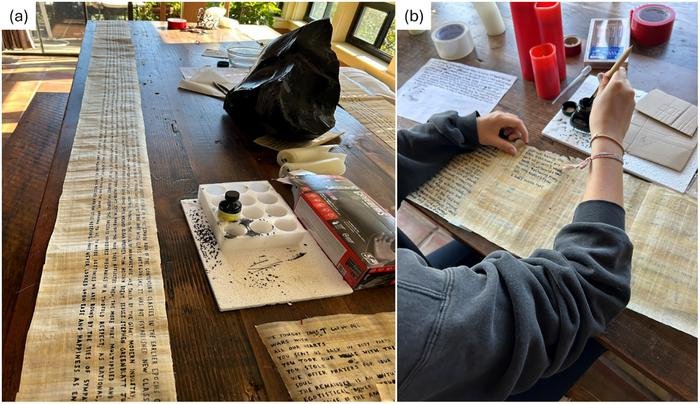
Preparation of papyrus scroll with inks of varying lead concentrations. Image credit: Seiler et al., 2026, PLOS One, CC0 1.0 Universal
Recently, AI and X-ray tomography have enabled researchers to unroll some scrolls and read portions of the text virtually. However, X-rays struggle to distinguish ink from papyrus because both are carbon-based.
Some Herculaneum scrolls, though, contain lead in the ink. Because X-rays can more easily differentiate papyrus from lead, the authors recommend scanning for lead and virtually unrolling only those scrolls that contain it.
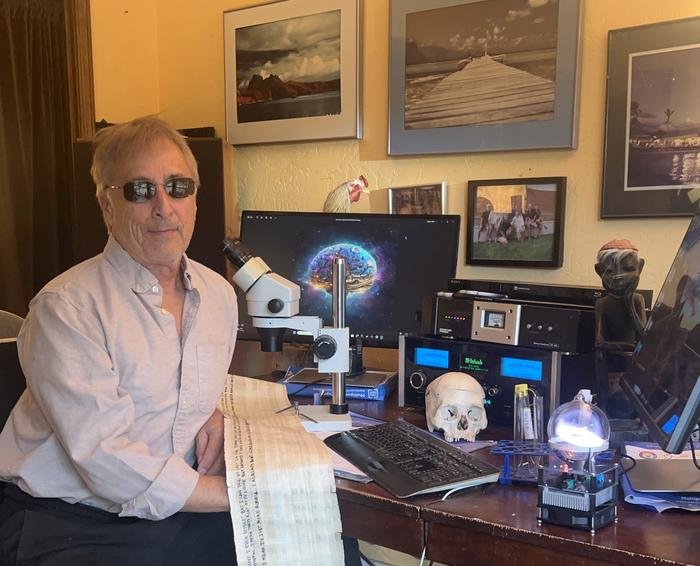
Douglas Seiler in Lab #3. Image credit: Douglas Seiler, CC-BY 4.0
To test this approach, the team recreated carbonized scrolls by writing on new papyrus with inks containing different lead concentrations, then heating them in a high-temperature furnace. X-ray fluorescence detected lead at each concentration, and X-ray tomography, combined with custom software, enabled the team to read some of the words written on these scrolls.
See also: More Archaeology News
These results present a new opportunity to read some of the more complex Herculaneum scrolls.
Additionally, the team’s method for recreating carbonized scrolls could help improve virtual unrolling algorithms. By knowing the contents of these recreated scrolls, researchers can train algorithms to decipher ancient texts more effectively.
Written by Conny Waters - AncientPages.com Staff Writer