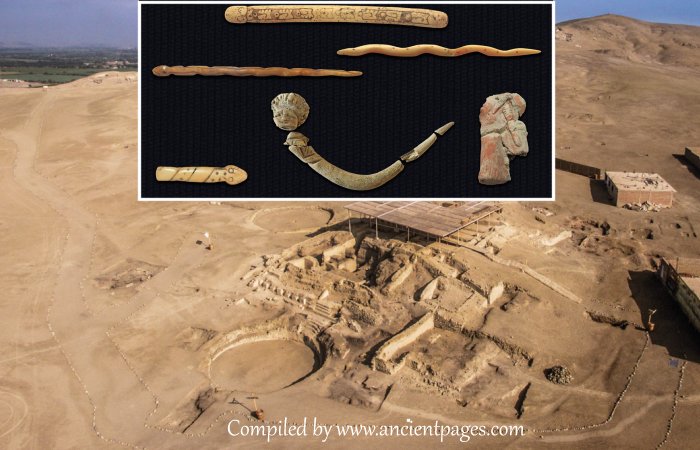


Conny Waters - AncientPages.com - Vichama is the Inca god of death, vengeance, and fertility, and the son of Inti, the sun god. The name also refers to a significant archaeological site: the Caral city north of Lima, which flourished between 1800 and 1500 BCE. Archaeologists have uncovered 3,800-year-old artifacts there, revealing stories of struggle and survival in a challenging environment.
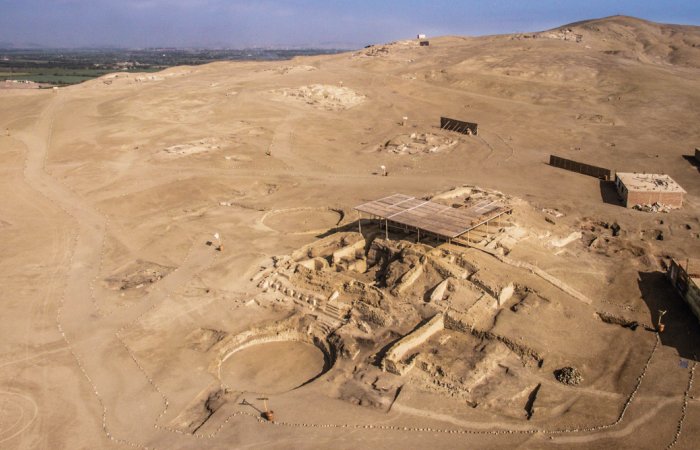
Caral Archaeological Zone. Credit: Peruvian Ministry of Culture
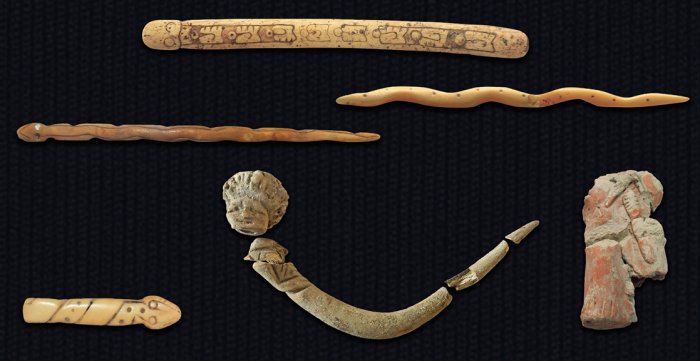
According to the Peruvian Ministry of Culture, these ancient bone-and-clay objects feature snake motifs and were found in both public and residential spaces. Some were intentionally placed as offerings during building renovations. These serpent artifacts illustrate how ancient Peruvians transformed catastrophic drought into lasting ritual memory and communal resilience.
Two notable sculptures were recovered from Sector D of Vichama. The first, carved from a young deer’s antler and about 30 centimeters long, depicts an apparently deceased anthropomorphic figure with closed eyes and mouth, accompanied by a serpent. This composition may represent transformation and renewal, with the serpent symbolizing the transition to a new life cycle.
The second sculpture, 6.9 centimeters long, is made of unfired clay and retains red and black pigments. Its front displays a relief of a snake with a triangular head, while one side shows the figure holding an object that may have served a ritual purpose.
Both pieces further demonstrate the serpent’s role in Vichama’s symbolic and ritual traditions, representing transformation, renewal, and the continuity of life. The serpent is also associated with water and fertility, which were essential for a society dependent on agriculture and fishing.
Dr. Ruth Shady Solís, director of the Caral Archaeological Zone, emphasized that this evidence allows us to understand how the inhabitants of Vichama interpreted the climate changes that occurred thousands of years ago and preserved in their memory the experiences associated with these processes.
Credit: Peruvian Ministry of Culture
“The Vichama society left reliefs depicting what climate change meant 3,800 years ago, so that the information about what happened and how we must prevent it from happening again would not be lost in people's memory. The message we are recovering is this: we must reflect, but how? By knowing history and, based on that, reflecting on what changes we must promote,” she stated.
Nineteen years of research have identified 34 anthropomorphic and ichthyomorphic reliefs in the Main Public Building (Sector A), forming the Mural of the Dance of Life and Death. In Sector K, the Mural of Fertility features two snakes converging on a central figure interpreted as an anthropomorphized seed.
Minister Alberto Beingolea highlighted the significance of the archaeological work at the Caral Archaeological Zone, led by Dr. Ruth Shady, and emphasized the value of recovering historical knowledge.
See also: More Archaeology News
“This is the testimony of a civilization that lived on Peruvian soil and faced natural disasters, suffered them, and suffered them severely. I believe it is a magnificent reflection, not to dwell on the past, but to look at the present and the future. They are speaking to us, they are telling us what might happen, and we must listen,” he stated.
Source: Peruvian Ministry of Culture
Written by Conny Waters - AncientPages.com Staff Writer