


Jan Bartek - AncientPages.com - During an architectural history investigation of a 1244 cellar on Konradigasse in Konstanz, Germany, researchers discovered that the ceiling was constructed from parts of a medieval ship. This finding by the State Office for the Preservation of Historical Monuments offers valuable insights into the region's maritime history.
Credit: Landesamt für Denkmalpflege
An interdisciplinary team from the State Office for the Preservation of Historical Monuments (LAD) at the Stuttgart Regional Council found that parts of a ship were used to build the ceiling of a 1244 cellar in Konradigasse, Konstanz. This discovery highlights medieval resource-recycling and circular-economy practices and sheds light on shipbuilding techniques of the period.
"Initially, it was only clear that the planks had been reused. The fact that they were originally part of a ship was a complete surprise," says Dr. Aline Kottmann, specialist in medieval archaeology at the State Office for Cultural Heritage Baden-Württemberg (Landesamt für Denkmalpflege, LAD).
The State Archaeology Office (LAD) is currently searching for shipwrecks in Lake Constance as part of the "Wrecks and Deep Sea" project, strengthening its expertise in maritime archaeology.
Credit: Landesamt für Denkmalpflege
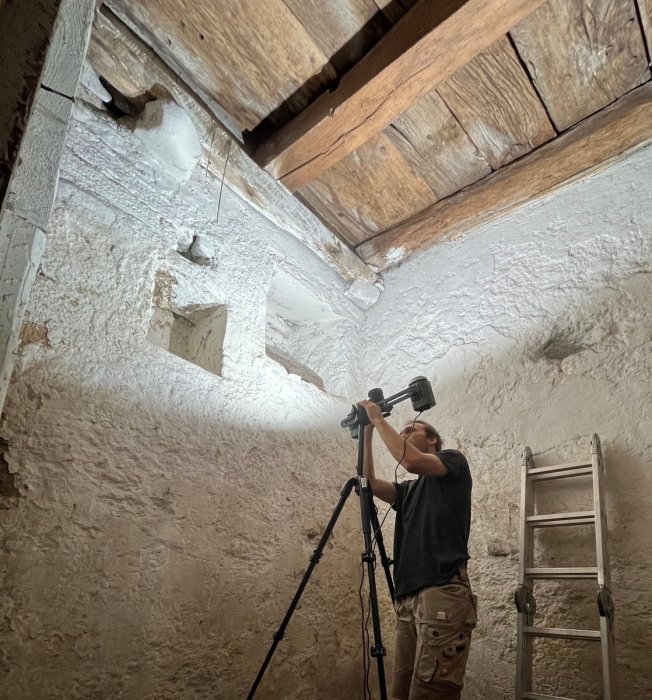
"It is known that decommissioned ships were reused as building timber in the Middle Ages. Nevertheless, the find in Constance is something very special: Here, not just individual fragments, but an almost completely intact ship's hull was used," reports Alexandra Ulisch, a staff member in the "Wrecks and Deep Sea" project. The ceiling covers more than 25 square meters and consists of at least 19 planks, identified as parts of a medieval ship by characteristic wooden pegs, rows of pegs, and typical plank shapes.
Initial analyses indicate these remains belong to a flat-bottomed cargo sailing ship, similar to other discoveries in the Lake Constance region, including the 14th-century Kippenhorn wreck near Immenstaad. "If parts of the side planking have indeed survived, new insights into the construction of medieval ships and the design of the transition between the bottom and side planks would be possible," reports Ulisch.
Credit: Landesamt für Denkmalpflege
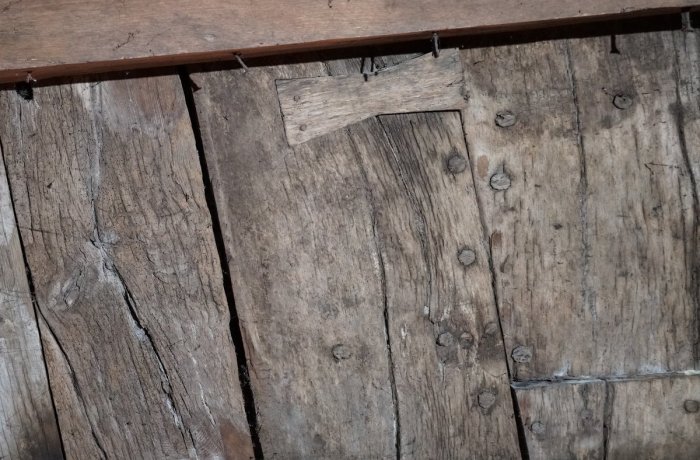
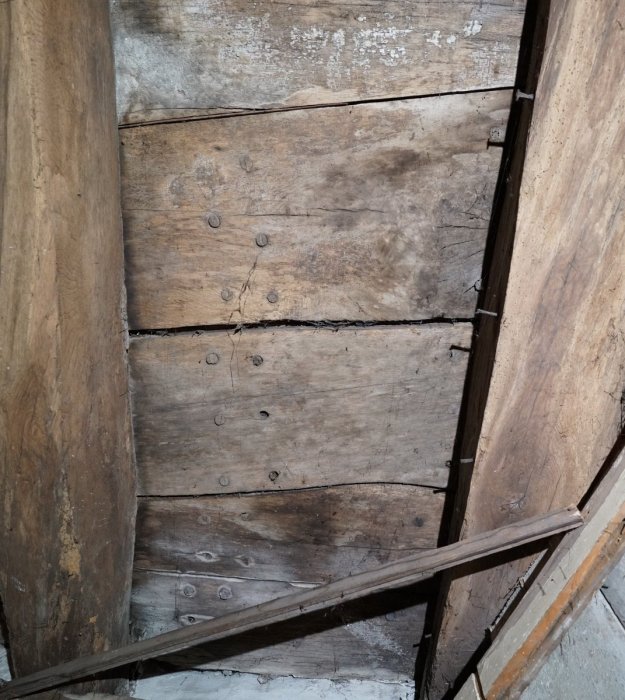
Several repairs to the planks are also notable. In multiple areas, damaged sections were removed and replaced with precisely fitted wooden inserts. At least four such repairs are visible, including a dovetail-shaped inlay not previously documented in medieval shipbuilding on Lake Constance. Another distinctive feature is the visible connection between some planks:
"They are precisely cut to fit one another and, as they were installed in the ship, are attached to the ceiling. This has also preserved the caulking, the sealant between the planks, in some places," reports Ulisch. The caulking material is of particular interest for maritime archaeology and was therefore analyzed.
Credit: Landesamt für Denkmalpflege
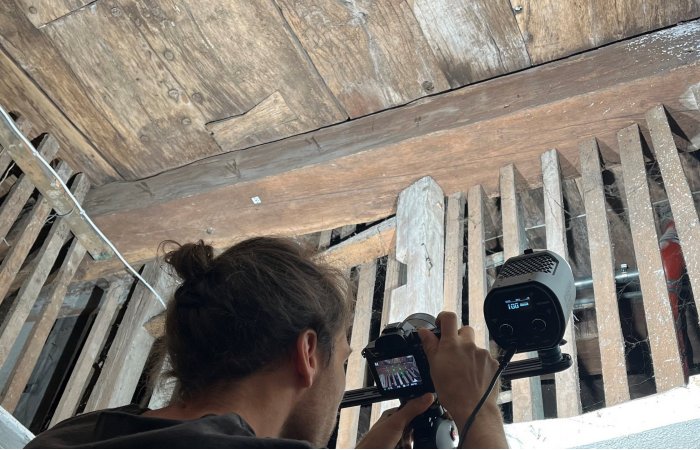
In mid-August 2026, the findings were documented again and recorded in 3D using structure-from-motion (SfM). Hundreds of images are now being digitally combined to form a complete picture. Wood samples were collected for dendrochronological analysis.
"The analysis of the samples will take place in the coming weeks. We are very excited to see the results," reports Dr. Aline Kottmann.
See also: More Archaeology News
The scientific significance of this discovery is largely due to its exceptional preservation. As Kottmann stated, “While the already few medieval shipwrecks in Lake Constance are underwater and can only be examined with considerable effort, the timbers of Konradigasse are preserved in a much more accessible environment.
Therefore, they offer ideal conditions for further analysis. The find goes far beyond a chance discovery. It is a valuable testament to medieval shipbuilding technology and of particular importance for the maritime archaeology of the Lake Constance region.”
Source: Baden-Württemberg – Regierungspräsidium Stuttgart - Landesamt für Denkmalpflege
Written by Jan Bartek - AncientPages.com Staff Writer