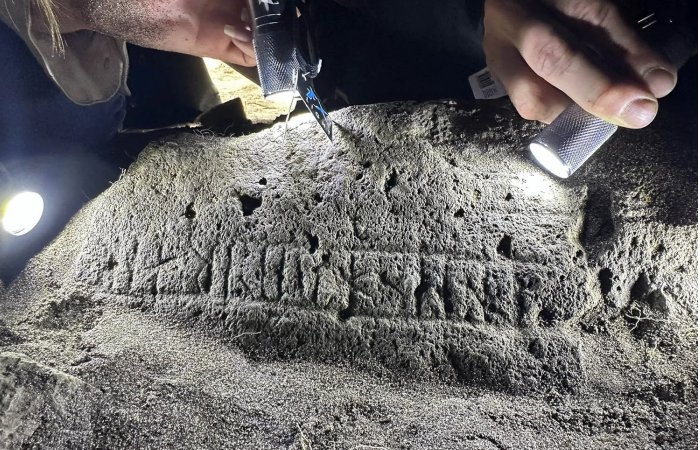


Jan Bartek - AncientPages.com - Very few runestones have ever been found in the Faroe Islands, so this discovery is especially important. This mysterious runestone not only increases the small number already known, but it could also reveal more about the islands’ medieval past.
The Faroe Islands are a self-governing group of islands within Denmark, located in the North Atlantic Ocean between Iceland and Scotland. Although the islands are small and not heavily populated, they have a rich history from the medieval period.
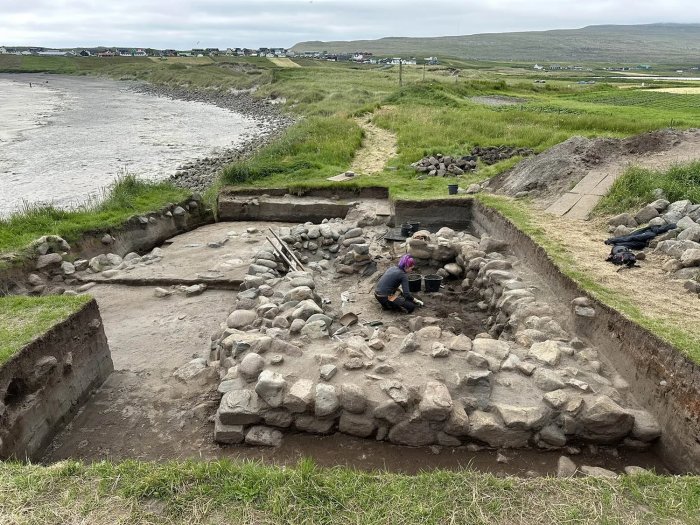
The excavation site. Credit: Helgi Michelsen
The runestone was recently found at the Á Sondum archaeological site on Sandoy during a dig led by the Faroe Islands National Museum, working with Aarhus University and the Moesgaard Museum.
The stone was set into the floor of what researchers think was a medieval chapel. Experts have identified the writing as Old Norse, but so far they have only been able to read the first words. Archaeologists from the National Museum gave an early translation: “Her hvílur…,” which means “Here lies…” or “Here rests…” in Old Norse.
To learn more about the runestone, archaeologists have asked a rune expert to visit the Faroe Islands in late August and study it closely.
Now that the runestone has been taken out of the ground, it is more fragile. To keep it safe, the stone will be moved from the dig site to the National Museum. Faroe Islands broadcaster KVF reports that the stone will also be 3D scanned to make a detailed digital copy before its surface gets more damaged.
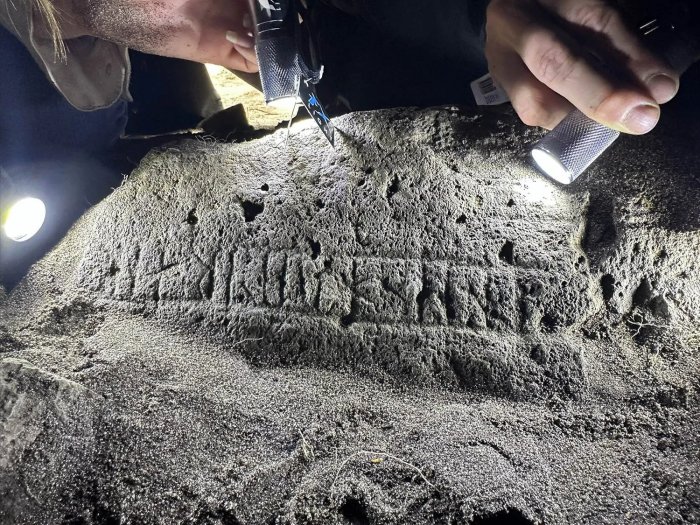
The discovered runestone. Credit: Helgi Michelsen
The runestone that was found could give important clues about how the area changed from Paganism to Christianity and about the people who lived there at that time.
Old Norse speakers settled in the Faroe Islands in the early 9th century, and over time, their Old West Norse dialect became modern Faroese. Some of these settlers were Norse–Gaels from areas around the Irish Sea, the Northern Isles, and the Outer Hebrides, including Shetland and Orkney. They brought Gaelic slaves, which affected the Faroese gene pool and added many Old Irish words to the language. The Færeyinga saga says that many Norwegians left their homeland because they were unhappy with Harald Fairhair’s rule, which also led to the settlement of Iceland.
Christianity came to the islands in the late 900s and early 1000s, brought by the chieftain Sigmundur Brestisson.
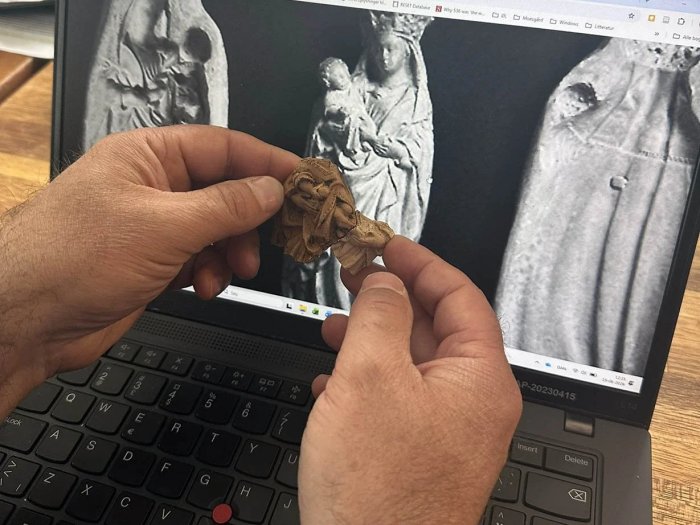
Virgin Mary with baby Jesus. Credit: Helgi Michelsen
Other artifacts uncovered at the Sondum excavation this summer include fragments of a small statue of the Virgin Mary with the Child Jesus and a charcoal, believed to be a small candle or oil lamp.
These finds might be connected to Christian activities at the site, and the building that was uncovered is thought to have been a medieval prayer house.
See also: More Archaeology News
The building faces east to west, with its entrance on the west side. This layout is common for medieval prayer houses and chapels. In the Faroe Islands, other examples include the prayer house at Bønhúsberg in Mykines, Bønhústoft in Leirvík, and the toft at Bakki in Velbastaður.
The National Museum plans to keep working on the excavation until the end of August.
Source: Faroe Islands National Museum
Written by Jan Bartek - AncientPages.com Staff Writer