


Jan Bartek - AncientPages.com - A new computational method can find traces of ancient hominin ancestry in modern humans without needing archaic reference genomes. This method has revealed that a mysterious "ghost" population contributed DNA to the ancestors of all modern humans before they left Africa.
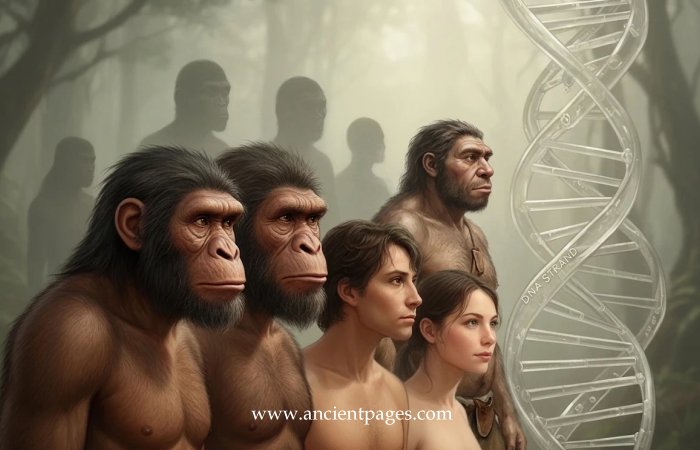
So far, sequencing Neanderthal and Denisovan genomes has shown that interbreeding with archaic hominins shaped our DNA. Scientists also think modern humans mixed with other unknown archaic groups, often called "ghost" populations.
Evidence from living people and Denisovan genomes suggests there were even older "super-archaic" lineages that split from the human family tree nearly a million years ago or more. But because there are few archaic DNA samples, especially from older or more diverse groups, and because current methods rely on reference genomes, it has been hard to fully trace the history of archaic DNA mixing.
Here, Yulin Zhang and colleagues developed a new computational method called TRACE that reconstructs ancestral recombination graphs (ARGs) – detailed maps of how genomes have evolved through recombination and shared ancestry – to detect the genetic signatures of ancient interbreeding.
Unlike previous approaches, TRACE requires neither an archaic reference genome nor data from an unadmixed outgroup population, allowing scientists to identify previously unknown archaic contributions using only the genomes of living people. The authors validated the approach in simulations and applied it to high-coverage genomes from global human populations, including the 1000 Genomes dataset.
TRACE successfully recovered known Neanderthal and Denisovan ancestry while uncovering previously unknown episodes of interbreeding with archaic human groups. The findings suggest that an unidentified "ghost" population contributed DNA to the ancestors of all modern humans before they dispersed out of Africa, rather than only to specific African populations as previously proposed.
See also: More Archaeology News
Surprisingly, this ghost ancestry is also found in genomic regions thought to reject Neanderthal and Denisovan DNA, suggesting those regions may have specifically selected against those lineages rather than against all archaic ancestry.
TRACE also found evidence that Oceanians inherited traces of an even more ancient "super-archaic" human lineage indirectly through Denisovans, revealing that the genetic legacy of modern humans was shaped by multiple waves of interbreeding with now-extinct human groups.
The study was published in the journal Science
Written by Jan Bartek - AncientPages.com Staff Writer


