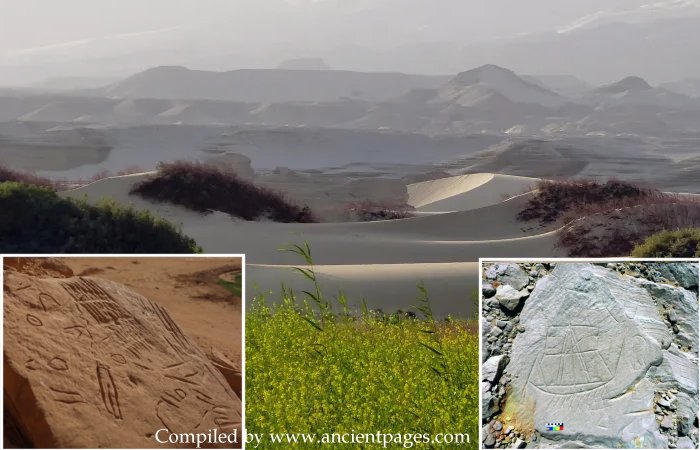



Jan Bartek - AncientPages.com - Thousands of ancient rock carvings in Egypt’s Western Desert are gradually disappearing. Climate change and human activity are damaging some of Africa’s richest prehistoric art collections. Polish archaeologists are working to document what remains before it is lost.
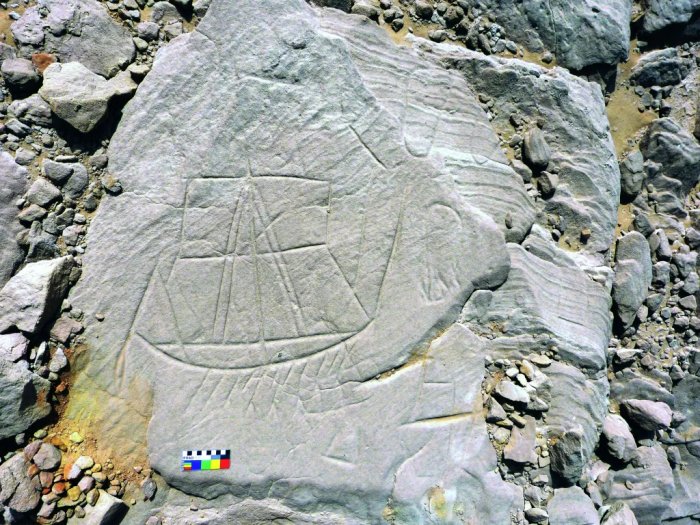
Depictions of a boat and sandals from the dynastic period. Credit: Paweł Polkowski
The Dakhleh Oasis, one of the largest in Egypt’s Western Desert, lies about 350 km west of the Nile Valley between the Farafra and Kharga oases. Spanning roughly 80 km and home to over a dozen settlements, it has been inhabited since prehistoric times and served as a key stop on caravan routes connecting the Nile Valley with the Sahara and Libya.
Thousands Of Rock Carvings Point To Long-Term Human Occupation
Thousands of petroglyphs carved into the desert rocks are among the most significant evidence of this long human presence. Polish scientists have studied these carvings for over 40 years.
Since 2016, Pawel Polkowski, PhD, from the Archaeological Museum in Poznan and the Institute of Archaeology and Ethnology of the Polish Academy of Sciences, has led the Dakhleh Oasis Project Petroglyph Unit. In 2019, he became head of the international Dakhleh Oasis Project, which coordinates multiple archaeological missions in the oasis.
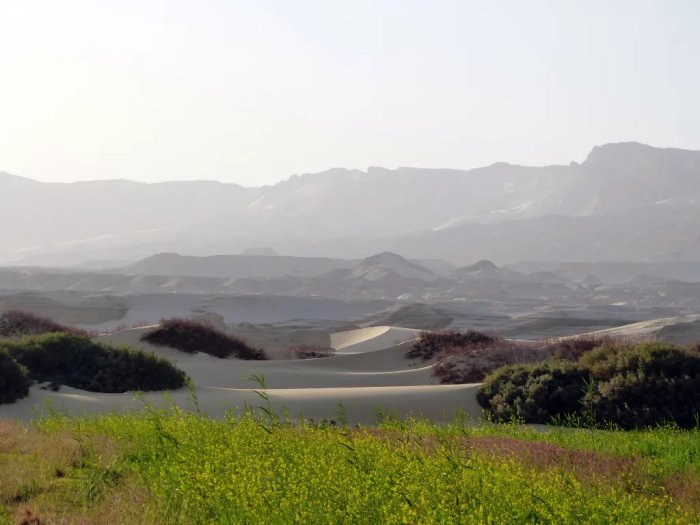
Dakhleh Oasis. The slope of the Libyan Plateau in the background. Credit: Paweł Polkowski
“We have inventoried approximately 350 rock art sites,” Polkowski says. “A site may contain one, sometimes a few petroglyphs, but there are also sites with several hundred or even over a thousand carvings. The petroglyphs date back to both prehistoric and ancient times, to 6,000–5,000 BCE, but some also come from the post-ancient, medieval, and modern periods; we also know of a few finds from the 20th and 21st centuries.”
Why Ancient Egyptian Rock Art Remains Overlooked
The researchers are examining not only prehistoric images but also hieroglyphic, Coptic, Greek, Graeco-Latin, and Arabic inscriptions. Together, these findings provide a rich record of human activity spanning thousands of years.
“Egypt is one of the richest countries in Africa and globally in terms of rock art,” Polkowski explains. “We are talking about vast complexes of paintings and petroglyphs in southwest Egypt, on the border with Libya and Sudan. These areas have enormous scientific and tourist potential. The entirety of Upper Egypt is one vast complex of rock art, spanning prehistory to the near-modern era. The Eastern Desert is also exceptionally rich in rock art, although there has never been much research there. And the entire Western Desert, where oases are located.”
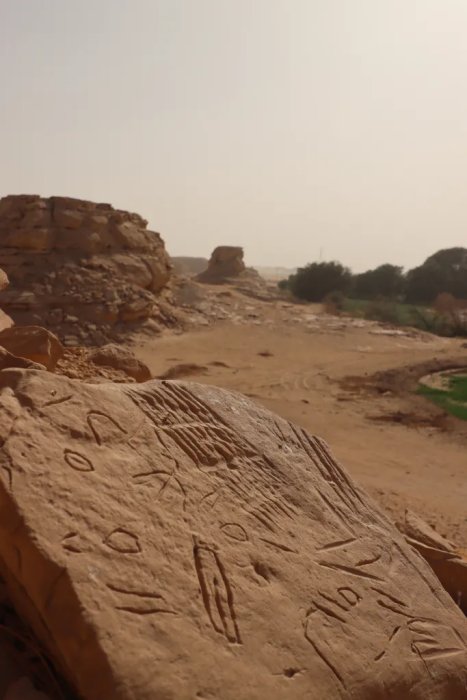
Credit: dr Paweł Polkowski
Although Egypt has a rich tradition of rock art, it remains relatively unknown internationally. This is largely because it competes with the more prominent monuments of pharaonic Egypt, which dominate archaeology, tourism, and popular culture.
“Therefore, it's difficult to interest local authorities in sites that are less spectacular from a tourist perspective, such as sites with rock carvings or inscriptions,” Polkowski says. “Unfortunately, they are often left unprotected. We and our colleagues from other missions document numerous destructions, sometimes quite dramatic ones.”
Fragile Rock Art Requires Special Effort
Many carvings have only partially survived due to natural erosion. The Nubian sandstone supporting much of the Dakhleh Oasis rock art is especially fragile.
“Many petroglyphs are only fragmentarily preserved. In some cases, this is the result of ongoing natural processes,” Polkowski says. “The Nubian sandstones on which the rock art in the Dakhleh Oasis was created are generally quite brittle. Many of these rocks are so soft that you could make a rock carving with your finger.”
Even harder, iron-rich rocks are not immune to decay. They are slowly worn away by extreme temperature changes and powerful winds carrying fine desert dust. The process is likely to accelerate as the climate changes.
“In recent years, an additional element has been added in the form of fairly regular heavy rains,” Polkowski says. “This was something that had not been a problem in this part of the world for a long time. Now, with global climate change, we are seeing this again. Rains are devastating to traditional architecture in that region, and to rock art. There is a little less of it each year, and certainly less from decade to decade, or from century to century.”
Why Scientific Work Is Challenging
Because much of the damage is irreversible, researchers are prioritizing detailed documentation. They plan to revisit known sites, enhance recording accuracy, and conduct contextual excavations to determine the age of individual carvings.
However, dating Egyptian rock art remains challenging. Unlike many archaeological objects, petroglyphs are rarely associated with materials suitable for direct analysis. Researchers mainly rely on comparisons with rock art from other regions and the archaeological context of the carvings.
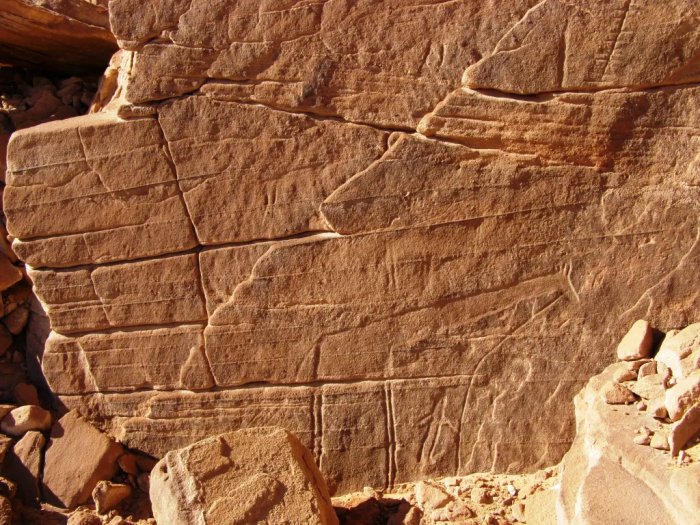
Giraffe held on a rope. Credit: Paweł Polkowski
Fieldwork has also become more difficult. Polkowski notes that since 2014, his team and others have been unable to obtain the permits required to resume research in Egypt’s Western Desert.
“For about 10 years, virtually no archaeological missions have worked in the Western Desert, with a few exceptions,” he says.
Research in Egypt, especially in remote desert areas, requires several approvals.
“To conduct research in Egypt, especially in the desert, you need to obtain a dozen or so permits, but three in particular are essential,” Polkowski explains. “The first is a permit from the Antiquities Service, i.e., the Ministry of Tourism and Antiquities. Every year, we manage to obtain such a permit, and the research program we propose is approved.”
However, missions must also receive approval from security services.
“It has always been a bit of a lottery, but in recent years, the situation has worsened significantly,” Polkowski says. “Permits never arrive, and there is never any feedback as to why. Once the deadline and time have passed, the mission must submit a new application, and this happens every year. The problem does not concern only us, but that is hardly a consolation.”
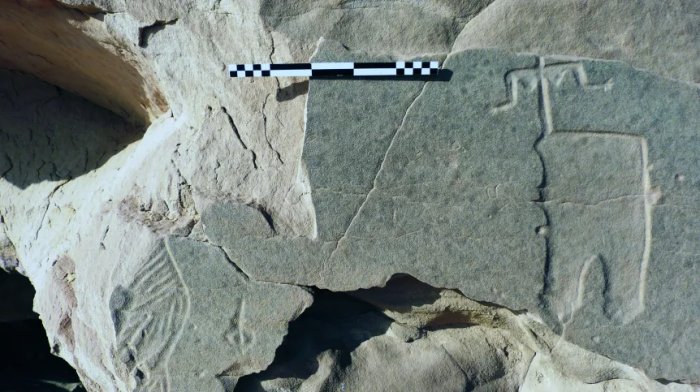
Accurate field documentation is increasingly urgent as newer carvings are covering older petroglyphs. Scientifically, these later additions are valuable because they demonstrate the continued human use of rock surfaces over thousands of years.
“From a legal perspective, of course, this is a form of vandalism,” Polkowski says. “Unfortunately, these changes are irreversible, and there is no protection for these monuments, so such situations are common. This applies to Egypt, Sudan, and most Saharan countries.”
Credit: Paweł Polkowski
The practice of adding new carvings over older ones, however, is not a modern phenomenon.
“We have Greco-Roman images and inscriptions found on dynastic and earlier carvings,” Polkowski explains. “The foot motif has been regularly carved over or next to prehistoric carvings throughout history, dating back to the dynastic period.”
Recent discoveries offer insight into those who traversed the desert in later centuries. Early 20th-century carvings at the Dakhleh Oasis likely depict British Army soldiers with rifles and flags. In 1916, British forces established a base in the area and conducted military operations.
See also: More Archaeology News
Among the modern carvings, archaeologists identified one particularly unusual and familiar object.
“The strangest thing I found carved into the rock was a very small piece of sandstone, carved to resemble a smartphone,” Polkowski says. “It was rectangular, with a screen and a keyboard carved on one side, and camera lenses on the other.”
Source: Science in Poland ( Nauka w Polsce)
Written by Jan Bartek - AncientPages.com Staff Writer