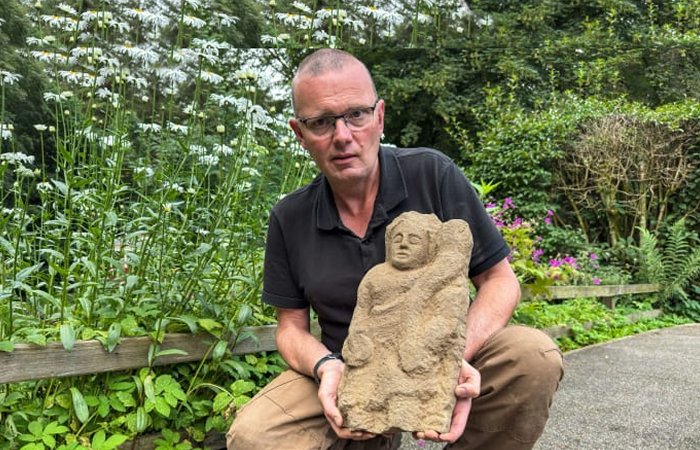



Conny Waters - AncientPages.com - A well-preserved Roman relief depicting a protective guardian spirit was found at Vindolanda in northern England, where it had been hidden beneath a barrack floor for over 1,600 years. The third generation of the Birley family of archaeologists uncovered it, making this not only a significant archaeological find but also a meaningful moment in the story of one of Britain’s most famous Roman sites.
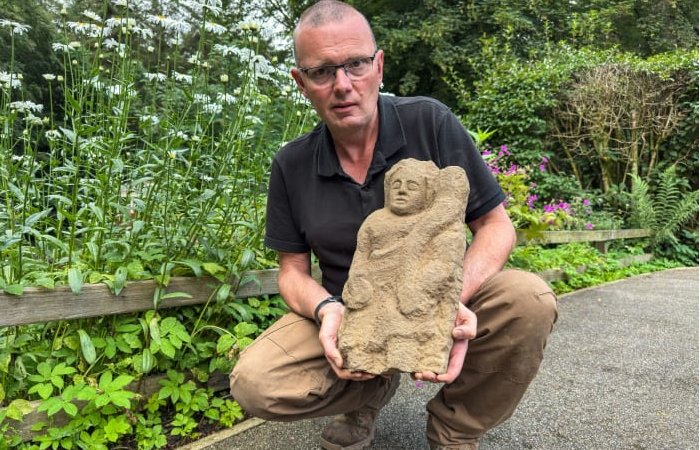
Dr Andrew Birley with carved sandstone depicting a Genius. Credit: Vindolanda Trust
Some archaeological finds are important for what they teach us, while others are memorable for the excitement of their discovery. The carved Roman Genius found at Vindolanda is both.
On 16 June 2026, Dr Andrew Birley, Director of Excavations at Vindolanda, was working in a fourth-century barrack building when he noticed a rounded flagstone. He knelt, turned the stone over, and found the face of a finely carved Roman figure that had not been seen since it was buried beneath the barrack floor over 1,600 years ago.
The relief, well preserved due to its burial, is believed to have been part of a home shrine. It likely represented a Genius, the protective spirit Romans invoked for safety, prosperity, and good fortune.
This discovery holds special significance. While many of Vindolanda's finds are made by volunteers each year, this remarkable artifact was uncovered by Dr Birley, the third generation of his family dedicated to the site's exploration. His grandfather, Professor Eric Birley, began excavations in the 1930s, and his father, Robin Birley, advanced understanding of the site through decades of archaeological work. Now, Andrew Birley has revealed one of Vindolanda's most evocative discoveries.
Dr Andrew Birley said: "I have been fortunate enough to have worked at the site for many years and made some wonderful discoveries along the way, but I was completely unprepared for what I found on the other side of this stone. It was an extraordinary moment, one that we were able to share with the team of archaeologists and volunteers whose hard work makes discoveries like this possible.
"My first thought was simply, 'Who on earth am I looking at?' Thankfully, Hadrian's Wall is home to an incredible community of generous and knowledgeable scholars. After sending photographs to Lindsay Allason-Jones, Dr Fraser Hunter and Alex Rome-Griffin, the unanimous response came back within hours: we had uncovered a previously unknown relief of a Genius – the protective spirit of a place."
The relief shows the Genius holding a cornucopia, symbolizing abundance and prosperity, in one hand and a patera, a shallow dish used in ritual offerings, in the other. Archaeologists believe it was carved locally, either by a mason at Vindolanda or by a sculptor from a regional workshop, such as the Roman fort at Lanchester in County Durham.
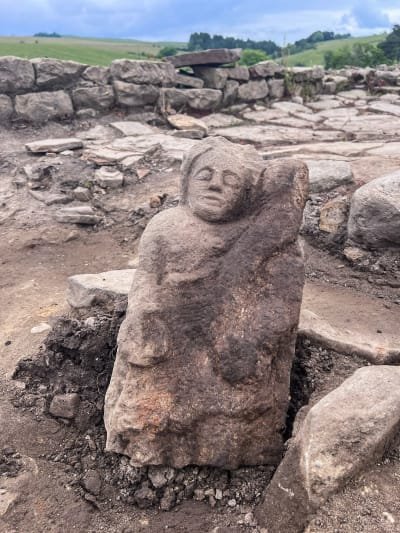
Carved stone depicting a Genius in situ. Credit: Vindolanda Trust
Inscriptions dedicated to a Genius are common across Roman Britain, reflecting the widespread worship of these protective spirits, but carved stone reliefs are rare. The Vindolanda discovery is therefore a significant addition to Romano-British sculpture, offering a rare opportunity to study both the iconography of a Genius and its archaeological context.
Reflecting on the discovery, Dr Birley added: "Once we knew who we had found, it somehow felt entirely appropriate. It was almost as though Vindolanda itself had reached out to the team and quietly said, 'We approve of what you are doing.' As archaeologists, moments like these are incredibly rare, and we feel privileged to have uncovered and preserved such an important part of the site's story."
See also: More Archaeology News
Buried beneath a fourth-century barrack block for over sixteen centuries, the relief provides new insight into the religious beliefs of the soldiers and families at Vindolanda during the final centuries of Roman Britain. Its exceptional preservation and secure archaeological context make it one of the most significant religious stone carvings found at the site in recent years.
The sculpture is currently undergoing conservation and detailed study before it is displayed in the on-site museum. Visitors will then be able to see a guardian that has watched over Vindolanda for more than sixteen centuries.
Source: Vindolanda
Written by Conny Waters - AncientPages.com Staff Writer