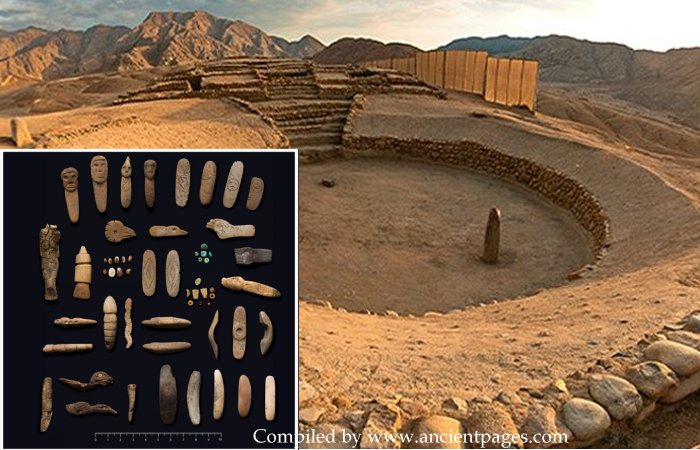



Jan Bartek - AncientPages.com - The ancient Peruvian city of Peñico was once a thriving trade hub and home to one of the oldest civilizations in the Americas. Located 12 kilometers from the Sacred City of Caral-Supe in present-day Huaura province, north of Lima, Peñico is gradually revealing its history to archaeologists working in the area.

Ancient city of Peñico. Credit: Peru Ministry of Culture
Following the abandonment of the main urban centers of the Caral Civilization (3000–1800 BC), cultural continuity persisted in the Supe Valley. Artifacts unearthed in the region provide valuable insight into the beliefs, traditions, and practices of its ancient inhabitants. Researchers from the Caral Archaeological Zone (ZAC), Executive Unit 003 of the Ministry of Culture, led by Dr. Ruth Shady Solís, identified an exceptional offering carefully placed during a ritual associated with the construction of a new platform in the Major Public Building (subsectors B1-B3) of the settlement.
These wooden and bone objects highlight Peñico’s continued significance as a center of power and ritual following the decline of the earliest American cities.
The offering included 43 wooden and bone pieces, some engraved and others showing signs of exposure to fire. These featured representations of mythical and anthropomorphic figures, including a female figure and possible deities, as well as zoomorphic forms such as birds, snakes, and tadpoles. Geometric motifs and abstract designs were also present. Several pieces contain cavities for inlaying minerals or semiprecious stones, underscoring their ceremonial use.
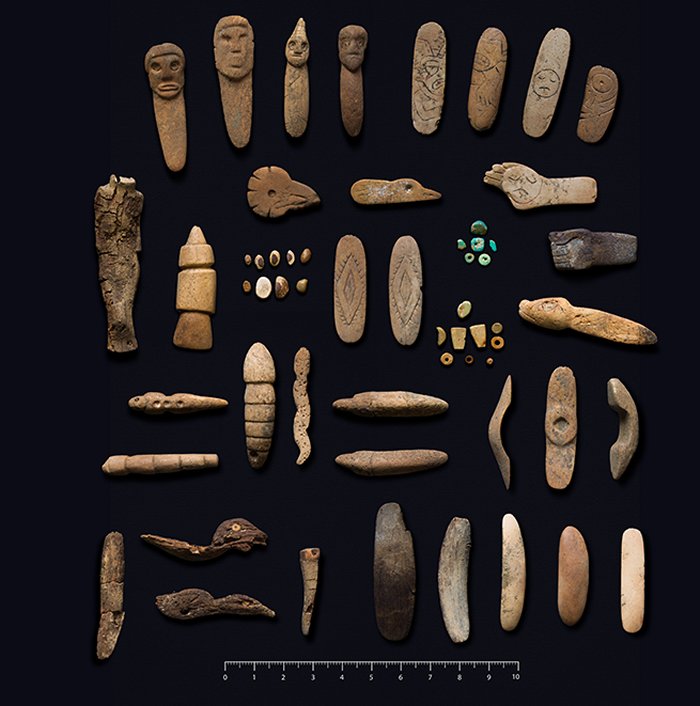
A total of 43 ancient items made from wood and bone, some featuring engraved designs, were found at the site. Credit: Peru Ministry of Culture
The assemblage also included three beads and three chrysocolla fragments; two bead fragments made from terrestrial gastropod shells (family Orthalicidae); nine eye representations crafted from mollusk shells intended for sculpture; and eight smaller objects of various shapes that are still under investigation.
Credit: Peru Ministry of Culture
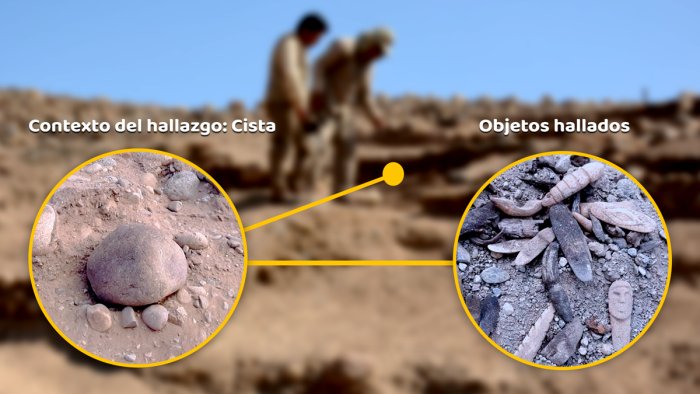
The discovery was made in a small area marked by pebbles arranged in a semicircle and covered by a large stone. The structure, containing both earth fill and ritual objects, measures 22 centimeters in length. This context provides clear evidence of a planned ceremonial act with deep symbolic significance for Peñico society.
This discovery extends beyond academic interest, providing valuable evidence of a society that preserved a cultural tradition from the Supe Valley and helped transmit essential knowledge to later Andean civilizations.
Peñico shows that, even after the decline of the Caral Civilization’s urban centers, the knowledge, memory, and beliefs of its people persisted, evolving into new cultural forms.

Aerial view of Peñico in Peru. Credit: Peru Ministry of Culture
Founded around 1800 BCE, the urban center of Peñico covered 19.44 hectares and emerged after the decline of the earliest Caral Civilization centers, including the Sacred City of Caral-Supe, 12.93 km away. Research shows that Peñico did not mark a cultural break. Instead, with its 15 public buildings, it served as a hub for integration between the coast and highlands, received goods from the rainforest, and preserved and adapted knowledge, rituals, and organizational forms from the Caral tradition.
See also: More Archaeology News
The recent discovery supports this historical continuity. Specialists have found similarities among the recovered pieces in materials, incision techniques, and iconographic patterns. Archaeological analysis also indicates that the offering was placed during the early construction of the Main Public Building, as part of ceremonies to consecrate important architectural spaces.
Source: Peru Ministry of Culture
Written by Jan Bartek - AncientPages.com Staff Writer