

Jan Bartek - AncientPages.com - Recent archaeological discoveries near Erbil in the Kurdistan region of Iraq are transforming our understanding of ancient urban life, governance, and decline.
At Kurd Qaburstan, archaeologists have uncovered the first significant group of cuneiform administrative tablets in the Erbil area, along with evidence of large-scale destruction, mass graves, and extensive fortifications. These findings offer one of the most detailed archaeological records to date of siege warfare and urban society during the Middle Bronze Age.
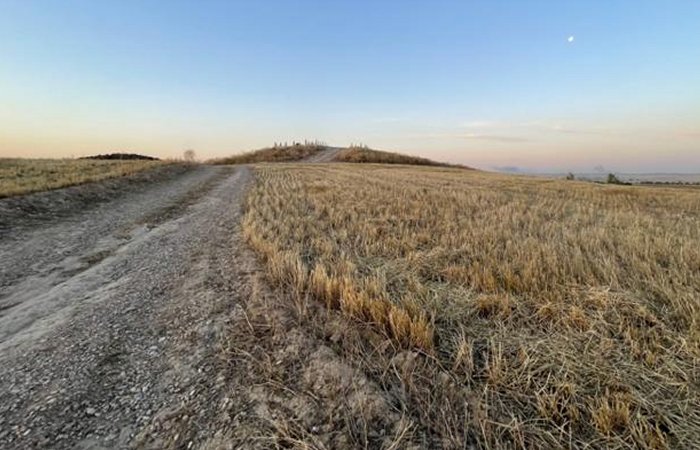
The landscape surrounding the ancient site of Kurd Qaburstan, where UCF-led excavations uncovered evidence of siege warfare, administrative archives and urban life dating back thousands of years. Photo courtesy of the Kurd Qaburstan Project
“Our 2025 research produced clear archaeological evidence linking the site to the siege of Qabra, beginning with the first significant group of cuneiform tablets found on the Erbil Plain,” says Tiffany Earley-Spadoni, associate professor of history at the University of Central Florida and director of the Kurd Qaburstan project. “Several tablets are dated within days of each other, matching the timeline of the city’s fall.”
The project is supported by the U.S. National Science Foundation and conducted in partnership with the Directorate-General of Antiquities and Heritage in the Kurdistan region of Iraq. The funded excavations took place during two summer seasons in 2024 and 2025.
A Lost Archive Emerges
Researchers recovered 20 cuneiform tablets and over 100 administrative sealings from destruction layers in the Lower Town East Palace (FIG 1). Epigraphers Paul Delnero (Johns Hopkins University), Parker Zane (Yale University), and art historian Marian Feldman (Johns Hopkins University) are currently studying these artifacts.
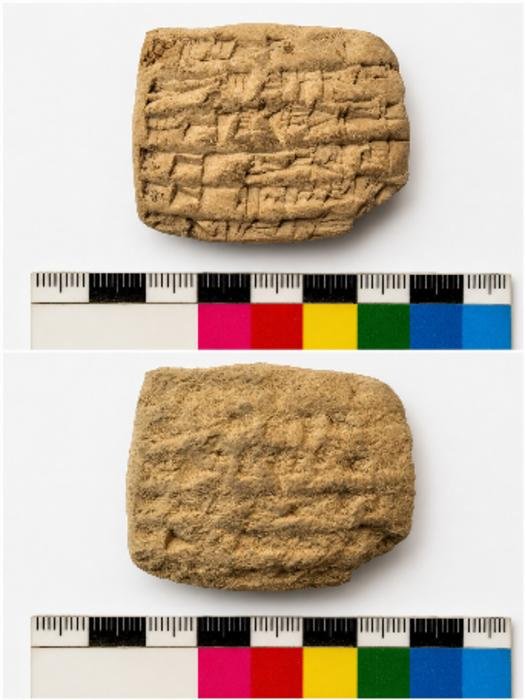
A cuneiform tablet from the Lower Town East Palace is shown before and after expert conservation. The tablet is part of a group of administrative texts discovered during excavations at Kurd Qaburstan. Credit: Carmen Gütschow/Kurd Qaburstan Project
The texts comprise palace administrative records and a letter that may reference a high-ranking official associated with Qabra. Some inscriptions may also relate to the destruction described on the Victory Stele of Dadusha.
“Most of the tablets are administrative and provide a snapshot of palace life and the economy of the ancient city,” Earley-Spadoni says. “One tablet appears to have been written by a high-ranking official in ancient Qabra.”
Evidence Of Siege Warfare
Collapsed structures, burned layers and concentrated debris suggest a coordinated and possibly prolonged assault (FIG 2).
“The two superimposed destructions match the historical sequence of the siege of Qabra and its conquest by Shamshi Addu,” Earley-Spadoni says. “The charred debris, the large number of ceramic vessels and individuals who met untimely deaths and were buried in the destruction layers, provide the clearest archaeological case of Middle Bronze Age siege warfare yet discovered in northern Mesopotamia.”
The Human Toll Of Conflict
Within the layers of palace destruction, researchers discovered the remains of 17 individuals, which were studied by bioarchaeologist Andrea Zurek-Ost at Michigan State University (FIG 3).
“The individuals were not formally buried and had no associated grave goods,” Earley-Spadoni says. “Some appear to have been left where they died, including possible palace workers. One individual was found face down over a stone basin.”
Researchers also uncovered a preserved street with an engineered drainage system, as well as domestic spaces for food processing and textile production. These findings indicate advanced infrastructure and economic activity.
Revealing An Ancient City Through Scaled Mapping
The team conducted a magnetometer survey over more than 80 hectares (about 180 acres), led by Andrew Creekmore III at the University of Northern Colorado. This survey, which detects buried structures by measuring changes in Earth’s magnetic field, revealed a monumental wall with bastions surrounding the site.
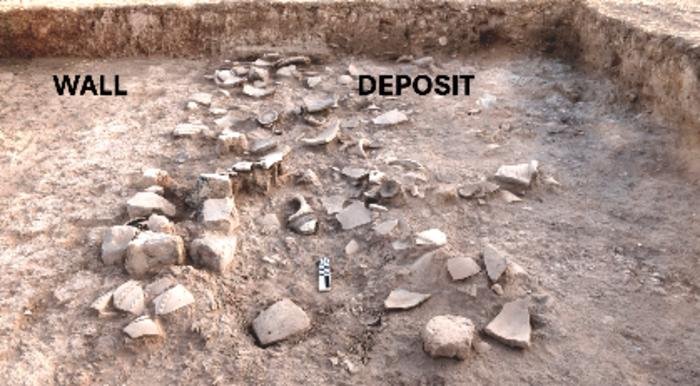
Broken vessels and other debris from a destruction layer were preserved east of a monumental mudbrick wall in the Lower Town East Palace at Kurd Qaburstan. Credit: Edward Dandrow/Kurd Qaburstan Project
The fortifications correspond with those depicted on the Victory Stele of Dadusha and support the identification of Kurd Qaburstan as the ancient city of Qabra.
Rewriting The Story Of Northern Mesopotamia
Mesopotamia is often associated with southern cities such as Uruk, traditionally regarded as the center of early urban civilization. According to Earley-Spadoni, discoveries at Kurd Qaburstan are drawing attention to the significance of northern cities.
See also: More Archaeology News
“The evidence from Kurd Qaburstan shows that northern cities could be large, complex, and politically significant, with administrative systems, fortifications, and infrastructure comparable to those of the best-known southern sites,” she says.
These discoveries build on ten years of excavation at Kurd Qaburstan by Johns Hopkins University, which has uncovered a city previously missing from the historical record.
“Laboratory investigations are underway, including isotopic and ancient DNA analyses of the 17 individuals,” Earley-Spadoni says. “This work will help researchers understand their origins and relationships.”
Each discovery advances researchers’ understanding of the city’s operation and eventual decline.
Source: University of Central Florida
Written by Jan Bartek - AncientPages.com Staff Writer