
Museum Classifies Roman Emperor Elagabalus As Trans – But Modern Labels Oversimplify Ancient Gender Identities
AncientPages.com - Elagabalus ruled as Roman emperor for just four years before being murdered in AD 222. He was still a teenager when he died. Despite his short reign, Elagabalus is counted among the most infamous of Roman emperors, often listed alongside Caligula and Nero.
His indiscretions, recorded by the Roman chroniclers, include: marrying a vestal virgin, the most chaste of Roman priestesses, twice; dressing up as a female prostitute and selling his body to other men; allowing himself to be penetrated (and by the bigger the penis the better); marrying a man, the charioteer Hierocles; and declaring himself not to be an emperor at all, but an empress: “Call me not Lord, for I am a Lady”.

The Roses of Heliogabalus by Alma-Tadema (1888). Credit: Public Domain
Based on this quote, North Hertfordshire Museum has reclassified Elagabalus as a transgender woman, and will now use the pronouns she/her. The museum has a single coin depicting Elagabalus, which is sometimes displayed along with other LGBTQ+ artefacts from their collection.
When writing about ancient subjects, from emperors to slaves, the first question historians have to ask is: how do we know what we do? Most of our written sources are fragmentary, incomplete and rarely contemporary, amounting to little more than gossip or hearsay at best, malign propaganda at worst. It’s rare that we have a figure’s own words to guide us.
Elagabalus is no exception. For Elagabalus, our principle source is the Roman historian Cassius Dio. A senator and politician before turning his hand to history, Dio was not only a contemporary of the emperor, but part of his regime.
However, Dio wrote his Roman history under the patronage of Elagabalus’ cousin, Severus Alexander. He took the throne following Elagabalus’s assassination. It was therefore in Dio’s interest to paint his patron’s predecessor in a bad light.
Sexual slurs and the Romans
Sexual slurs were always among the first insults thrown by Roman authors. Julius Caesar was accused of being penetrated by the Bithynian king so many times it earned him the nickname “the Queen of Bithynia”.
It was rumoured that both Mark Antony and Augustus had prostituted themselves for political gain earlier in their careers. And Nero was said to have worn the bridal veil to marry a man.
The Romans were no stranger to same-sex relationships, however. It would have been more unusual for a Roman emperor not to have slept with men. Roman sexual identities were complex constructs, revolving around notions such as status and power.
The gender of a person’s sexual partner did not come into it. Instead, sexual orientation was informed by sexual role: were they the dominant or passive partner?
To be the dominant partner, in business, politics and war as much as in the bedroom, was at the root of what made a Roman man a man. The Latin word we translate as “man”, vir, is the root of the modern word “virile”, and to the Romans there was nothing more manly than virility. To penetrate – whether men, women, or both – was seen as manly, and therefore as Roman.
Conversely, for a Roman man to be passive, to be penetrated, was seen as unmanly. The Romans thought such an act of penetration stripped a man of his virility, making him less than a man – akin to a woman or, even worse, a slave.
A man who enjoyed being penetrated was sometimes called a cinaedus, and in Latin literature cinaedi are often described as taking on the role of the woman in more than the bedroom, both dressing and acting effeminately. The implication is always that the way they dressed, acted and had sex was somehow subversive – distinctly un-Roman.
The word cinaedus appears in Latin literature almost exclusively as an insult — and it’s this literary role that is ascribed to Caesar, Mark Antony, Nero and Elagabalus. The power of the insult stems not from saying that these men had sex with men, but that they were penetrated by men.
It’s worth noting that these rules of Roman sexuality only applied to freeborn adult, male Roman citizens. They did not apply to women, slaves, freedmen, foreigners or even beardless youths. These people were all considered fair game to a virile Roman man, as uncomfortable a concept as that might be to us today.
Was Elagabalus transgender?
While the Romans clearly engaged in acts that we today consider gay or straight sex, they would not recognise the sexual orientations we associate with them. The ancient Romans did not share the same conceptions of sexuality that we do.
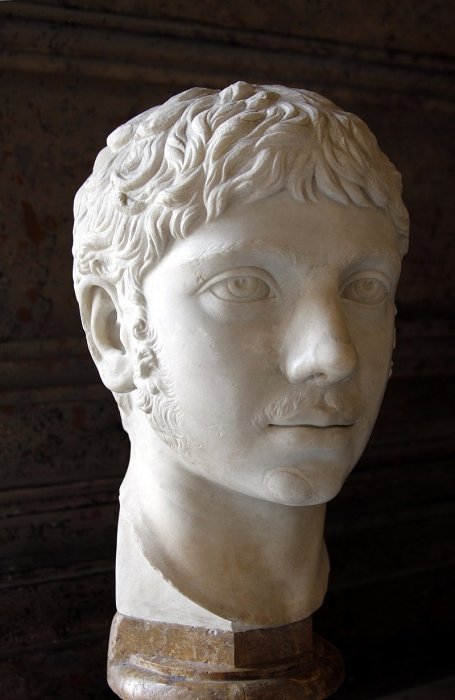
Bust of Elagabalus - Palazzo Nuovo, Musei Capitolini, Rome, Italy - Credit: José Luiz Bernardes Ribeiro, CC BY-SA 4.0
Many men’s sexual behaviour was what we would now term bisexual. Some lived in a manner we might describe as gender non-conforming. The concept of a person being transgender was not unknown. But an ancient Roman would not have self-identified as any of those things.
We cannot retroactively apply such modern, western identities to the inhabitants of the past and we must be careful not to misgender or misidentify them – especially if our only evidence for how they might have identified comes from hostile writers.
In attempting to fact check the sexual slurs and propaganda from the biographical facts, there is a danger that we lose sight of the fact that ancient Romans did recognise a huge variety of sexual orientations and gender identities – just as we do today. To attempt to crudely ascribe modern labels to ancient figures such as Elagabalus is not only to strip them of their agency, but also to oversimplify what is a wonderfully, fabulously broad and nuanced subject.
Written by Andrew Kenrick, Visiting Research Fellow, School of Literature, Drama and Creative Writing, University of East Anglia
Provided by The Conversation
This article is republished from The Conversation under a Creative Commons license. Read the original article.
More From Ancient Pages
-
 Moll Cutpurse – London’s Queen Of Thieves
-
 Mysterious Ancient Village In A Prehistoric Anomalous Zone – Dangerous Underground Secret – Part 2
-
 Stunning Facial Reconstruction Of Saint Ludmila’s Sons Of The Czech Royal Premyslid Dynasty
-
 Secrets Of The Magnificent 3000-Year-Old Peebles Hoard Revealed
-
 On This Day In History: British Fleet Attacked The Spanish ‘Invincible Armada’ – On July 21, 1588
-
 Enigma Of The Unusual Forest In Disguise
-
 World’s Oldest Mosaics Of Biblical Jonah And The Whale Discovered
-
 Mystery Of The East Asian Lineages In Europe 45,000 Years Ago Solved – Population Hub Out Of Africa Holds The Clues
-
 Unique Sword Casts New Light On Viking Voyages Across The North Sea
-
 Lost Kingdom Of Cleopatra – Legendary Lost City Of Heracleion
-
 Reports Of Mysterious Whistling Giants Roaming The Cascade Mountains – Ancient And Modern Accounts
-
 Qilin – One Of Four Noble Animals In Chinese Myths And Legends
-
 Mysterious Ancient Vanished Civilization With Unusual Physical Characteristics – Survivors Of The World’s First Race? – Part 1
-
 Oldest Modern Human Genome Identified With The Help Of Neanderthal Ancestry
-
 World’s Oldest Beer Factory Discovered In Abydos, Egypt
-
 Intriguing Phenomenon Sheds New Light On The Etruscans
-
 Ancient Artifacts With Puzzling Signs Found In North America May Be Evidence Of A Lost Civilization Or Unknown Native American Tribe
-
 Secrets Of Quipu – One Of The Most Mysterious Phenomena That Existed In Odd Number Of Dimensions
-
 Female Viking Pirate Rusla – The Red Maiden’s Deadly Encounter With Her Brother Tesondus
-
 Star-Shaped Magnetic Anomaly At Hidden Stone Circle In The Outer Hebrides Gives New Insight Into Ancient Beliefs

