
Lost Kingdom Of Idu And Its Seven Unknown Kings
A. Sutherland - AncientPages.com - An ancient city called Idu (now Satu Qala) was long hidden beneath a mound, and a few years ago, it was finally unearthed in northern Iraq.

Ancient Idu Kingdom - Glazed brick SQ 10-10 (measurements: 37.0 x 37.0 x 8.5 cm). Source
Mentioned in the 2nd millennium BC, Idu was a major center and the capital of the central province of Assyria. As located at the gate that leads from the plains of the west to the mountains of the east and northeast, Idu was a significant crossroad of two axes, south-north, and west-east. In the region met many people like Hurrians, Babylonians, and Assyrians.
This historical and archaeological place, even today, separates two central provinces from each other: Erbil and Kirkuk.
The oldest written evidence concerning the region of Idu comes from the Ur III period. Destroyed due to temporary military campaigns, Idu finally appeared again in the Middle Assyrian period under its old name, but this time as a flourishing center and capital of its region.
 King Sennacherib and his crown prince Arda-Mullissi after the battle of Lachish in 701 BC. From the palace at Nineveh. Source
Middle Assyrian control over the provinces weakened, and an independent royal dynasty arose in Idu. It was towards the end of the Middle Assyrian period. Cuneiform writing uncovered on the site described Idu as a flourishing kingdom for 140 years.
According to inscriptions at the site, at least seven successive kings with Semitic and Hurrian names ruled Idu. Six of the kings worked to build and expand the local palace center.
The title of "kings of the land of (the city of) Idu" implies that the kingdom extended beyond the immediate city area.
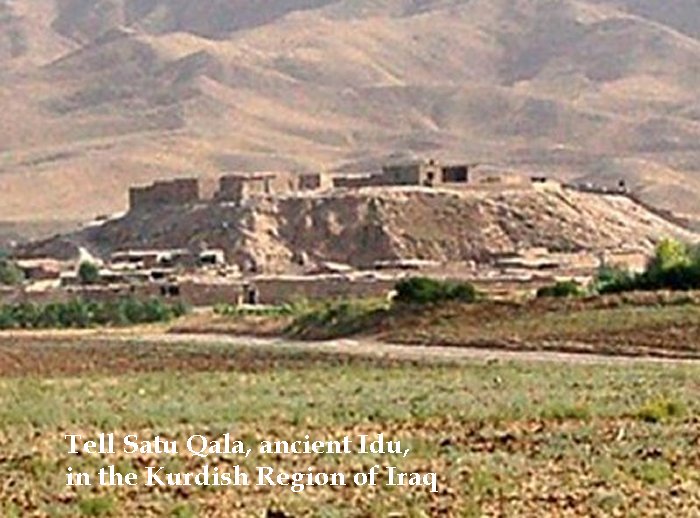 Ancient ruins of Idu. Source
By the end of the 10th century BC, Assyria again appeared on the scene to reclaim some of the territories the empire had lost at the end of the 2nd millennium. Archaeological excavations revealed scrolls with images of griffons and sphinx statues that once decorated King Ba'auri's grand palace.
Based on findings made by a team of archaeologists from the University of Leipzig, Germany, Idu was under the control of the Assyrian Empire about 3,300 years ago, then later gained its independence as the empire declined.
Tell Satu Qala is situated along the Little Zab in Iraqi Kurdistan. 2008 an ancient palace center was discovered during excavations near Satu Qala.
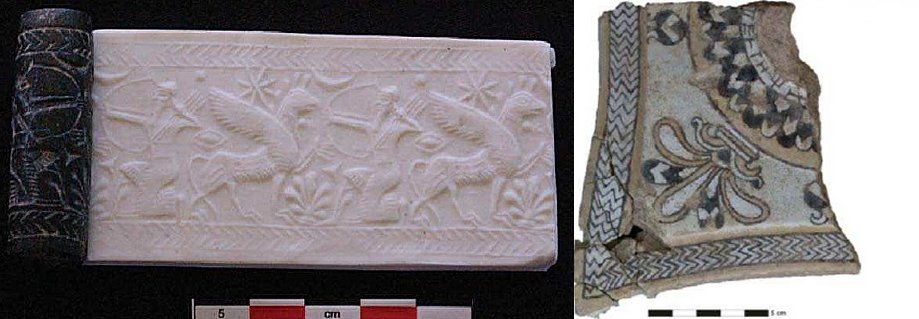 Kingdom of Idu - Cylinder seal; wall peg. Source
The area was carefully examined when an inscribed mudbrick came to light that identified it as ancient Idu, the provincial capital of the Assyrian Empire that was already known from other texts.
In 2010 and 2011, a team of archaeologists from several German universities carried out small-scale excavations resulting in the recognition of archaeological material ranging from the fourth to the first millennium BC.
Numerous inscribed mudbricks were found during these excavations, from which the names of at least seven local kings, previously unknown, could be reconstructed.
Moreover, the find of a wall peg with the partly preserved name of Assurnasirpal II indicates that Idu was firmly part of the Assyrian Empire at the time.
Idu is one of the crossing points from south to north. These were essential routes to Iran in the east and Babylonia in the south.
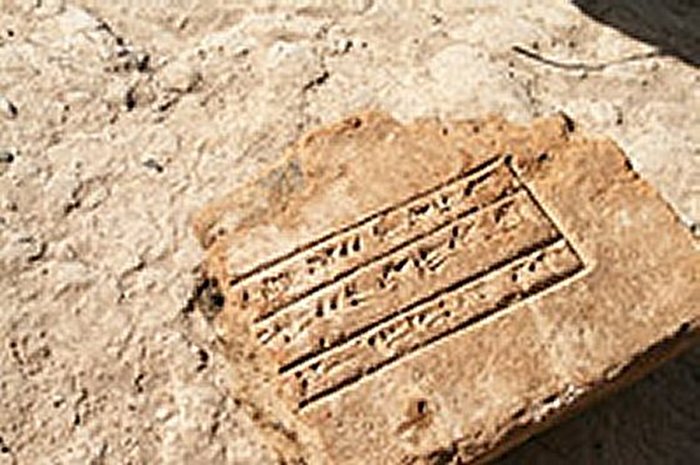
Inscriptions from Satu Qala (Idu) - Glazed brick (measurements: 25.5 x 19.0 x 8.0 cm). Photo credit: Leiden University.
"The role of the Lower Zab as a regional boundary goes back to much older periods. In the Middle Babylonian and Middle Assyrian periods, the Lower Zab region was the subject of long-term dispute between the two states, and the boundary was eventually set there only after peace had been concluded.
The Assyrians reconquered the city about 140 years later. Researchers have found artwork, including a bearded sphinx with a human head and the body of a winged lion, and a cylinder seal dating back roughly 2,600 years depicting a man crouching before a griffon. Also, the city's name was revealed during excavations in the area in 2008 when a resident from a nearby village brought them an inscription with the name carved in it.
Written by – A. Sutherland - AncientPages.com Senior Staff Writer
Updated on July 25, 2023
Copyright © AncientPages.com All rights reserved. This material may not be published, broadcast, rewritten or redistributed in whole or part without the express written permission of AncientPages.com
Expand for referencesMore From Ancient Pages
-
 Ouroboros – Cosmic Serpent And The Self-Devourer – Universal, Powerful Symbol Of Great Antiquity
-
 Tomb Of Nicolaus Copernicus: Is The Mystery Surrounding Astronomer’s Burial Place Really Solved?
-
 Neanderthals’ Lack Of Drawing Ability Could Explain Why Modern Humans Became Smarter
-
 New Insight On What Ancient Noses Smelled
-
 Oldest Aqueduct Dated To 3rd Century BC Discovered In Rome
-
 God Patecatl – Father Of ‘Four Hundred Rabbits’ In Aztec Beliefs
-
 King Tut’s Cosmic Dagger Was Not Made In Egypt – New Study Reveals
-
 Huge Ring Of Ancient Shafts Discovered Near Stonehenge
-
 What Happened To The Staircase In The Temple Of The Goddess Hathor?
-
 Ancient DNA Unravels The Mystery Of Huge 6,500-Year-Old Cemetery And The Tomb Of A ‘Masculine Woman’ In Normandy, France
-
 Is North America’s Oldest House In Ohio A 12,250-Year-Old Clovis Dwelling? Archaeologists Re-Investigate The Paleo Crossing Site
-
 Tangaroa – Polynesian God Of Ocean And Fish In Constant Struggle With His Brother
-
 Never-Before-Seen Colorful Inscriptions And Reliefs At The Esna Temple, Egypt Revealed After Restoration
-
 New Pyramid Discovered In The Sacred City Of Caral – Home To South America’s Oldest Civilization
-
 Hawaiian Petroglyphs Reemerging On Oahu’s Coast Are Considered An Ancestral Message About Rising Ocean Levels
-
 Extraordinary Biblical Frescos Uncovered In Domitilla Catacombs
-
 Howard Carter Stole Tutankhamun’s Treasures – Previously Unpublished Letter Reveals
-
 Roman Sexuality Was Far More Complex Than Simply Gay Or Straight – Pompeii’s House Of The Vettii Reveals Why
-
 Cappadocia And Huge Unique Selime Cathedral
-
 Mystery Of The British Pompeii Deepens – Bronze Age Settlement Destroyed By Dramatic Fire

