
What Can Monument 9 Reveal About The Mysterious Olmec Civilization?
AncientPages.com - Aztec and Maya civilizations are household names – but it’s the Olmecs who are the ‘mother culture’ of ancient Mesoamerica.
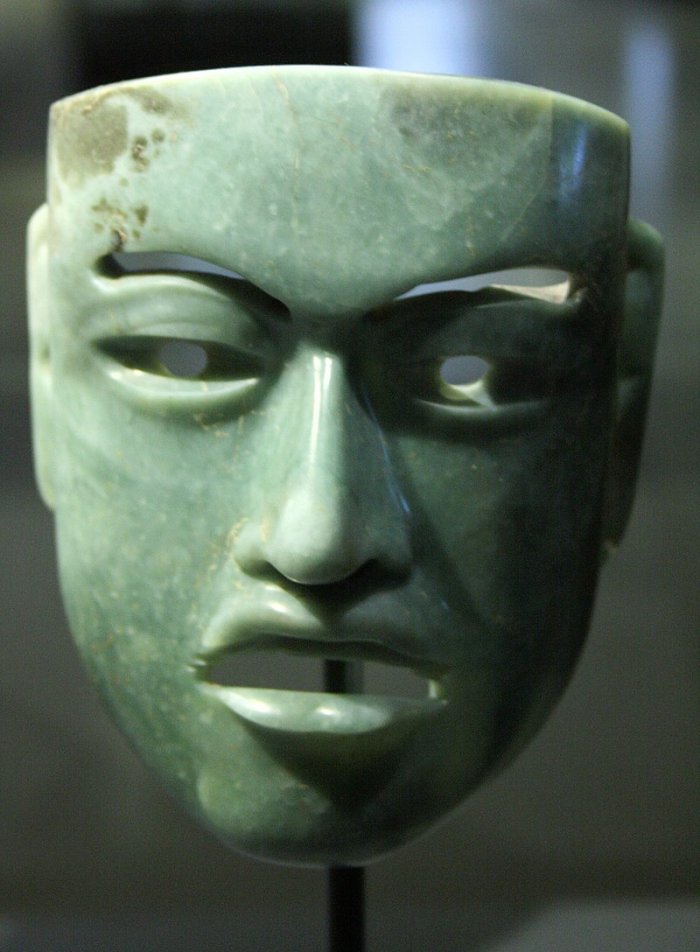
Jade Olmec warriors mask from Tabasco (Mexico). Musées Royaux d'Art et d'Histoire, Brussels (Belgium). Credit: Michel Wal - CC BY-SA 3.0s
An extremely important 1-ton sculpture, sometimes referred to by archaeologists as an “Earth Monster” or Monument 9, was repatriated to Mexico from a private collection in Colorado in May 2023, according to an announcement from Mexico’s Consul General in New York . The monument features the head of a front-facing creature with a gaping mouth: a supernatural being that represented the living, animate earth to an ancient culture in Central America and Mexico.
This sculpture was reportedly found at the base of a hill at Chalcatzingo, an archaeological site some 80 miles (130 kilometers) south of Mexico City, and dates to roughly 600 B.C. Chalcatzingo is closely related to Olmec culture, one of the earliest in ancient Mesoamerica.
I am an archaeologist specializing in Mesoamerica: an area that encompassed present-day southern Mexico, parts of Costa Rica and all of Guatemala, Belize, Honduras, El Salvador and Nicaragua. I have visited Chalcatzingo many times while researching the development of this rich cultural region.
Elaborate art
The Olmec heartland was in what are now the Mexican states of Tabasco and southern Veracruz, along the southern coast of the Gulf of Mexico. Much of their influence was based on economic wealth from corn.
Of Olmec art that has survived the centuries, their carved heads are particularly striking and well known. By 1000 B.C., Olmec sculptors at San Lorenzo, Mexico, had fashioned no fewer than 10 colossal heads, all over 6 feet high. Archaeologists believe these are individualized portraits of rulers, each with their own specific headdress: depictions of specific people, which is quite rare in New World art.
The Olmecs were also masters in the carving of jade. I was involved in locating the original Olmec and Maya jadeite sources in highland eastern Guatemala, found in stone outcrops often located about 6,000 feet above sea level.
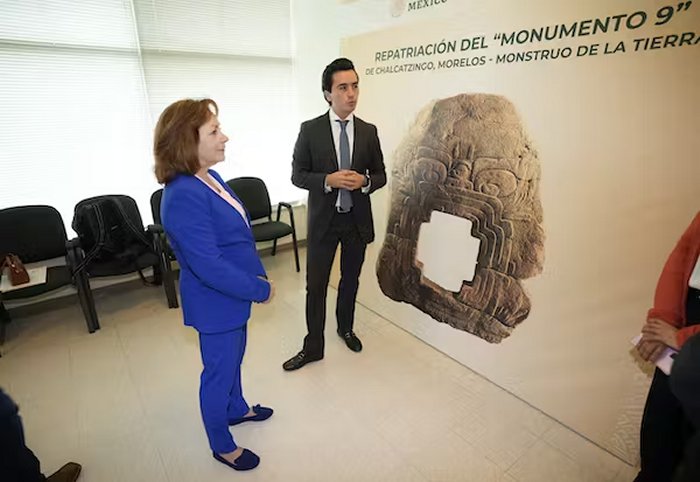 Colorado Lt. Gov. Dianne Primavera, left, is shown a photograph of Monument 9 before it was returned to Mexico. AP Photo/David Zalubowski
Artisans beginning around 900 B.C. carved life-size jade masks that almost look like molded plastic, but which must have been the result of a laborious process to grind and polish this extremely hard, dense stone.
Sacred system
All Olmec sculpture was created for a purpose, whether it be religious or political. In the case of Monument 9, it clearly pertains to the Earth, which in Mesoamerica was considered a sacred, living being.
The Olmecs existed at a time when maize agriculture had first developed, which stabilized and increased their economy – a transformative shift in the development of Mesoamerican civilization.
During this period, they developed an elaborate religious system that emphasized the sacredness of corn and rain, including a maize god. Quite frequently, this deity is depicted with an ear of corn emerging out of the center of his cleft head. In other cases, the head is sharply turned back, invoking growing corn. This form appears in Teopantecuantitlán, an archaeological site in highland Mexico, where there is a masonry court with four images of the Olmec maize god.
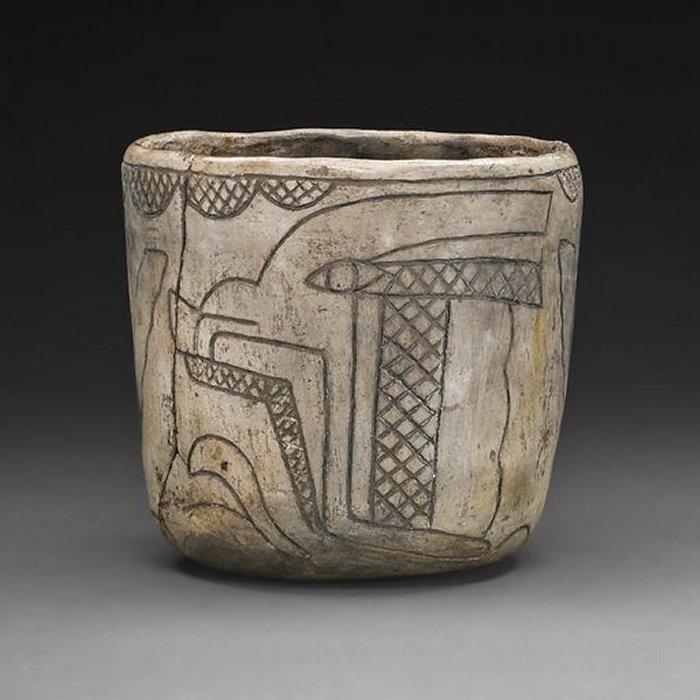
A cup showing the Olmec maize god as growing corn. Credit: The Art Institute of Chicago - Public Domain
As a tall grass, corn needs a great deal of water to survive the summer, making rain all-important. Trying to please the rain god in return for rain was a vital part of Olmec religion.
The Olmec spread similar practices and beliefs across ancient Mexico and Guatemala, probably in part to engage other peoples more directly with their economic trade network. Rather than an empire of domination, the Olmec were a culture focused on agricultural abundance and wealth.
Sacred mountains were of extreme importance as well, as can be seen at Chalcatzingo and at a hill called Cerro El Manatí, located very close to the site at San Lorenzo. At this hill, there is a perennial spring with sweet freshwater that fills a pool below at the base. In this pool, the Olmec offered a huge amount of valued material, including rubber balls for ritual sport, as well as many jadeite axes. According to two scholars of Mesoamerica, Ponciano Ortiz and Mari´a del Carmen Rodri´guez, this is the first clear example of a sacred mountain of abundance, which persists in Mesoamerican belief and ritual to this day.
Earth Monster’s home
Far to the west of the Olmec heartland, in the Mexican state of Morelos, is Cerro Chalcatzingo, the site where the Earth Monster monument originated. Here, the Olmec focus on the mountain as a provider of wealth and sustenance, portrayed in several sculptures as a cave.
Even before Olmec times, the idea of fertile caves was shown as a four-lobed motif resembling a flower – an important symbol that continued even into the 16th century with the Aztec.
The most famous Olmec bedrock carving at Chalcatzingo is called Monument 1 and features a woman in profile – probably a goddess – seated within the cave.

An Olmec structure at the archaeological site in Chalcatzingo. Ihiroalfonso/Wikimedia Commons, CC BY-SA
This carving is directly above where rainwater pours down from the top of the mountain. Below are what archaeologists call “cupules”: cuplike holes carved in bedrock directly below to receive this water, and collected by priests and pilgrims. On the opposite side of the hill is another rock carving featuring the same cave in profile, facing Monument 1.
Sadly, Monument 9, which was recently returned to Mexico, was looted from the site, so its original context is unknown. In archaeology, it is important to understand not only when an object was made and who created it, but where it was placed. Nonetheless, Monument 9 portrays the same cave as two other sculptures at the site, which are carved directly into the rock surface of the mountain.
Me confirma nuestro Cónsul Jorge Islas desde Nueva York que la pieza Olmeca más buscada por Mexico ha sido recuperada y está a punto de retornar a su casa, de donde nunca debió ser sustraída. pic.twitter.com/WWQ4H0eOE7
— Marcelo Ebrard C. (@m_ebrard) March 31, 2023
Monument 9 is significant, as it denotes the central Earth Monster cave, and unlike the other two Olmec carvings, it is face-on rather than rendered in profile. It probably was placed against a mound with its open mouth leading to a chamber inside, symbolizing a portal to the underworld.
That this highly sacred object is back in Mexico is of utmost importance for Indigenous Mexicans. To its creators, Monument 9 likely represented the source of life and abundance, as well as sacred rituals associated with them – ideas and practices that pervaded subsequent Mesoamerican civilizations.
Written by Distinguished Professor of Anthropology, University of California, Riverside.
Provided by The Conversation
This article is republished from The Conversation under a Creative Commons license. Read the original article.
More From Ancient Pages
-
 Shu: Egyptian God Of Air, Symbol Of Life-Giving Breath And The One Who Separates Heaven From Earth
-
 Tavern And Mysterious Tools Discovered In North Carolina – Stunning Ancient Time Capsule
-
 Ancient Greeks In Ukraine: 2000-Year-Old Settlement With Previously Unknown Structures – Localized By Polish Archaeologists
-
 On This Day In History: Comet Donati First Observed By Italian Astronomer – On June 2, 1858
-
 Mystery Of Ancient Beehive Tombs Around The World
-
 Viking Era Sword Discovered By Young Girl
-
 Did Leonardo Da Vinci Invent Contact Lenses In 1508?
-
 New Study Sheds Light On The Phenomenon Of Female Jewish Slavery And Uncovers Gang Rape In Livorno’s Slave Prison
-
 Unsolved Ancient Mystery Of Hand Of Prêles – Unique Discovery Of Ancient Bronze Hand Puzzles Scientists
-
 Hollow Bones That Let Dinosaurs Become Giants Evolved At Least Three Times Independently
-
 Amanirenas – Fearless Queen Of Kush Who Defeated Ancient Romans
-
 Large, High-Elevation Cities Along Asia’s Silk Roads Exposed By High-Res Lidar
-
 Diyu – Terrible Chinese Hell And Judgement Of God Yama
-
 Medicine in Antiquity: From Ancient Temples To Roman Logistics
-
 Violent Conflict Played A Crucial Role In Early Farming Societies In Neolithic Europe – New Study
-
 Ancient Human Feeding Behavior Studied By Scientists
-
 Secrets Of The Freemasons – Masonic Symbols Reveal Worship Of Ancient Mother Goddesses
-
 Dragon Empress Wu Zetian Challenged Confucian Beliefs Against Female Rulers
-
 New Cosmic Ray Bombardment Of The Great Pyramid – Search For The Hidden Chamber Continues
-
 Iraq’s Ancient Kish City Survived The Great Flood – Today It’s Neglected And Lies Buried In Sand

