
Boreas – Mighty North Wind God In Greek Mythology
A. Sutherland - AncientPages.com - In Greek mythology, the Anemoi are the personifications of the winds, and their origin indicates a connection with the elemental forces of nature.
They are the sons of Titanides Eos, the goddess of the dawn, and Titan Astraeus (Astrajos), the god of the starry night.
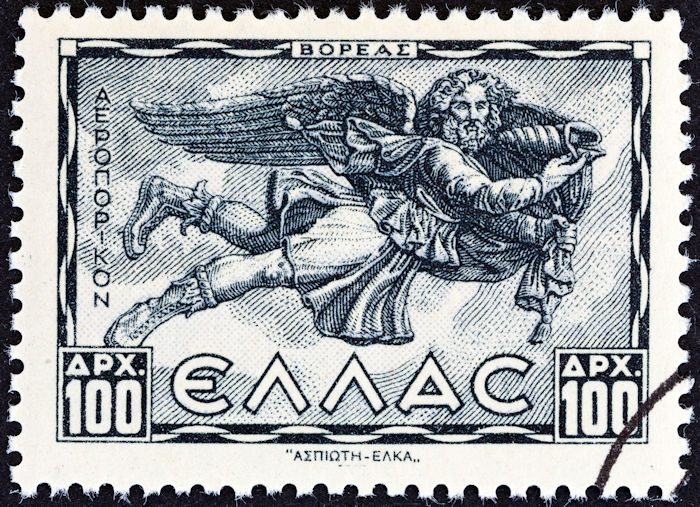
Credit: Adobe Stock - Lefteris Papaulakis
One is Boreas (N)), the god of the north wind, which brings the cold winter. Others are Apeliotes (E), Kaikias (NE), Notus (S), Eurus (SE), Lips (SW), Zephyrus (W), and Skiron (NW).
Vicious and extremely strong, the Boreas (his Roman is Aquilo) had his abode in the Thracian mountains and brought the wintry north wind. Herodotus and Pliny the Elder (AD 23–79), ancient Roman nobleman, scientist, historian, and author of Naturalis Historia, describe this northern land as Hyperborea "Beyond the North Wind," where people experienced complete happiness and had extraordinarily long lifespans.
Usually flying in a chariot with swift horses (or wings) across the sky, Boreas was highly honored by the great city of Athens in the 5th century BC and even credited with destroying Persian ships with his winter winds.
It occurred when the city of Athens was threatened by Xerxes, the son of Darius the Great and the fourth King of Kings of the Achaemenid Empire, ruling from 486 to 465 BC.
The danger was so close that the people prayed to the mighty Boreas. The deity was then sent tremendous winds to sink 400 Persian ships. Grateful for the god's apparent help, the people of Athens established a cult dedicated to him in 480 BC.
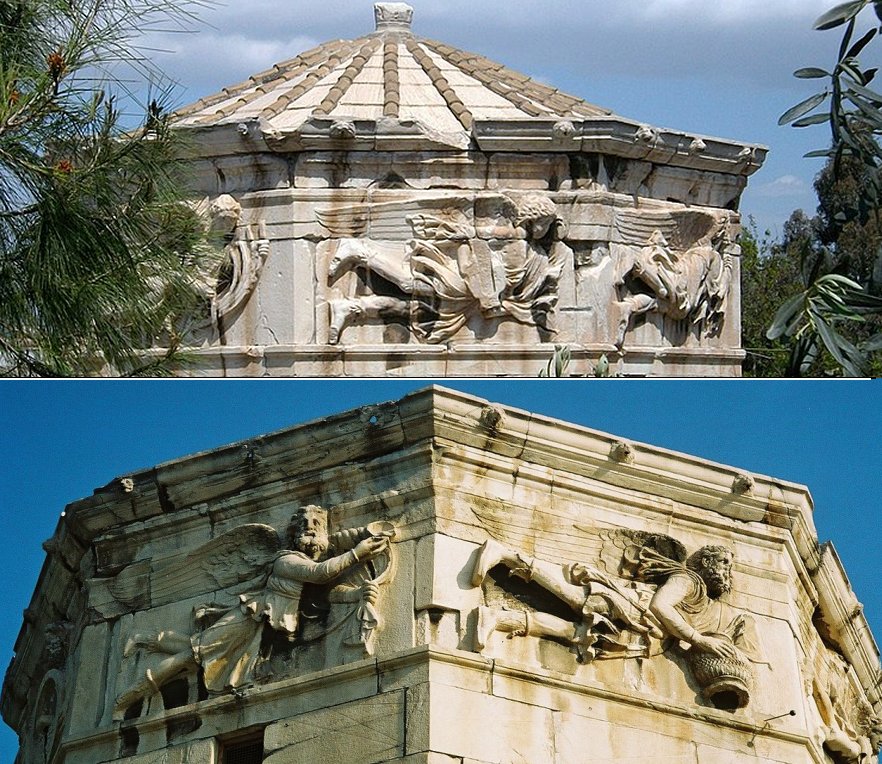
The tower of the winds. Credit: Joanbanjo - CC BY-SA 3.0
A similar event had occurred twelve years earlier, and Herodotus wrote about the incident as follows:
" Now, I cannot say if this was really why the Persians were caught at anchor by the stormwind, but the Athenians are quite positive that, just as Boreas helped them before, so he was responsible for what happened on this occasion also. And when they went home, they built the god a shrine by the River Ilissus."
The river Ilissus plays an essential role in Greek mythology. It is a small river that rises from springs on Mount Hymettus in Attica, the territory of Athens.
The river – 'channeled underground in the first half of the twentieth century - flows southeast and south of Athens's ancient, central, fortified area. Before the diversion of its course, it used to be a tributary of the Cephissus (modern Kifisos) River. Ilissus is featured in tales of the city's legendary past as one of the two major rivers of Athens.
Notably, the banks of the Ilissus were the site of the abduction of Orithiya, daughter of the Athenian king Erechtheus, to Thrace by Boreas, god of the north wind,' wrote Annette Giesecke in her 'Classical Mythology A to Z.'
The Athenians even considered boreas as their close relative by marriage. The god kidnapped Orithyia while gathering flowers by the Ilissus River. Orithyia was an Athenian princess and daughter of Erechtheus, a legendary king and probably also a divinity of Athens.
At first, Boreas tried to plead for her favors, persuading her to marry him. However, when it failed, he wrapped the princess Orithyia up in a cloud, married her, and with her, had had two daughters, Chione, goddess of snow, and Cleopatra (the wife of Phineus) and two sons, the Boreads - Calais and Zetes, both known as the Boreads.
The abduction of Orithyia was widespread in Athens, and his depictions were popular, especially those on the Greek vases showing Boreas as a winged, bearded man in a tunic with shaggy, sometimes frosted, and spiked hair.
Pausanias, a Greek traveler and geographer of the second century AD, wrote that Boreas had snakes instead of feet, though he was usually depicted with winged human feet in art.
Written by – A. Sutherland - AncientPages.com Senior Staff Writer
Updated on March 14, 2023
Copyright © AncientPages.com All rights reserved. This material may not be published, broadcast, rewritten or redistributed in whole or part without the express written permission of AncientPages.com
More From Ancient Pages
-
 Malignant Serpent God Apophis: Symbol Of Chaos And Forces Of Darkness
-
 Bronze Age Human Remains Uncovered In Dorset During Excavation Of Iron Age Settlement
-
 1,400-Year-Old Christian Chalice With Etched Symbols Found In Rubble At Vindolanda Fort, Britain
-
 On This Day In History: First Experimental Hydrogen-Filled Balloon Reaches A 900m Altitude – On August 27, 1783
-
 2,000-Year-Old Completely Preserved Shipwreck With Amphorae Found Near Šćedro Island
-
 On This Day In History: Irish Rebellion Led By The United Irishmen Against British Rule Begins – On May 24, 1798
-
 On This Day In History: Battle Of Lugdunum Was Fought – On Feb 19, 197
-
 Previously Uncounted Copies Of Newton’s Groundbreaking ‘Principia’ – Discovered
-
 Remarkable Archaeological Discoveries Made Near Bratislava, Slovakia
-
 Susanoo-no-Mikoto – Shinto God Of The Sea And Storms Was Banished From Heaven
-
 Wolstenholme Towne: Lost Virginia Settlement – Destroyed, Abandoned And Forgotten
-
 Viking Burial Rituals: High Ancient Funeral Pyre Reflected High Social Status
-
 Cup Of Jamshid – Holy Grail Of Ancient Persia Offered Immortality And Visions Of The Future
-
 Amazing Discovery Of A Wakizashi, Japanese Sword In Berlin-Mitte
-
 Capoeira: Ancient Martial Art Disguised As A Dance Became A Symbol Of Resistance To Oppression
-
 200-Year-Old Message In A Bottle Written By Archaeologist Unearthed In France
-
 When And Why Was Yakuza, The Japanese Mafia Founded?
-
 On This Day In History: One Of The Tallest Women In History – Died – On August 5, 1888
-
 Norse Shamanism: A Völva And Her Prophecies Were Feared Among Norse Gods And Vikings
-
 Mysterious Ancient Grave With Unusual Artifacts That Belonged To A Völva – Norse Female Shamans Did Exist

