
Ggantija Double Temple On Malta Is Older Than Stonehenge And Great Pyramid Of Giza
A. Sutherland - AncientPages.com - Early Maltese temples were egg-shaped and resembled the womb of the goddess of fertility.
Later, from 4,000 to 3,000 BC, the Maltese built such temples with four or five semicircular projections off the temple's main room that served different religious purposes.
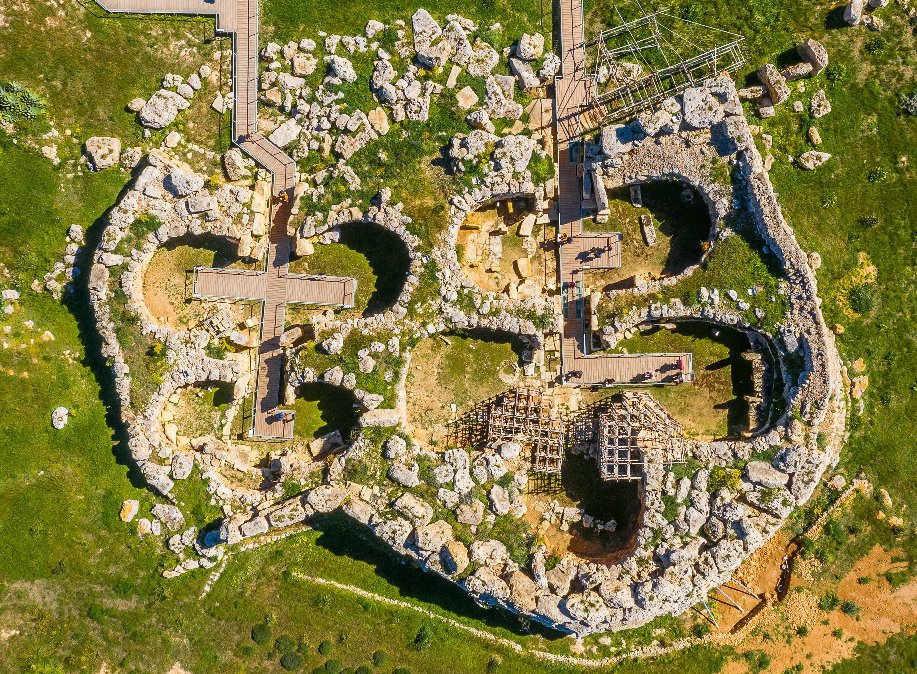
Down view of Ggantija Gozo. Image credit: Adobe Stock - Sandro
These shapes were intentionally created, giving an impression of the goddess' body. The Neolithic Maltese expressed their religious beliefs by creating many megalithic temple complexes like Ggantija, Mnajdra, Hagar Qim, and Tarxien.
The same prehistoric builders constructed the impressive Hal Saflieni Hypogeum, containing several levels and chambers.
Double Temple Is Dedicated To The Goddess Of Fertility
On Gozo, the second-largest Maltese island, there is a structure known as the Ggantija DoubleTemple. It dates back to around 3,000-3,600 BC and is dedicated to the goddess of fertility.
The Neolithic Maltese people built these gigantic megalithic structures of the hard Coralline Limestone and softer Globigerina Limestone found on the island. These limestone blocks weighed up to fifty tons.
The slabs weighing up to fifty tons give us an idea about the temple builders' incredible engineering and construction skills.

Temple of Ggantija. Image credit: Kritzolina - CC BY-SA 4.0
Ggantija (Ġgant - means' giant' in Maltese) double temple is an impressive structure. It is also known as the Twin Temple. A massive limestone block wall, which places us up to six meters high, encircles both temples.
Legendary Female Giant Sunsuna, The Builder
The ancient legend says that a female giant named "Sunsuna" built the temple walls. It took her only one day and one night, and she did it while nursing a baby. Another version of the legend suggests that "Sunsuna" carried the rocks on her head from a dolmen, Ta' Cenc, located on the south coast of Gozo Island.
The Great Sunsuna Goddess was worshiped as the center of the religion, considered very old and perhaps the oldest religion of humankind. Massive, elaborate temples were built in honor of this goddess.
The remains of these prehistoric structures are still dotting the fascinating landscape of Malta.

Temple of Ggantija. Image credit: BoneA - CC BY-SA 4.0
To build the Temple of Ggantija, the builders used several huge stone blocks. The doorway slabs have round holes that resemble offering holes found in the floors. Archaeologists discovered several stone spheres, suggesting that they may have been used for moving (perhaps manipulating or supporting) the huge megaliths.
Today, there are many theories about how the stone-age people could move gigantic megaliths with only primitive tools.
Ggantija Double Temple of Malta was where many different rituals took place in the main rooms' apses (curving spaces). Worshipers who honored death and regeneration used a lot of stone furniture. The people's customs, who created the temples and later disappeared around 2500 BC, are not well-known and remain obscure.
According to studies, the Temple people did not suffer from diseases, invasions, or lack of food. Still, one theory suggests that religious extremism and environmental conditions somehow caused the end of the religious traditions of these people.
The temple contained, for example, a significant ritual basin approx. one meter across and a pillar carved in low relief depicting a snake; there was also a shrine with three altar tables and a trapezoid-formed slab set on edge. The shrine held several limestone blocks decorated with spirals.

Ggantija Temple. Image credit: - CC BY-SA 3.0
Now, there is evidence that the first people to inhabit Malta arrived 700 years earlier than history books indicate. Researchers analyzed ancient soils and DNA and could reveal that Malta’s first inhabitants came from different parts of the Mediterranean and Europe, including Africa.
Researchers also found that a second colonization arrived in 3850 BC from Sicily and lasted an extraordinary 1,500 years in Malta without a break.
However, in some periods of Malta's prehistory, “climate change fluctuations made Malta uninhabitable", according to Professor Caroline Malone, from the Queen's University Belfast have been working at one burial site in Malta since 1987. One of the team's discoveries was in the form of 220,000 bones, representing between 500 and 800 people dating from 3600-2350 BC.
As the settlers in Malta depended on climate change, "there was a substantial break of around 1,000 years between the first settlers and the next group who settled permanently on the Maltese islands and eventually built the megalithic temples."
Carbon dating determined that the Maltese temples were constructed around .3600 BC. Some evidence indicates that several underground temples, similar to that of Hypogeum, might have yet to be uncovered in Malta.
Written by – A. Sutherland - AncientPages.com Senior Staff Writer
Copyright © AncientPages.com All rights reserved. This material may not be published, broadcast, rewritten or redistributed in whole or part without the express written permission of AncientPages.com
Expand for referencesBetsy Ross-Edison, Seven Temples on Malta
Francis Aloisio, The Islands of Dream Speak
More From Ancient Pages
-
 On This Day In History: Battle of Castillon Ended ‘Hundred Years’ War – On July 17, 1453
-
 Mysterious Ancient Mass Grave With Roman Skeletons Baffles Archaeologists
-
 Startling 3,000-Year-Old Gold Bowl Decorated With A Sun Motif Discovered Is A Truly Unique Artifact
-
 Ancient Petroglyph Code Cracked By Archaeological Explorers
-
 This Is The Mysterious Hilltop Where Civilization Began Scientists Say
-
 Wari Culture: Ancient Astronomical Observatory Excavated In Cusco, Peru
-
 Previously Assumed Turkic Origin Of The European Huns – Refuted; They Had Ancient Siberian Roots
-
 Fragments Of Old City’s Fortifications And Carved Hand Imprint Unearthed In Jerusalem
-
 World’s Oldest Shoe Is 5,000-Year-Old
-
 Never-Before-Seen Ancient Texts Hidden In Saint Catherine’s Monastery In Sinai Are Now Available Online
-
 Unearthing The Mystery Of The Meaning Of Easter Island’s Moai
-
 Has The Burial Place Of Mysterious Dark Age King Cerdic Of Wessex Been Located?
-
 Was Tintagel Castle A Fortress Used By Iconic Hero King Arthur?
-
 Why The Legend Of Robin Hood Is More Complex Than Previously Thought And Possibly Wrong
-
 Archaeologists Solve A 1,000-Year-Old Mystery Mentioned In Norse Sagas
-
 Ancient Burial Site Flagstones In Dorset Is Older Than Stonehenge
-
 Native Americans’ Unexplained Encounter With A Strange Underground Humanoid 500 Years Ago – Who Was This Being?
-
 10 Ancient Shipwrecks And Several Underwater Artifacts Found Around The Island Of Kasos
-
 On This Day In History: Precious Rosetta Stone Found By Napoleonic Expedition To Egypt – On July 15, 1799
-
 Never-Before-Seen Frescoes From Hadrian’s Time Unveiled At Ancient Roman Baths

