
Falerii Novi – Huge Ancient Underground Roman City Reveals Its Secrets
Ellen Lloyd - AncientPages.com - The ancient Roman Empire relied on a network of cities that played a pivotal role in its domain's administration, social organization, and economy. By the first century A.D., there were approximately 2000 cities across the Roman world, including Falerii Novi.

Ancient ruins of the city of Falerii Novi. Credit: Adobe Stock - Buffy1982
Historical records inform that Falerii Novi was founded by the Falisci tribe in 241 B.C., following the defeat of a revolt led by the inhabitants of nearby Falerii Veteres (now Civita Castellana). The fortified city of Falerii Novi in Lazio, Italy, was inhabited until the 7th century B.C., when it was abandoned and, more or less forgotten, lying buried beneath agricultural fields and olive groves.
"According to one source, 12th-century chronicler Zonaras, Rome forcibly resettled the defeated Faliscans to a less defensible location — Falerii Novi or "new Falerii." Its construction, intimately associated with the Roman road Via Amerina, is a rare example of preserved Roman Republican urban planning.
The city was occupied through Roman Antiquity and the early medieval period (6th and 7th centuries C.E.). It was on a strategic trading route leading north from Rome, perhaps from Ponte Milvio, through central Italy.
We know little of its later history, except that the still-standing church of Santa Maria di Falleri was founded by Benedictines in 1036, disbanded in 1392, and the building was in ruins by 1571. It is now restored mainly with excavated Roman roads visible beneath the floor.

Credit: Verdonck et al., Antiquity
When and how Falerii Novi became buried remains a mystery. How did such a large walled city become covered in so much soil? And what happened in late Antiquity to cause its abandonment?" 1
In 2020, archeologists from the University of Cambridge and Ghent announced a detailed ground-penetrating radar mapping survey that found a vast ancient underground city.
The Roman city discovered using radar was unlike anything seen before. Covering an area of approximately 30 hectares and being just under half the size of Pompeii, the town consisted of a bath complex, market, temple, public monument, and a sprawling network of water pipes.
The ancient city discovered by the researchers was Falerii Novi, but the site needed to be much more significant to be excavated. Fortunately, high-resolution 3D images of buried structures allowed scientists to travel back in time and better understand what this place once looked like.
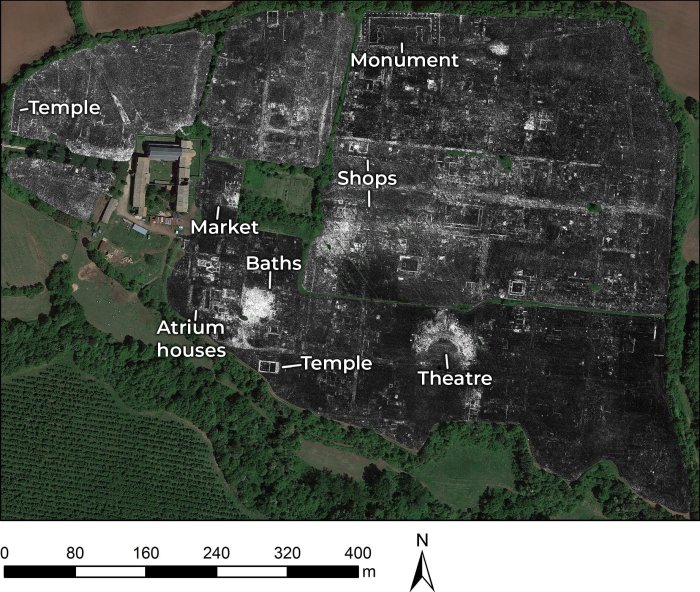
Credit: Verdonck et al., Antiquity
The GPS survey revealed "previously unrecorded public buildings, such as a temple, a macellum or market building, and a bath complex. While these buildings fall within the expected repertoire of a Roman city, some are architecturally sophisticated—more elaborate than would usually be expected in a small town. More unexpected were two enormous structures adjacent to the walls. Immediately east of the north gate is an enclosure defined on three sides by a substantial portions duplex (covered passageway with a central row of columns) approximately 90 × 40m in size, opening onto the street. A pair of structures, each with a central niche, face each other within the interior of the complex." 2
In their science study, the researchers explained they were unfamiliar with a direct parallel to this structure, but it was a public monument.
According to the scientists, one of the most incredible structures discovered during this survey was, without doubt, a colossal structure over 100 meters long, thought to be a colonnaded temple against the north city wall.
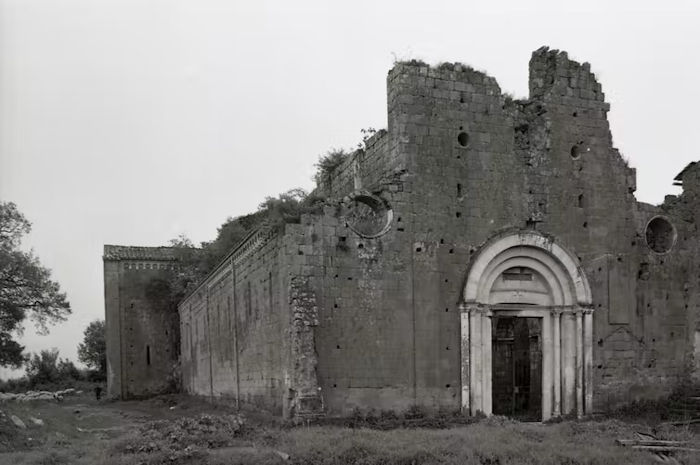
The church of Santa Maria di Falleri in 1972. Credit: Wikimedia Commons
The discovery of the ancient underground city of Falerii Novi is significant because understanding the earliest development of towns in Italy during this period is central to any comprehension of Roman imperialism itself. However, as Professor Martin Millett also explained," the earliest phases of these cities, many of which have continued in occupation until today, lie deeply buried beneath later structures." 3
The discovery of the ancient underground city of Falerii Novi emphasizes the importance of a ground-penetrating radar mapping survey in archaeology.
Written by Ellen Lloyd – AncientPages.com
Updated on January 2024
Copyright © AncientPages.com All rights reserved. This material may not be published, broadcast, rewritten or redistributed in whole or part without the express written permission of AncientPages.com
Expand for references- Emlyn Dodd - Unearthing Falerii Novi’s secrets in the hot Italian summer: an archaeologist reports from the dig, The Conversation
- Verdonck, L., Launaro, A., Vermeulen, F., & Millett, M. (2020). Ground-penetrating radar survey at Falerii Novi: A new approach to the study of Roman cities. Antiquity, 94(375), 705-723. doi:10.15184/aqy.2020.82
- Conny Waters - Amazing Underground Ancient Roman City Discovered In Italy - AncientPages.com
More From Ancient Pages
-
 Large Fresco Depicting The Procession Of The Wine God Dionysus Found In Pompeii
-
 Broken Pebbles In Arene Candide Cave Shed New Light On Ancient Burial Practices
-
 Tabula Peutingeriana: Huge Ancient Roman Map Created By Unknown Cartographer
-
 Hippocrates Didn’t Write The Oath, So Why Is He The Father Of Medicine?
-
 Treasure Hoard Of Rare Gold Coins From The Crusader Conquest Discovered In Caesarea, Israel
-
 Strange Story Of The Viking Who Mysteriously Vanished And Ended Up In America By Mistake – He Was Not Happy About It!
-
 Halloween: Facts And History About All Hallows’ Eve And Its Connection With Samhain – An Ancient Celtic Festival
-
 Spectacular 2,500 Years Old Shwedagon Pagoda In Myanmar – World’s Oldest Pagoda
-
 Has The Mystery Of The Lost Trading Ship Zuytdorp Been Solved?
-
 On This Day In History: William Laud Archbishop Of Canterbury Beheaded – On Jan 10, 1645
-
 Seti I – Remarkable Pharaoh Who Saved The Kingdom Of Egypt And Gave It New Glory
-
 Mysterious Manuscript 512 Reveals Lost Ancient City Hidden In The Amazon Jungle
-
 Surprising Discovery Of Box Filled With Neanderthal Bones From Cova Simanya Donated To Museum
-
 Wreckage of The French Steamship That Sank In Atlantic In 1856 Found Off The Coast Of Massachusetts
-
 Fossils In The ‘Cradle Of Humankind’ May Be More Than A Million Years Older Than Previously Thought
-
 The Mysterious Metaphysical World Of Isaac Newton
-
 Rare Discovery Of More Than 18,000 Inscribed Pot Sherds Document Life In Ancient Egypt
-
 Archaeologists Dug For Evidence Of The Rosetta Stone’s Ancient Egyptian Rebellion – Here’s What They Found
-
 Human Footprints Of People Who Used Caves Of Ojo Guareña, Burgos 4600 Years Ago
-
 Golden And Silver Facial Ornaments, Wooden Figurines Among The Finds In Tomb Of Tibetan Plateau

