
Is Legendary Celtic Warrior Queen Medb Buried In An Ancient Mound On The Top Of Knocknarea?
Ellen Lloyd - AncientPages.com - Like many mythical Irish queens, Medb had a strong personality, and she was courageous and intelligent but also cunning and sometimes cruel.
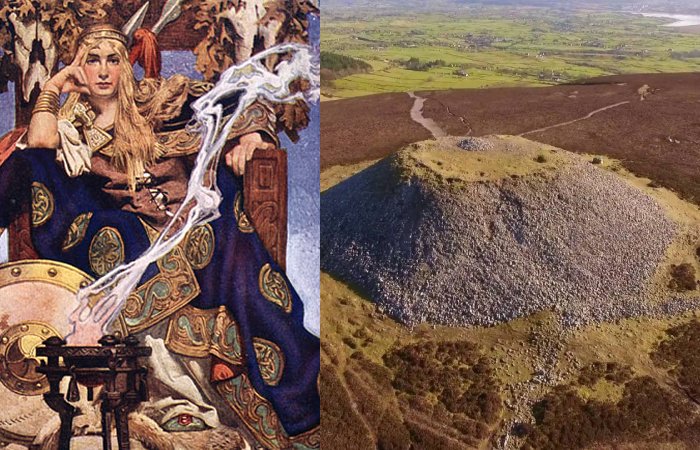
Queen Maev by J. C. Leyendecker. Credit: Joseph Christian Leyendecker (1874 - 1951) - T. W. Rolleston, Myths and Legends of the Celtic Race, Public Domain - Right: Queen Maeve's Cairn on the summit of Knocknarea. Credit: carrowkeel.com
Described in ancient myths as a fair-haired wolf queen, Medb wanted, like most Celtic women, to be equal to men. When it was time to pick a husband, she insisted on choosing a man without meanness, jealousy, or fear.
The choice fell on Ailill mac Máta, one of the Ulster kings, but though he was a courageous man, some events reveal his possessiveness.
Queen Medb Was One Of Many Powerful Women Mentioned In Irish Mythology
In the Ulster Cycle, one of the four great cycles of Irish mythology, we encounter many strong-minded women who fight alongside men on equal terms. Celtic women could be warrior queens leading great armies into battles, Druid priestesses, poets, and much more. They were not always, but often respected by men, and their knowledge served their people.
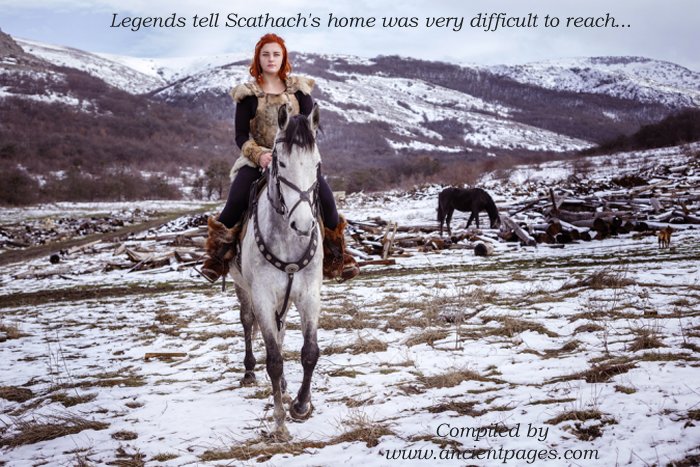
Those who are somewhat familiar with Celtic mythology know it was from Scathach, the great Irish hero Cuchulainn, who learned how to become a mighty warrior. The legendary Martial arts teacher Scathach trained him personally and revealed secrets that made him invisible.
Known as 'Mother and nurse of heroes,' Scathach, whose name means the 'Shadowy One,' was a great warrior queen who taught the art of combat in the Ulster Cycle of Irish mythology.
Queen Medb of Connacht has often been referred to as a sovereignty goddess, but we can only guess whether it is something she would have liked to be associated with. A sovereignty goddess is thought to represent the land and sovereignty over the land. According to scholars, the term denotes a goddess who personifies a territory and confers freedom upon a king by marrying or having sex with him.
Queen Medb's Encounter With Warrior Cuchulain
The Book of Leinster, an old manuscript written in the twelfth century, tells a story about the conflict between Ulster and Connacht and whether men could accept a female ruler.
As the story goes, "one night, Ailill (ahl-il), the king of Connacht, and his wife, Queen Medb (mayv), lay in bed arguing over which one of them was richer. Ailill suggested that Medb had improved her lot by marrying him and that it was proper for a man to rule the kingdom instead of her, but Medb insisted that she was as rich and tough as any king.
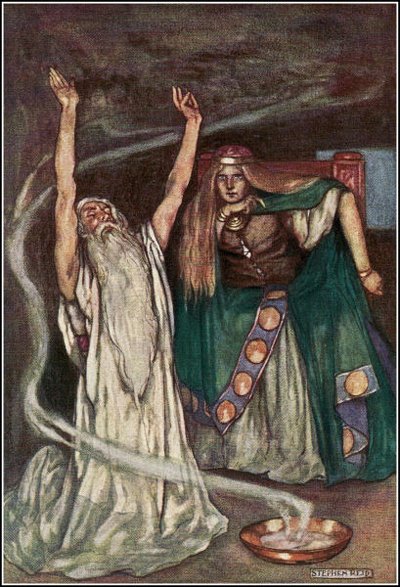
Queen Meave and the Druid by Stephen Reid, from Eleanor Hull's The Boys' Cuchulainn (1904). Credit: Public Domain
They couldn't agree, so that very night, they did an inventory.
They laid out their garments and jewelry and lined up the livestock. And for every possession, Ailill put up, Medbput up one just as good, except for one thing: a beautiful, white-horned bull.
This bull had been born to one of Medb's cows, but it had left her herd because it didn't want to belong to a woman. Medb was devastated and decided then and there that she would get a bull to equal the white-horned one. The only bull as good as this one was the brown bull of Cuailnge, the property of Daire mac Fiachna, king of Ulster.
Medb sent messengers to Ulster requesting the loan of the brown bull for one year. She offered generous terms: fifty yearling heifers, a large piece of land, a fabulous chariot, and her own "friendly thighs."
Daire agreed readily, but that evening, Medb's messengers boasted that if he had not accepted her terms, they would have taken the bull by force. After that, the deal was off.
This didn't particularly perturb Medb; she had expected this to happen and quickly assembled a vast army. It marched off to Ulster to capture the brown bull.
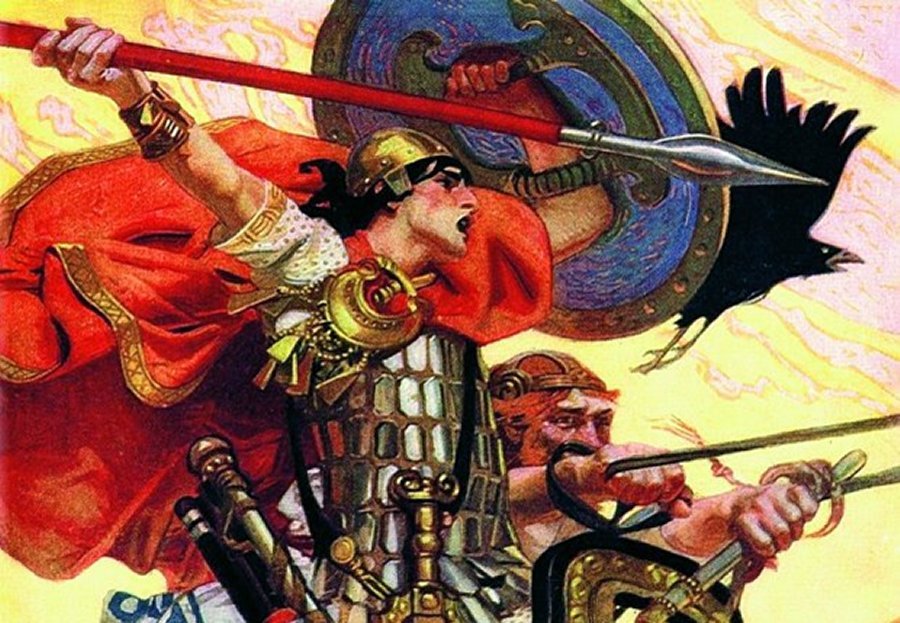
"Cú Chulainn Riding His Chariot into Battle", illustration by J. C. Leyendecker in T. W. Rolleston's Myths & Legends of the Celtic Race, 1911
The Ulster army started marching to meet its attackers, but on the way, the soldiers were all struck by strange, debilitating pains, the result of an old curse by the goddess Macha. So instead of encountering an army, Medb's warriors met a single hero: Cuchulain (koo-hool-n)." 1
Queen Medb's warriors were no match for Cuchulain, who killed 100 soldiers single-handed. The next day he defeated many of her warriors in a single battle.
Queen Medb understood Cuchulain was a fearsome opponent, and she had to devise something to distract him. So, she "forced him to fight his foster brother, Fer Diad, whom Cuchulain loved more than any other man. She persuaded Fer Diad to fight on her behalf by promising him her daughter as a wife. The men fought for three days without either one gaining an advantage, and each one sent assistance to the other at night." 1
Eventually, Cuchulainn killed Fer Diad with his most lethal weapon, the cruel magical spear Gae Bolg.
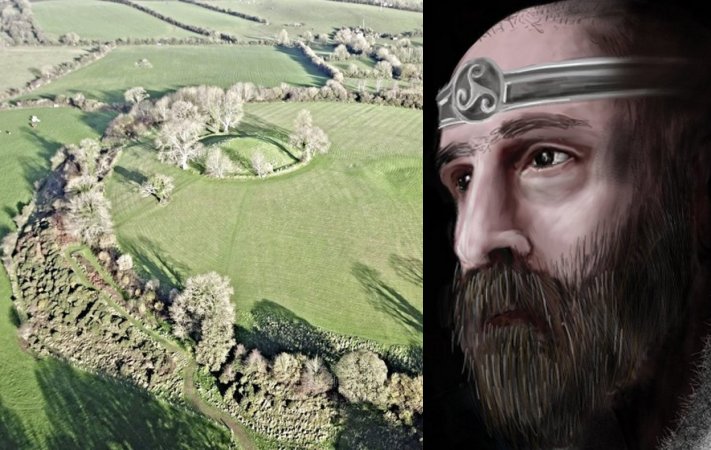
Left: Navan Fort in Co Armagh. Credit: Irish News - Right: Ailill mac Máta, one of the Ulster kings. Credit: Irish artist Cormac McCann, CC BY-SA 3.0
Once Cuchulainn encountered Queen Medb face to face, he could have easily killed her, but he decided to spare her because she was a woman.
The Irish queen sent the brown bull to Connacht to protect it. There it came into a fight with a white-horned bull that it killed. But then, after having run a long distance, the brown bull also died.
Queen Medb and her husband, Ailill, made peace with Cuchulain and the men of Ulster, and there was no fighting between them for several years. Still, Queen Medb was not the most forgiving person who could live with the thought she had been defeated. She spent many years contemplating how to get revenge on Cuchulain.
Where Is The Burial Place Of Queen Medb And Her Husband Ailill?
Not long ago, archaeologists announced they had discovered a massive underground anomaly in Ireland. Researchers detected what they believe to be a vast temple complex and ceremonial center where legendary kings, including Chonchobhar mac Nessa, gathered. Iron Age temples of the early, legendary Ulster Kings are suggested to be hidden below the ground.
Could this exciting archaeological discovery confirm several mythological Irish events? Is it possible this is the burial place of Ulster King Ailill mac Máta, the husband of Queen Madb? It's too early to say anything, but future studies may offer answers.
Queen Medb's burial place is still shrouded in mystery. It has been suggested she was put to rest upright, facing her enemies in Ulster. Her grave has never been found, but the 40-foot (12 m) high stone cairn on the summit of Knocknarea (Cnoc na Ré in Irish) in County Sligo is often mentioned as a place where the legendary Celtic warrior queen could be buried. No one has excavated the 5,000-year-old burial mound, but once this has been done, we can know whether it contains the remains of Queen Medb or not.


Written by Ellen Lloyd – AncientPages.com
Updated on March 16, 2024
Copyright © AncientPages.com All rights reserved. This material may not be published, broadcast, rewritten or redistributed in whole or part without the express written permission of AncientPages.com
Expand for referencesMore From Ancient Pages
-
 Hidden Ancient Message About Humans’ Future Found Inside San Miniato Al Monte Basilica?
-
 What America’s First Board Game Can Teach Us About The Aspirations Of A Young Nation
-
 Motilla del Azuer: Impressive And Unusual 3,200-Year-Old Fortress
-
 We Dated A Sacred Aboriginal Women’s Site Used for Birthing Ceremonies And Discovered 7,000 Years Of Tool Making
-
 Discovery Of Camouflaged Ancient Stone Chest In Egyptian Temple May Reveal Hidden Royal Tomb – Who Is Buried Near Hatshepsut’s Temple?
-
 Unique Viking Age Runestone With A Cross And Animal Biting Its Own Tail Discovered By Farmer In Sweden
-
 7.2-Million-Year-Old Pre-Human Remains Suggest Our First Ancestor Came From Europe Not Africa
-
 Can Peptide Droplets Explain The Emergence Of The First Living Organisms On Earth?
-
 Settlement Of Europe: Result Of Several Migration Waves By A Single Population – Study
-
 2,700-Year-Old Face Cream For Men Found In Chinese Tomb
-
 Cupbearer Was Privy To Conversations And Political Secrets Hidden Behind Closed Doors
-
 Everyday Life Of A Samurai: Armor, Appearance And Belongingness
-
 Ancient Mystery Of The Unidentified Strangely Dressed Man Found In Massachusetts And His Connection To Undeciphered Rock Carvings
-
 Who Or What Is Behind These Unexplained Lights Following People Over Long Distances?
-
 Unraveling the mystery of the Rhynie Man
-
 Pre-Columbian Pachacamac Site Dedicated To God Of Creation, Fire And Earthquakes In Inca Religion
-
 Reconstructed Face Of A Young Man Who Lived Some 1,300 Years Ago
-
 DNA Reveals Secrets Of The Phoenician-Punic Civilization’s Success – Ancient Mediterranean Societies Were Cosmopolitan
-
 Runic Inscription On The Viking-Age Galloway Hoard Deciphered
-
 Pytheas’s Voyage To The Arctic In 325 B.C. And Account Of Thule, The Strange Land Beyond

