
Joseph Pujol – The Professional Farter Who Entertained People
Conny Waters – AncientPages.com - History shows no limits in the entertainment world. Since people seem interested in a variety of things, it’s possible to earn money on almost anything, even farting.
Most would think once or twice before farting in the company of family, friends, or strangers, but Joseph Pujol did not let his natural needs and talent be a cause of embarrassment.
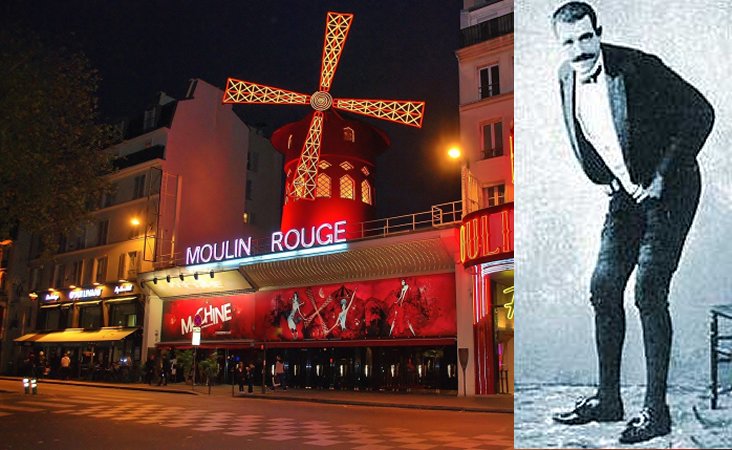
Left: Moulin Rouge, Paris, France. Credit: Public Domain - Right: Joseph Pujol. Credit: Public Domain
People loved seeing him on stage, and Pujol became the highest-paid entertainer in 19th-century France. All this sounds strange and unusual. Why would people go and pay just to see someone fart? Actually, it’s not as bad as it sounds, and those who watched him couldn't stop laughing.
Joseph Pujol (1857–1945) who went by the name, Le Petomane, meaning “The Fartiste” had a remarkable ability to abdominal muscles which enabled him to fart at will.
“Pujol didn’t actually pass intestinal gas as part of his stage performance. Instead, he possessed the ability to “inhale” or move air into his rectum and then control the release of that air with his anal sphincter muscles. He discovered his unusual ability as a child when, on a trip to the coast, he realized he could suck water into his anus and project it out with astonishing force. It was said of him that “he could wash your walls with just a bucket and a squat.” As an adult, Pujol was known to create spouts measuring over 16 ft (5 m).
He also found that by varying the force with which he expelled air anally, he could produce different musical notes and while working as a baker, he would entertain customers by imitating musical instruments, claiming to be playing them behind the counter. “ 1
Dressed elegantly in a red cape, black trousers, and white cravat, with a pair of white gloves casually held in his hands, Pujol performed for the first time in Marseille in 1887, and his show was an immediate success. He quickly became famous and traveled to Paris, where he continued to perform at the Moulin Rouge.
The audience was astounded, but there were no doubts he was going to be a huge name in the French capital. People loved his performance and among his audience were famous names such as Edward, Prince of Wales, King Leopold II of the Belgians, and Sigmund Freud.
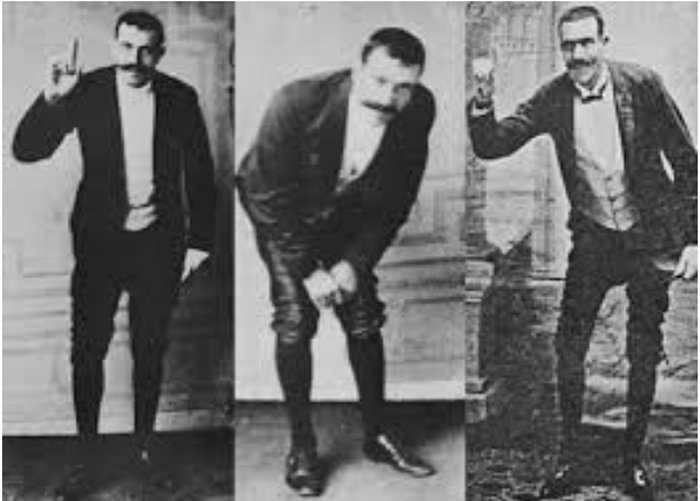
People loved Joseph Pujol's shows. Credit: Public Domain
“Highlights of his show included the sound effects of cannon fire and thunderstorms, as well as playing “O Sole Mio” and “La Marseillaise” on an ocarina through a rubber tube in his anus. He could also blow out a candle from several yards away. Members of his audience, which included royalty, were known to laugh so hard that some of them passed out.” 1
When people in other countries learned about his shows, they wanted to see him and Pujol embarked on successful tours through Europe and North Africa. Wherever he went, people simply laughed, and his entertainment was very appreciated.
Then, World War I broke out and Pujol left the stage for good. He returned to his hometown Marseilles and continued working in his bakery. Later, he moved together with his wife to Toulon where he started a prosperous biscuit factory.
Joseph Pujol died in 1945, shortly after the Allied had landed. He was buried in the cemetery of La Valette-du-Var, where his grave can still be seen today.
Updated on September 22, 2023
Written by Conny Waters – AncientPages.com Staff Writer
Copyright © AncientPages.com All rights reserved. This material may not be published, broadcast, rewritten or redistributed in whole or part without the express written permission of AncientPages.com
Expand for referencesMore From Ancient Pages
-
 Migration Of Early Humans Out Of Africa Began Thousands Of Years Earlier Than Previously Thought
-
 Enoch – The Initiator – Pre-Flood Messenger Of God
-
 Rare 2nd Temple-Era Etchings Of Menorah And Cross Discovered In The Judean Hills
-
 Rare Iron- And Viking-Age Mortuary Houses Discovered In Norway
-
 Ancient Ruins Of Hovenweep: Impressive Puebloan Masonry
-
 Tuonela – The Land Of The Dead In Beliefs Of Ancient Finnish People
-
 Ancient Mystery Of Peculiar Nail With Six Faces And Six Eyes – Unusual Discovery In Borgholm Castle, Sweden
-
 How Did Mesopotamia Change The World?
-
 Scotland’s Oldest Tartan On Display For The First Time!
-
 Bezvodovka: Little Known Ancient Solar Observatory In Ukraine Reveals Its Secrets
-
 Another Franklin Expedition Crew Member Identified
-
 Proof That Neanderthals Ate Crabs 90,000 Years Ago Is Another ‘Nail In The Coffin’ For Primitive Cave Dweller Stereotypes
-
 Cerberus – Giant Multi-Headed Dog Guards The Underworld Of God Hades In Greek Mythology
-
 Sun: Highest Cosmic Power Worshiped By Ancient People And Represented By Deities
-
 Ancient Tomb Of William The Conqueror’s Nephew Discovered In Exeter
-
 Dancing Around The Throne: Networking In The Time Of King William I
-
 One Of A Kind Viking Age Hammer Of Thor Discovered In Ysby, Sweden
-
 Many Roman Citizens Joined The Huns And Preferred Their Nomadic Lifestyle – New Study
-
 Wax Tablets Reveal Ancient Secrets of The Illyrians
-
 Neanderthal And Denisovan Blood Groups Deciphered And The Results Are Surprising

