
Tipón (Tipon): Who Taught The Inca How To Build Artificially Irrigated Garden?
A. Sutherland - AncientPages.com - There are many unanswered questions regarding the Inca’s marvelous engineering masterpiece known as Tipón.
How did the Inca manage to reach this high level of development? What was the source of their advanced knowledge of hydraulics?
Nowhere else in Tawantinsuyu (“Land of the Four Quarters”) as the Inca used to refer to their empire, are there so well-planned and carefully finished agricultural terraces and irrigating channels as in the Tipón complex.
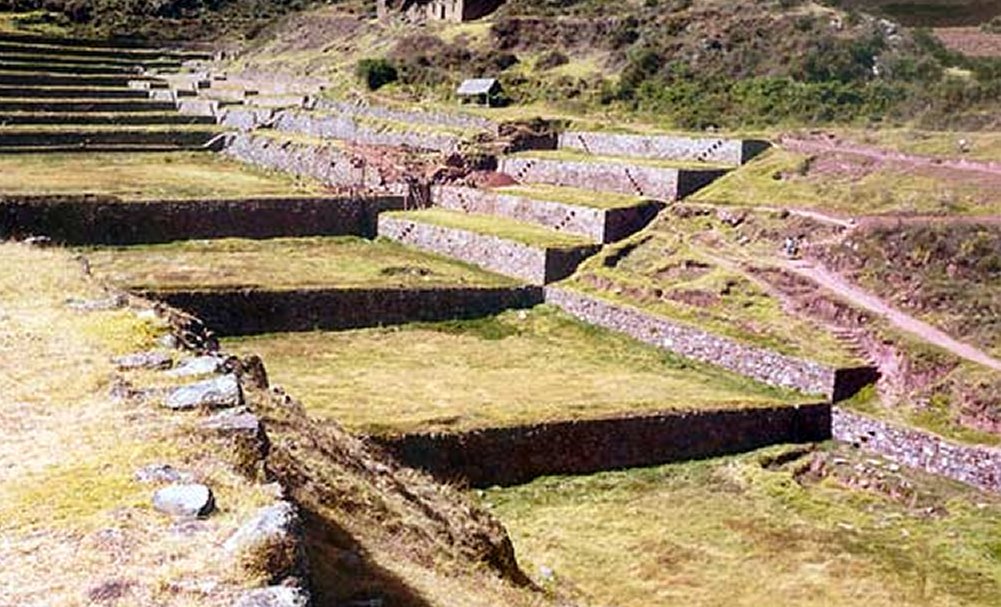
Cusco Tipón terraces. Source
The original name of this Inca site is lost in time; however, Dr. Luis Antonio Pardo, the prominent Peruvian historian, believes that the current name of Tipón may derive from the Quechua word ‘Tuxeuj’ (“to be boiling”). It is believed that Tipón's walled agricultural enclosure was built by earlier people of the Cusco Valley.
As narrated by Inca Garcilaso de la Vega (1539 – 1616), a chronicler and writer, apparently, Tipón was part of the royal estate belonging to Inca Yawar Huaca (Yawar Waqaq), the seventh Sapa Inca of the Kingdom of Cusco (beginning around 1380 AD).
In his book "Tipon: Water Engineering Masterpiece of the Inca Empire", Kenneth R. Wright writes:
“The balance of Tipon is mostly covered by walled terraces for both irrigated and dry land farming. The exceptions are some upper slopes too steep for terraces and a huge, smooth, volcanic rock slab that is so steep that it will not hold topsoil.
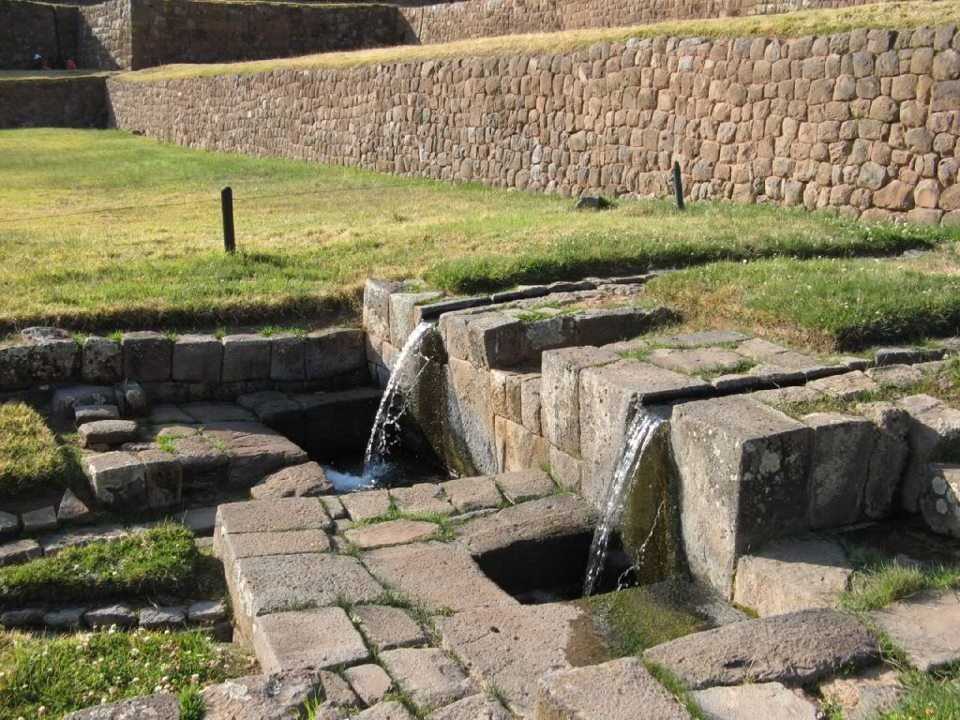
Tipon - home to one of the largest irrigation works in terraces, with many outdoor water channels. image source
The massive outer wall of Tipon, 15 to 20 feet high and nearly 4 miles long, encircles the community. The wall provided security and firmly established the perimeter of this estate.
Tipon was a perfect location for the Inca nobility to construct an estate. Its perennial spring, adjacent streams on the east and west, and fertile volcanic soils were coupled with an already walled agricultural enclosure built by earlier people of the Cusco Valley…”
At the same time, Tipon was devoted to religious ceremonies and agricultural experiments. The site that dates back to the beginning of the 15th century, is located at 3,560 meters above sea level, about 23 km southeast of Cusco, in the district of Oropesa (province of Quispicanchis), along the Cusco-Puno road.
It covers 239 hectares and consists of enclosures and wide agricultural terraces irrigated by a network of water channels fed by a natural spring.
Tipón - A Laboratory Of Agricultural Products
Besides being an archaeological complex, Tipón is home to one of the largest irrigation works in the terraces, with a great distribution of outdoor water channels.

This beautiful compound of agricultural terraces, long stairs and stone canals is located 20 km south of the city of Cuzco.
One can think of Tipón as the largest artificially irrigated Inca garden or rather an unusual complex of garden-like structures rising on many levels and on dozens of stone terraces.
This was a garden laboratory, probably used for experimenting with agricultural products, utilizing the various micro-climates found within the complex.
It can be assumed that Tipón was a similar place for Inca agronomists, as Moray (Moroy), famous for its oval farm terraces. Moray, located in the Sacred Valley of the Incas, has an old but very sophisticated irrigation system. Probably like in Moray, also in Tipón, the Incas experimented with the cultivation of new plant varieties of potatoes, corn, and other plants.
To these activities, they needed water that flowed through fine stone structures (aqueducts, spillways, canals and falls) and farm terraces situated at many different levels. Having proper conditions, the Inca plants could grow at different temperatures and with different sun exposure.
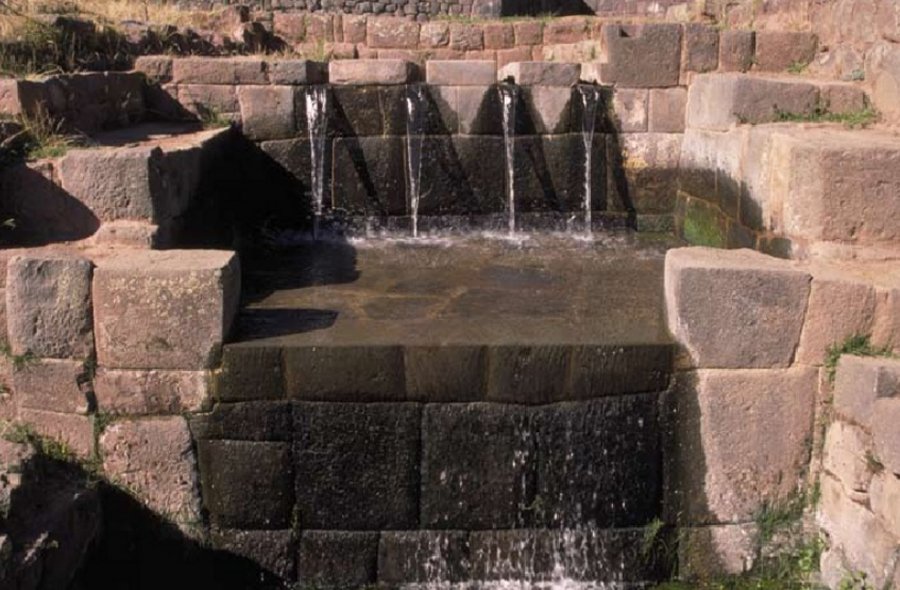 The hydraulic engineering of the Tipon fountain represents a high standard of care to create an aesthetic amenity. Credits: Wright Water Engineer
Therefore, the terraces rise from the bottom of the valley to its upper edge, while water flows here through aqueducts and canals, freely adjusted.
Centuries ago, the Tipón ingenious complex was most likely destroyed by the Incas themselves, who did not want to leave it in the hands of the Spaniards.
After many years, the complex was reconstructed and restored to its former glory. Tipón was once an important, specially protected place and it is evidenced by a large, oval fort that rises on the northern flank of the complex.
Written by – A. Sutherland - AncientPages.com Senior Staff Writer
Updated on January 20, 2024
Copyright © AncientPages.com All rights reserved. This material may not be published, broadcast, rewritten or redistributed in whole or part without the express written permission of AncientPages.com
Expand for referencesMore From Ancient Pages
-
 On This Day In History: Joan Of Arc Enters Orleans, The City Besieged By The English – On Apr 29, 1429
-
 Unsolved Prehistoric Enigma Of Sophisticated Spiro People And Their Mysterious Mounds
-
 Deciphered Dead Sea Scroll Reveals Secret Calendar And Two Events Not Mentioned In The Bible
-
 Ancient Venetian Merchants Were Always Prepared For The Worst
-
 Secrets Of Mount Shasta – One Of The Most Sacred Places On Earth
-
 Diyu – Terrible Chinese Hell And Judgement Of God Yama
-
 Mystery Of The Copper Age ‘Ivory Lady’ Solved
-
 Unique 2,000-Year-Old Decorated Roman Sandal Lost By Well-Cleaner Found In Spain
-
 Surprising Evidence Prehistoric People In Survived In The Coldest Regions Of Spain
-
 Napta Playa – Egypt’s Stonehenge And Its Ancient Astronomical Alignments
-
 Why Did Neolithic Make Us Taller And More Intelligent But More Prune To Heart Disease?
-
 How Did Ancient People Wake Up On Time Before The Alarm Clock Was Invented?
-
 Pharaoh Ramses II Comes One Step Closer To The Gods In The Company Of Hathor, Sekhmet and Ptah – Statues Discovered
-
 Incredible 700-Year-Old Tombs With Beautiful Decorations And Carved Bricks Found In Shandong, China
-
 Secrets Of The Spiral Symbol Left By Ancient Civilizations
-
 Amazing 4,500-Year-Old Egyptian Bead-Net Dress Found In Giza Tomb Restored
-
 Palermo Stone: One Of The Earliest History Records Of Ancient Egypt
-
 Map Of Hidden NT Landscape Where First Australians Lived More Than 60,000 Years Ago
-
 Secrets Of 2,000-Year-Old Tomb Of Cerberus Revealed To The Public
-
 Sami People: Facts And History About The Only Indigenous People Of Most Northern Europe

