
Ancient Ruins Of Quilmes: Largest Pre-Colombian Settlement In Argentina
A. Sutherland - AncientPages.com - Once in the past, Quilmes was a great pre-Columbian city in northern Argentina. Brutal invasion by the Spaniards forced the Quilmes Indians to flee and abandon everything they owned. Before they left, they tried to defend their holy city, until the end.
Located in the Calchaquí Valleys, Tucumán Province, the ancient Quilmes ruins are the remains of the largest pre-Columbian settlement in Argentina.
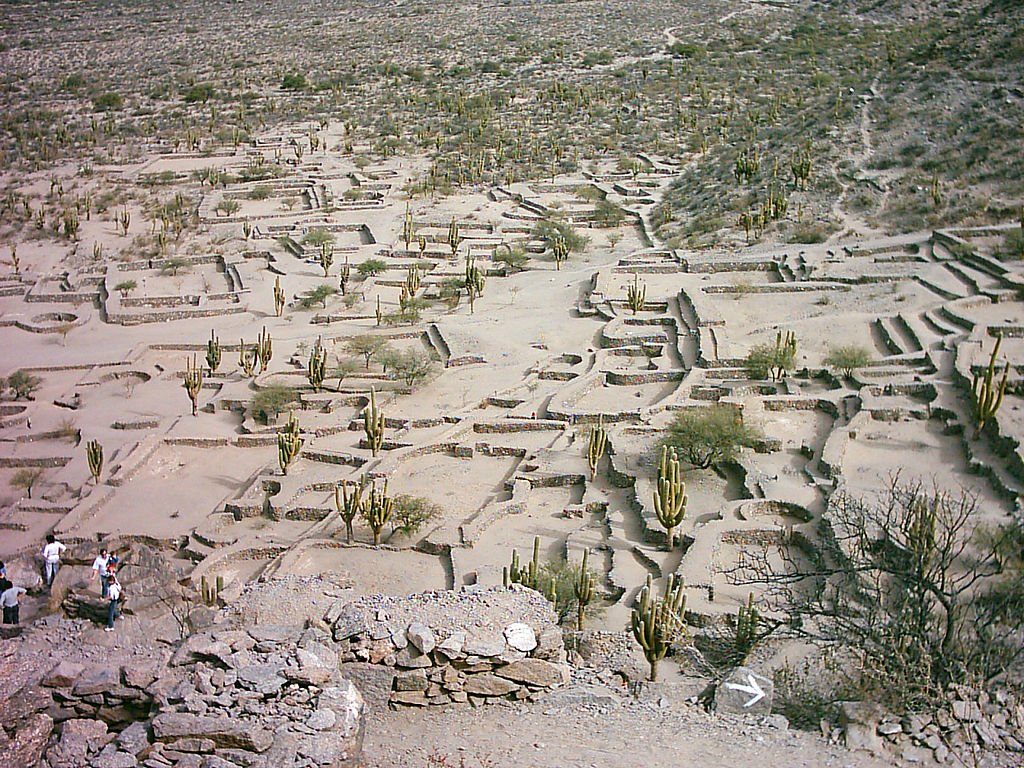
The ancient city on Quilmes was once inhabited by 5,000 people. Image credit: Fernando Pascullo
The ruins were discovered in 1888 by Samuel Alejandro Lafone Quevedo, but it was first in 1897 these ancient structures were studied by the archaeologist Juan Bautista Ambrosetti.
It was an ancient city, occupying about 30 hectares with high population density, complex socio-cultural structures, and highly developed irrigation mechanisms. The area dates back to ca 850 AD and it is believed that about 5,000 people lived in the city.
The Quilmes people were an indigenous tribe of the Diaguita group in Argentina. They resisted the Inca invasions of the 15th century and continued to resist the Spaniards for 130 years until finally being defeated in 1667.
Quilmes was a fortress city, located at the altitude of 1850m, to which five thousand people could find protection when tribal attack threatened their quiet and peaceful existence. It is known that the Diaguitan people built the place; they were sophisticated with their own language, social structure, and weaponry. Its cultural zenith is dated to 900AD.
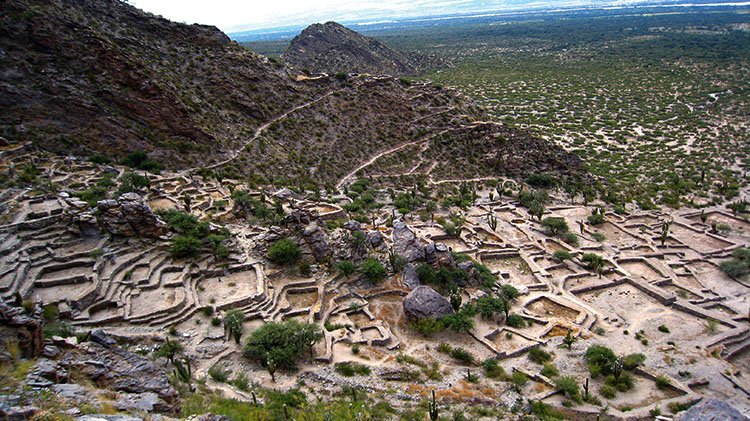
Ruins of the Quilmes civilization. Image credit: Alicia Nijdam-Jones.
They could protect themselves and Quilmes was almost impossible to conquer for thousands of years. Then, the situation changed when the Inca came and after them, the Spanish Conquistadors began to threaten the inhabitants of Quilmes.
When the Spanish conquistadors arrived the Quilmes Indians were more or less helpless, their resistance was insufficient but they fought as best as they could. At the end, there was only one option left: they had to escape the invaders.
Even today, the remains of Quilmes show some evidence of the people's clever defenses including narrow and sharply angled passageways with small entrances (barely wide enough for one person to go through). These entrances could be immediately barred with a single large rock.
To save themselves, they had to walk with only the minimum necessary supplies for more than 1200 km. They walked all the way until they came to the vicinity of the city of Buenos Aires. Hundreds of people died during this journey. Those who survived died later from diseases that were unknown to them.
The history of the city of Qilmes and its people is not forgotten. Today, there are only a few Quilmes left in Tucumán Province.
In 2009, the descendants of the ancient Quilmes took possession of the land. They now guide tourists across the area and tell the ancient history of this city and all people who once lived there.
The ruins of Quilmes are considered one of the most important archaeological locations in Argentina
Written by – A. Sutherland - AncientPages.com Senior Staff Writer
Copyright © AncientPages.com All rights reserved. This material may not be published, broadcast, rewritten or redistributed in whole or part without the express written permission of AncientPages.com
More From Ancient Pages
-
 On This Day In History: Battle Of Nineveh Was Fought – On Dec 12, 627 AD
-
 Magical Dinas Emrys: Legendary Battle Of The Dragons And Merlin’s Hidden Treasure
-
 1,000-Year-Old Multi-Shaped, Double-Sided Mold For Jewelry Found In Swiss City Of Chur
-
 The Incas Used Stringy Objects Called ‘Quipus’ To Record Data – We Just Got A Step Closer To Understanding Them
-
 12,000 Years Ago Siberian People Possessed Technique To Soften Ivory And Create Toys Or Art Items
-
 Major Discovery Of A Complete Ancient Roman City In Luxor, Egypt
-
 Scientific ‘Detective Work’ With South American Mummies Reveals They Were Brutally Murdered
-
 Human Skeleton Dated To Parthian Era Unearthed At Tepe Ashraf In Iran’s City Of Isfahan
-
 Magical Adder Stone And Its Immense Power
-
 Race To Save Magnificent Underwater Stone Age Paintings Hidden In The Cosquer Cave
-
 Were Owl-Shaped Plaques Children’s Toys In Copper Age?
-
 407-Million-Year-Old Plant Fossil Challenges Long-Held Theory On Fibonacci Spirals Found In Nature
-
 Tarkhan Dress – The World’s Oldest Woven Garment
-
 New Video Footage Reveals Intriguing Viking-Style Shipwreck At The Bottom Of Norway’s Largest Lake Mjøsa
-
 12,000-Year-Old Artifacts In Louisiana Saved By Scientists
-
 Mystery Of The Royal Tombs At Vergina Deepens – Has Alexander The Great’s Sacred Purple Tunic Been Found Inside?
-
 Copper Artifacts Reveal Changing Connections In Prehistoric Europe
-
 Interaction Between Homo Sapiens And Neanderthals Studied Using New Radiocarbon 3.0 Method
-
 Mysterious Mount Roraima Surrounded By Myths And Clouds Of Dense Fog
-
 Did Ancient Seafarers In Southeast Asia Build Sophisticated Boats As Far Back As 40,000 Years Ago?

